Skip to content
Vitamin K2 for Bone and Muscle Support: A Complete Guide
# Your Trusted Dietary Supplement Brand In US
- Emily

Table of Contents
Many people think of bone support as a calcium issue and muscle support as a magnesium or protein issue. That sounds simple, but real-life nutrition is rarely that simple. Bones are not built or maintained by calcium alone. Muscles do not work well with hydration alone. The body depends on a network of nutrients that help manage mineral balance, absorption, recovery, and long-term structural support. That is why vitamin K2 has become such an important topic in modern supplement conversations. It is no longer seen as a background nutrient. It is now part of a smarter discussion about how the body uses calcium, how daily movement is supported, and how recovery formulas can be designed with more purpose.
Vitamin K2 helps support proteins involved in bone metabolism and calcium use. It is often paired with vitamin D3 because D3 helps the body absorb calcium, while K2 helps support the systems that use calcium more effectively in the body. For this reason, K2 is often included in bone recovery and daily wellness formulas designed for more complete support.
This matters to a much wider audience than many brands realize. It matters to people who sweat during workouts, to adults thinking about long-term bone strength, to those dealing with muscle fatigue after activity, and to people who simply want a daily supplement routine that feels more complete. Once you understand how K2 fits into the bigger picture, you stop seeing it as just another small-print ingredient on a label. You start seeing it as part of the reason a formula feels more thoughtful, more advanced, and more useful in real daily life.
What Is Vitamin K2 and Why Does It Matter?
Vitamin K2 matters because it helps the body support important bone-related processes that go far beyond basic vitamin intake. It is often discussed in bone health formulas because it plays a role in activating proteins associated with bone metabolism and calcium handling. For customers, the real value of K2 is simple: it helps make a formula feel more complete, not just more crowded.
What makes K2 different from K1?
Many shoppers see “vitamin K” on a label and assume all forms do the same job. They do not. Vitamin K is a group of nutrients, and the two forms most often discussed are vitamin K1 and vitamin K2.
Vitamin K1 is found mainly in leafy green vegetables and is more commonly associated with normal blood clotting. Vitamin K2, by contrast, is more often discussed in connection with bone support, mineral utilization, and structural health. In supplements, the two most recognized forms of K2 are MK-4 and MK-7.
For everyday customers, the difference matters because K2 is usually chosen for a reason. It is not included just to make the label look more premium. It is added because it fits formulas designed around:
- bone support
- calcium balance
- healthy aging
- active lifestyle recovery
- daily structural support
This is especially important in a crowded supplement market. Many products still rely on “big ingredient lists” that look impressive but do not tell a clear story. A better product usually has fewer ingredients with stronger logic behind them. K2 is one of those ingredients that helps create a more convincing formula story.
A customer comparing two products may see this difference very quickly:
| Formula Style | What It Looks Like to the Customer | Likely Perception |
|---|---|---|
| Calcium-only formula | Basic mineral support | Incomplete or old-fashioned |
| D3-only formula | Better absorption support | Useful, but still narrow |
| D3 + K2 formula | More complete bone support logic | Smarter and more premium |
| D3 + K2 + minerals | Full-system support | Most advanced and balanced |
This is one reason K2 has become more attractive not only to educated consumers but also to brands that want to offer a more credible product. People today are asking better questions. They are no longer impressed by a long label alone. They want to know why an ingredient is there, what role it plays, and whether the formula has been built for real results rather than visual marketing.
Why is K2 linked to bone health?
K2 is closely linked to bone health because it supports proteins involved in bone metabolism. This is where the topic becomes much more interesting than simple “more calcium = stronger bones” messaging.
Bone is living tissue. It is constantly changing, repairing, and remodeling. It is not a static structure. That means good bone support is not just about adding one mineral. It is about supporting the wider system that helps bones stay strong and functional over time.
K2 is associated with that system because of its relationship with bone-related proteins such as osteocalcin. This matters because customers today are increasingly looking for formulas that feel intelligent, not outdated. They want something that supports how the body actually works, not just something that checks a category box.
From a product education perspective, here is what customers usually care about most:
- Will this formula support long-term bone strength?
- Does it make sense with vitamin D3?
- Is this more advanced than taking calcium alone?
- Can it fit both bone and muscle support goals?
Those questions are exactly why K2 has become more relevant in wellness content, supplement labels, and search behavior. Consumers are becoming more ingredient-aware, and K2 fits that shift well.
The table below helps explain why calcium alone is no longer enough for many informed shoppers:
| Bone Support Approach | What It Offers | Where It Falls Short |
|---|---|---|
| Calcium only | Basic mineral supply | Does not explain how the body uses it |
| Calcium + D3 | Better absorption support | Still limited in overall formula depth |
| Calcium + D3 + K2 | Better support framework | Feels more complete and modern |
| D3 + K2 + magnesium + calcium | Broader system support | Best suited for premium positioning |
This is one of the strongest commercial advantages of K2. It helps transform a simple supplement into a more thoughtful nutritional system. That is valuable for consumers, and it is also valuable for brands that want better differentiation.
Is K2 only about blood clotting?
No. That is one of the biggest misunderstandings around vitamin K.
The reason many people still think this way is simple: for years, vitamin K was discussed mainly in the context of blood clotting. That is still an important part of its biological role. But it is not the full picture. K2 is now much more widely discussed because it also connects to bone-related functions and broader structural support.
This shift is important for content strategy as well as product positioning. A customer who only thinks of vitamin K as a clotting nutrient may ignore it. A customer who understands that K2 is relevant to bone support, mineral use, and daily physical resilience sees it very differently.
This is especially true among:
- adults over 30
- women thinking about long-term bone support
- active people who sweat regularly
- people interested in mobility and healthy aging
- supplement users who want more than “basic hydration”
Once K2 is explained in this wider context, it becomes a much more meaningful ingredient. It stops feeling technical and starts feeling practical.
That practical value can be described in a very simple way:
- it helps make bone formulas more complete
- it gives D3-based formulas stronger logic
- it supports more advanced positioning than standard mineral products
- it fits both daily wellness and active recovery concepts
This is why K2 has gained so much attention in modern supplement development. It bridges science, customer understanding, and better formula design. It also helps premium brands stand out because it signals that the product has been designed with more care and better nutrient logic.
How Does Vitamin K2 Support Bones?
Vitamin K2 supports bones by helping the body activate proteins involved in bone metabolism and mineral-related processes. In simple terms, it helps support the system around bone health, not just one part of it. That is why K2 is often paired with vitamin D3 and minerals in more advanced bone and recovery formulas.
How does K2 help calcium utilization?
This is one of the most important reasons K2 has become so popular in supplement education. Customers do not just want to take calcium. They want to know that their formula actually makes sense.
Calcium is essential, but calcium alone does not tell the whole story. A more useful question is:
How well is the body prepared to handle and use that calcium?
That is where K2 becomes valuable. K2 helps support the proteins involved in calcium-related processes in the body, especially those connected to bone metabolism. It does not simply “push calcium into bones” in a simplistic way. Instead, it supports the broader biological mechanisms that make bone-support formulas more coherent and more complete.
For customers, the practical message is this:
- calcium provides raw material
- vitamin D3 helps support absorption
- K2 helps support the body’s calcium-related bone processes
That is why K2 often appears in premium formulas rather than basic mineral products.
A formula with calcium but no supporting logic may feel incomplete. A formula with D3 and K2 gives customers a clearer reason to trust what they are taking. This matters even more in categories such as:
- bone support
- women’s wellness
- healthy aging
- active lifestyle recovery
- post-workout mineral replenishment
Below is a simple way to compare how customers often interpret formula value:
| Nutrient Combination | Customer Interpretation | Perceived Formula Strength |
|---|---|---|
| Calcium only | Basic | Low |
| Calcium + magnesium | Better | Moderate |
| Calcium + D3 | More thoughtful | Moderate to high |
| Calcium + D3 + K2 | Complete | High |
| Electrolytes + D3 + K2 + minerals | Recovery + structure support | Very high |
This is where K2 creates real commercial value. It gives the formula a stronger story, and customers often respond well to products that feel smarter rather than just bigger.
Which bone proteins depend on K2?
Customers do not need a medical lecture, but they do appreciate knowing that an ingredient has a real biological role. In the case of K2, two names are especially important: osteocalcin and matrix Gla protein.
You do not need to turn these into hard-to-read science terms on the page. But you do want to explain what they mean in a simple, confident way.
- Osteocalcin is a protein found in bone and is closely associated with bone metabolism.
- Matrix Gla protein is another vitamin K-dependent protein that has drawn attention in discussions about calcium-related processes in tissues.
The value of mentioning these proteins is not just educational. It also builds trust. It shows the reader that K2 has a real place in formula design. It is not a trendy ingredient added for decoration.
For a customer, this explanation reinforces three important points:
- K2 is connected to actual bone-related biological functions
- the ingredient has a deeper role than basic label marketing suggests
- a D3 + K2 formula usually has a stronger structure than a simple vitamin formula
This is especially useful when educating customers who may already be familiar with calcium and vitamin D but are new to K2. Once they understand that K2 supports specific proteins involved in bone health, the formula becomes easier to believe in.
That can directly improve conversion because educated customers are more likely to purchase when the explanation feels grounded, practical, and honest.
Does K2 work better with calcium and vitamin D3?
In most consumer-friendly formulas, yes, this is one of the most logical combinations.
That does not mean every person needs all three in every single product. But from a formula design perspective, calcium, D3, and K2 work well together because they support related parts of the same bigger picture.
A simple way to explain it is:
- Calcium gives the body a key structural mineral
- Vitamin D3 helps support calcium absorption
- Vitamin K2 helps support the proteins involved in bone metabolism
That is why the combination feels stronger and more complete than any one of these nutrients alone.
Customers often do not say this directly, but their purchase behavior shows it clearly. They are more likely to buy formulas that feel:
- complete
- easy to understand
- built with purpose
- suitable for long-term use
This is especially true in premium supplement categories. Basic single-nutrient products still have a market, but formulas with better nutrient logic are more attractive for customers who want more value from one product.
A stronger bone-support formula is also easier to market across more user groups:
| User Group | Why D3 + K2 + Minerals Appeals |
|---|---|
| Adults 30+ | Long-term support feels more relevant |
| Women | Bone-support story is clearer |
| Active users | Recovery and mineral logic feel more complete |
| Travelers | Daily support in one product feels convenient |
| Busy professionals | Easier routine, less guesswork |
| Aging users | Better fit for mobility and structural wellness goals |
This is one reason AirVigor’s formula direction is commercially strong. When nutrients are selected based on how they work together, the result is not just a product that looks better on paper. It becomes a product that is easier to explain, easier to trust, and easier to use consistently.
A customer may not remember every nutrient name. But they do remember how the product made them feel:
- more supported
- less confused
- more confident in the formula
- more willing to reorder
That is the real value of K2 in a well-designed product.

Can Vitamin K2 Support Muscle Function?
Vitamin K2 is best known for its role in bone-related nutrition, but it is increasingly discussed in relation to muscle support as well. The most accurate way to explain this is simple: K2 is not a direct “muscle pump” ingredient, but it may still matter for muscle performance, recovery quality, and long-term physical function because muscles and bones work as one connected system.
What is the link between muscle and bone health?
Most consumers do not separate bone health and muscle health in real life. They experience them together.
When someone says:
- “My legs feel weak after training.”
- “I recover slowly now.”
- “My muscles get tight easily.”
- “I feel less stable than before.”
They are usually not describing one isolated issue. They are describing a bigger physical support problem involving movement, recovery, mineral balance, and structural strength.
This is why the connection between muscle and bone matters so much.
Bones provide the framework for movement. Muscles create force, stability, and control. If muscles are not functioning well, movement becomes less efficient. If bone support is poor, long-term structural performance can decline. The two systems are constantly interacting.
That is one reason a formula that supports only “hydration” may feel incomplete for many users. Hydration helps, but it is often only the first layer. People also want:
- muscle comfort after sweating
- better daily recovery
- support for repeated training
- fewer disruptions from fatigue or soreness
- more confidence in long-term physical resilience
This is where K2 becomes more relevant. It helps move the conversation beyond short-term workout support and into a more advanced idea: supporting the body that performs, not just the moment of performance.
For many customers, this matters more than aggressive sports positioning. A large part of the market is not made up of elite athletes. It is made up of:
- runners
- cyclists
- gym users
- hikers
- active parents
- busy professionals
- adults who sweat often but do not identify as athletes
These people are not just asking for “energy.” They are asking for a body that feels more stable, more recoverable, and easier to keep moving over time.
That is why a K2-containing formula can feel stronger than a standard hydration product. It brings a wider support story.
How may K2 affect muscle-related support?
When customers ask whether K2 supports muscles, what they usually mean is not “Will it build muscle like protein?” What they really mean is:
- Will it help me feel less run-down?
- Will it support my body after sweating?
- Will it help me stay more physically capable over time?
- Will it make this formula more complete than a basic electrolyte powder?
Those are smart questions.
The strongest role of K2 still sits on the bone and calcium-related side of the equation. But once you understand that muscle function depends heavily on mineral balance, daily structural support, and whole-body recovery, the value of K2 becomes easier to understand.
A good way to think about it is this:
- muscles rely on minerals to function properly
- movement relies on the muscle-bone system working together
- recovery depends on more than water alone
- a better formula supports the full system, not just one symptom
This is why K2 can fit naturally into products focused on:
- active recovery
- muscle comfort after sweating
- daily mobility support
- long-term physical maintenance
- healthy aging formulas
- recovery-oriented electrolyte products
For customers, this creates a stronger sense of formula depth. A product that contains sodium and potassium alone may be seen as a basic hydration tool. A product that combines electrolytes with calcium, magnesium, D3, and K2 feels more intentional. It suggests that the brand is thinking about what happens after the sweat, not just during it.
That difference matters in conversion.
A customer comparing products may think:
| Formula Type | What the Customer Feels It Is For | Perceived Value |
|---|---|---|
| Basic electrolyte formula | Quick hydration only | Low to moderate |
| Electrolytes + magnesium | Better muscle comfort support | Moderate |
| Electrolytes + minerals + D3 | More complete recovery | High |
| Electrolytes + minerals + D3 + K2 | Recovery plus structural support | Very high |
That last category is where more premium products can win. It gives customers a reason to choose something that feels more advanced and more aligned with real-life recovery needs.
Is the evidence around muscle support still developing?
Yes, and that should be stated clearly.
This is actually a strength, not a weakness, when writing for informed customers. People trust a brand more when it explains what an ingredient is strongly known for and where the conversation is still growing.
K2 has a very clear place in bone-support discussions. Its muscle-related role is better understood as part of a wider system involving:
- mineral support
- daily movement
- post-sweat recovery
- physical resilience
- active aging
- body structure support
This is the best way to present it honestly and effectively.
A less effective approach would be to oversell K2 as if it were a direct performance enhancer or muscle-growth ingredient. That would create the wrong expectation. K2 works better as part of a “smarter recovery and support” message.
That message is often more persuasive anyway, especially for mainstream consumers.
Most customers do not wake up wanting a biochemistry lecture. They want a product that helps them with practical issues such as:
- feeling wiped out after a long run
- waking up sore the next day
- managing sweat-related fatigue
- keeping training more consistent
- supporting strength and mobility as they get older
When K2 is positioned inside that broader customer reality, it becomes much more believable and much more useful.
This is especially valuable for recovery electrolyte products. A standard hydration product solves one problem. A recovery-focused electrolyte with K2 can speak to several:
- hydration
- fatigue support
- mineral replenishment
- recovery quality
- daily structural support
That is a more compelling offer in both content and product design.
Key reasons customers may care about K2 in a recovery formula
- It makes the formula feel more complete
- It supports a stronger bone-and-mobility story
- It pairs naturally with D3 and minerals
- It gives recovery products more depth than basic hydration powders
- It appeals to both active users and everyday wellness users
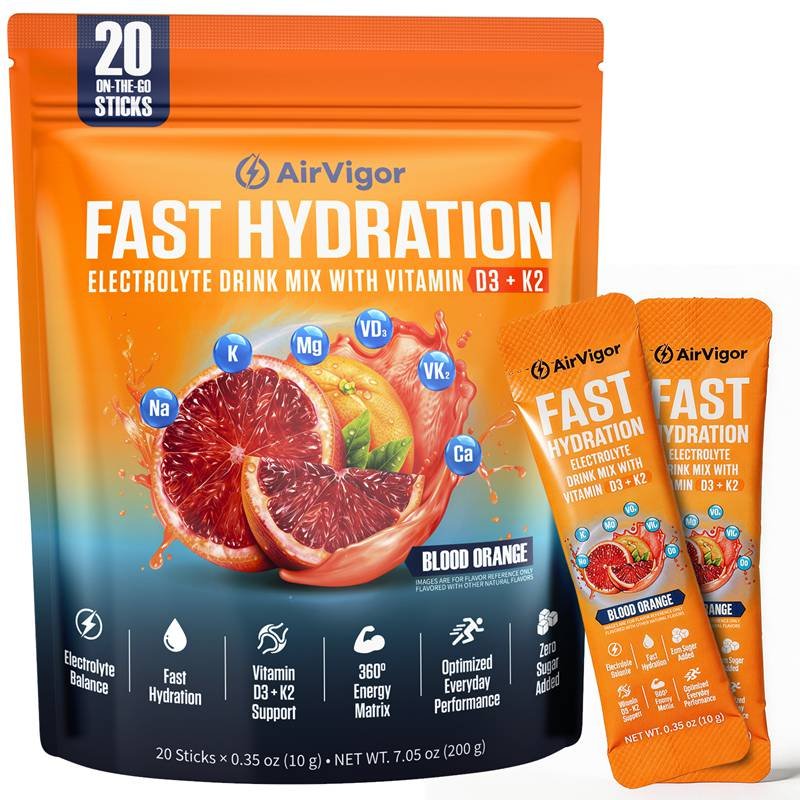
This is one reason AirVigor’s formula direction has real market potential. The combination of electrolytes, calcium, magnesium, vitamin D3, and vitamin K2 gives the product a broader job to do. Instead of being just another sweat-replacement powder, it becomes a more thoughtful recovery support system for people who want hydration plus something more meaningful.
How Does Vitamin K2 Work With Vitamin D3?
Vitamin D3 and vitamin K2 are often paired because they support different parts of the same bigger nutritional goal. D3 is commonly associated with helping the body absorb calcium, while K2 is often included to support the body’s calcium-related bone processes. Together, they create a formula that feels more complete, more modern, and easier for customers to understand.
Why is D3 often paired with K2?
There is a simple reason this pairing has become so popular: customers increasingly want formulas that make sense.
Years ago, a product could succeed just by saying “contains calcium” or “high in vitamin D.” Today, many shoppers look deeper. They compare labels. They read ingredient lists. They ask what each nutrient is doing. They want to know whether a formula was actually built with logic.
That is where D3 and K2 work extremely well together.
A simple explanation customers understand quickly is:
- Vitamin D3 helps the body absorb calcium
- Vitamin K2 helps support the body’s use of calcium in bone-related processes
Even if a customer does not know the deeper science, this pairing feels intuitive. It creates a stronger product story than D3 alone.
This is especially important in categories like:
- bone support
- daily wellness
- women’s nutrition
- active recovery
- healthy aging
- recovery electrolytes with broader support positioning
Many customers are also trying to reduce supplement clutter. They do not want five different bottles unless there is a strong reason. A formula that combines D3 and K2 gives them a sense that the product is doing more in one step.
That convenience matters.
It improves:
- daily compliance
- perceived value
- purchase confidence
- repeat purchase potential
Customers are much more likely to reorder a product when they feel it saves them effort and still gives them a complete support system.
How do D3 and K2 play different roles?
This is an important point because many pages make the mistake of blending the two together too loosely.
D3 and K2 work well together, but they are not the same nutrient and they do not play the same role.
A clear, customer-friendly explanation looks like this:
| Nutrient | Main Job in the Formula | Why It Matters to the Customer |
|---|---|---|
| Vitamin D3 | Supports calcium absorption | Helps make mineral intake more useful |
| Vitamin K2 | Supports bone-related calcium processes | Makes the formula feel more advanced |
| Calcium | Provides key structural mineral support | Still the most recognized bone mineral |
| Magnesium | Supports muscle and mineral balance | Adds recovery and comfort relevance |
This table works well because it turns technical nutrition into a decision-making tool. Customers can immediately see that the product is not just a random group of ingredients. Each one has a role.
That role clarity is important in premium supplements because informed shoppers do not only buy the formula. They buy the logic behind it.
This is also where K2 adds major value. D3 is familiar. Most people have heard of it. K2 is the ingredient that adds depth. It tells the customer:
- this formula was designed more carefully
- the brand understands nutrient synergy
- the product is aiming for more than the basics
That is why D3 + K2 is such a strong pairing for modern product positioning. It works not only nutritionally, but commercially.
Do customers really need both in one product?
In practical product design, very often yes.
This does not mean every individual must take D3 and K2 together in every situation. But from a customer experience point of view, combining them in one product often makes a lot of sense.
Why?
Because customers are usually looking for one of these things:
- a more complete daily supplement
- a better bone support formula
- a recovery product that does more than rehydrate
- a convenient all-in-one routine
- stronger value from one purchase
A combined D3 + K2 formula speaks directly to these needs.
It reduces friction.
It reduces confusion.
It reduces the feeling that the customer still has to “build the formula themselves” by buying additional products.
This is especially important for everyday users, not just highly educated supplement shoppers.
The average customer often chooses based on questions like:
- Does this look complete?
- Does this make sense?
- Will this fit into my routine?
- Is this more advanced than the cheaper option?
A D3 + K2 formula answers “yes” to all four more easily than a single-ingredient product.
That is one reason this combination works so well in recovery-oriented hydration products. A formula that already includes electrolytes and minerals can become much more differentiated when D3 and K2 are added with a clear purpose.
Instead of sounding like another hydration mix, it can stand for:
- hydration plus recovery
- sweat support plus muscle comfort
- mineral replenishment plus daily structure support
- fatigue support plus longer-term wellness value
That is a much more powerful message.
Why this pairing works especially well in a recovery electrolyte product
For a recovery electrolyte product, the D3 + K2 combination is especially useful because it helps elevate the product beyond a simple hydration tool.
A basic electrolyte powder usually focuses on:
- sodium
- potassium
- hydration speed
- sweat replenishment
That is fine, but it is also common. Many brands can do that.
What makes a product more memorable is when it supports the next layer of customer need. After sweat loss, people are not only thinking about water. They are also thinking about:
- muscle fatigue
- soreness
- next-day recovery
- repeated training
- daily physical support
That is where a broader mineral and vitamin system becomes more compelling.
A product such as AirVigor’s recovery electrolyte formula has a stronger story because it combines:
- sodium, potassium, and chloride for hydration support
- calcium and magnesium for mineral balance
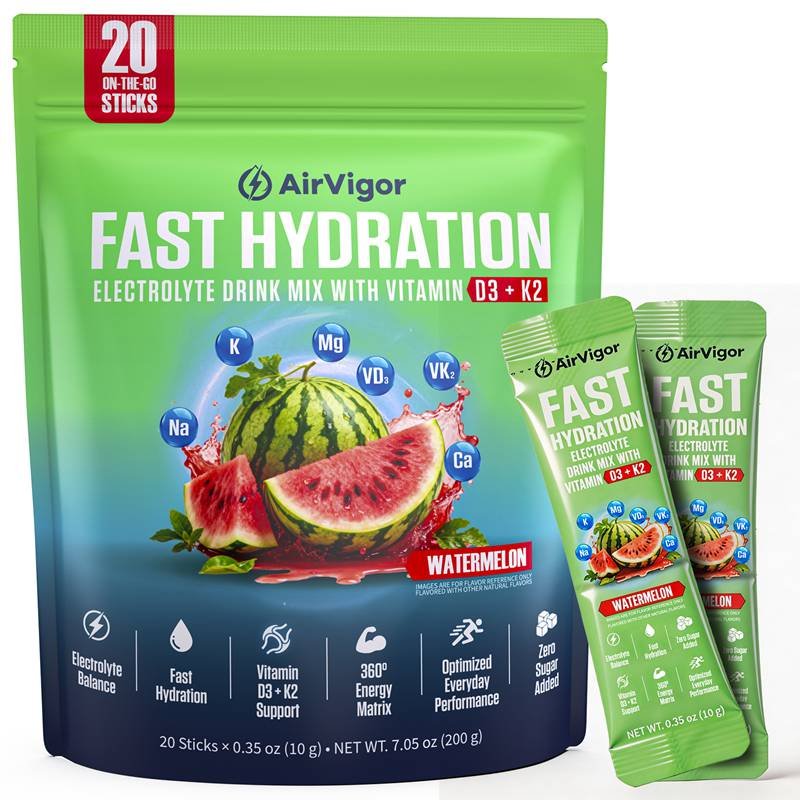
- vitamin D3 and K2 for a more advanced support structure
This creates a product customers can understand in a much more complete way:
| Customer Need | Basic Electrolyte | Recovery Electrolyte with D3 + K2 |
|---|---|---|
| Rehydration | Yes | Yes |
| Sweat mineral replacement | Yes | Yes |
| Muscle comfort relevance | Limited | Stronger |
| Daily support logic | Limited | Stronger |
| Bone-related support story | No | Yes |
| Premium differentiation | Low | High |
That final row is important. Premium differentiation is not just about adding ingredients. It is about making those ingredients make sense together. D3 and K2 help do exactly that.
What customers tend to like about D3 + K2 formulas
- They feel more complete than single-nutrient products
- They are easier to understand and explain
- They fit both wellness users and active users
- They create a stronger premium impression
- They often feel worth the price
In a competitive market, these benefits matter.
A customer may not remember every dosage number, but they will remember whether a formula felt thoughtfully built. D3 + K2 helps create that impression naturally. When paired with a recovery electrolyte system, it also helps the product feel like something designed for real life: sweat, fatigue, movement, recovery, and staying consistent.
That is exactly the kind of product story that can help AirVigor stand out more naturally, because it gives the brand a practical reason to talk about not just hydration, but smarter recovery support for everyday active people.

Who May Benefit From Vitamin K2?
Vitamin K2 is not limited to a niche group. It is relevant to a wide range of people who are thinking about bone strength, recovery, daily movement, and long-term physical support. Instead of targeting only one type of user, K2 fits naturally into broader lifestyle categories such as active living, daily wellness, and healthy aging.
Which adults should pay more attention to K2 intake?
Many adults do not actively think about vitamin K2 intake, mainly because it is not as widely discussed as vitamin D or calcium. However, as people move into their 30s and beyond, their priorities begin to shift. They start to care more about long-term structure, stability, and recovery rather than just short-term performance.
Several groups tend to benefit more from paying attention to K2:
- Adults with low dietary variety (especially low intake of fermented foods)
- People who rely on convenience or processed meals
- Individuals with limited outdoor activity or irregular routines
- Office workers with long sedentary hours
- People who already supplement with vitamin D3 but not K2
One important point is that K2 intake from diet alone is often inconsistent. While vitamin K1 is widely available in vegetables, K2 is less common in everyday foods, especially in Western diets.
This creates a gap that many consumers are not aware of.
A well-designed supplement helps fill that gap in a simple, consistent way, without requiring major lifestyle changes. That is why K2 is often included in daily wellness formulas rather than only in specialized products.
From a customer perspective, the key value is not complexity — it is convenience and completeness.
Is K2 useful for active people and aging adults?
Yes, and this is where K2 becomes especially versatile.
For active individuals, the focus is often on:
- staying consistent with training
- reducing fatigue after sweating
- maintaining physical performance over time
- avoiding “burnout cycles” from repeated exertion
These users are not always looking for extreme performance products. Many of them want something that helps them feel more stable and recover more smoothly.
For aging adults, the priorities shift slightly toward:
- maintaining mobility
- supporting bone strength
- reducing stiffness
- staying physically independent
- feeling confident in daily movement
K2 fits both groups because it supports the structural side of physical health.
It does not act like a stimulant.
It does not create artificial energy spikes.
Instead, it contributes to a more stable foundation — which is exactly what both groups are looking for, even if they describe it differently.
This is why K2-based formulas are often positioned successfully across multiple markets:
| User Type | What They Want | Why K2 Fits |
|---|---|---|
| Active users | Better recovery and consistency | Supports structural system behind movement |
| Casual fitness users | Less fatigue and soreness | Adds depth beyond hydration |
| Aging adults | Bone and mobility support | Aligns with long-term needs |
| Busy professionals | Simple daily support | Easy to integrate into routine |
| Travelers | Stable energy and recovery | Convenient, all-in-one approach |
This wide applicability is one of the strongest advantages of K2. It allows a single product to serve multiple audiences without losing clarity.
Are low-intake diets a concern?
Yes, and this is often underestimated.
Modern eating patterns do not always support consistent nutrient intake. Even people who consider their diet “healthy” may still miss certain nutrients simply because they are not commonly found in everyday foods.
K2 is a good example of this.
Foods naturally rich in K2 — such as fermented products — are not consumed regularly in many regions. This means that even individuals who eat balanced meals may still have relatively low K2 intake over time.
Additional factors that can contribute to lower intake include:
- irregular meal timing
- reliance on packaged foods
- travel-heavy lifestyles
- low diversity in food choices
- limited exposure to traditional diets
For customers, this is not something to worry about — it is simply something to be aware of.
This is where supplements provide real value. Not by replacing food, but by helping create consistency where diet may not be perfect.
From a product perspective, this is also why K2 works well in daily-use formats such as:
- stick packs
- capsules
- drink mixes
- combination formulas
The easier the product is to use, the more likely people are to stay consistent — and consistency is what makes any nutritional support meaningful over time.
How Do You Choose and Use a Vitamin K2 Supplement?
Choosing a vitamin K2 supplement is less about chasing the highest number on the label and more about understanding how the formula fits into your daily routine. The best products focus on balance, usability, and overall formula design rather than isolated ingredient hype.
Which form is better: MK-4 or MK-7?
The two main forms of vitamin K2 used in supplements are MK-4 and MK-7.
They both belong to the same family, but they differ in how they are commonly used in products.
- MK-4 is typically used in higher-dose formats and appears more often in specific regional or clinical-style products
- MK-7 is more commonly used in everyday supplements due to its longer presence in the body and convenience for daily use
For most consumers, MK-7 tends to be the more practical option because:
- it supports once-daily usage
- it fits better into simple routines
- it is widely used in modern wellness products
However, the form alone should not be the only decision factor.
What matters more is the overall formula:
- Is K2 paired with relevant nutrients like D3?
- Does the product serve a clear purpose?
- Is it easy to take consistently?
- Does it fit your lifestyle?
A well-designed formula with slightly lower numbers but better synergy is often more valuable than a high-dose product with no clear structure.
How much K2 is commonly used?
Most consumer products include vitamin K2 (especially MK-7) in a range that supports daily use without making the formula overly complex.
A common reference range looks like this:
| Ingredient | Typical Daily Range |
|---|---|
| Vitamin K2 (MK-7) | 45–120 mcg |
| Vitamin D3 | 1000–5000 IU |
| Calcium | 200–600 mg |
| Magnesium | 50–200 mg |
These ranges are not about maximizing one ingredient. They are about creating balance.
Customers often make the mistake of focusing only on one number. But in reality, a supplement works as a system. A balanced formula is easier to use, easier to trust, and easier to maintain over time.
This is especially important in categories like:
- bone support
- recovery support
- daily hydration + mineral products
- long-term wellness supplements
A product that feels “too heavy” or overly complicated is less likely to be used consistently.
A product that feels light, clean, and purposeful is more likely to become part of a daily habit.
Are there any safety notes or considerations?
Yes, and this is an important part of responsible product use.
Vitamin K can interact with certain medications, particularly those related to blood clotting. Anyone taking such medications should consult a healthcare professional before adding a K2 supplement.
Other practical considerations include:
- Taking K2 with food can improve absorption
- Consistency is more important than occasional use
- Choosing a product with clear labeling and quality control matters
- Avoiding unnecessary ingredient overload can improve usability
From a product quality perspective, customers are also paying more attention to:
- ingredient sourcing
- manufacturing standards
- label transparency
- stability and shelf life
- taste and usability (for drink formats)
These factors are often what separate a product that is tried once from a product that is used long-term.

Final Thoughts
Vitamin K2 has become more important because people now expect more from a supplement than a single isolated benefit. They are not only looking for calcium, hydration, or one simple vitamin. They want formulas that feel more complete, make better nutritional sense, and fit more naturally into everyday life. That is where K2 stands out. By supporting bone-related processes and working well alongside vitamin D3 and key minerals, it helps create a stronger foundation for products focused on bone support, recovery, and daily physical resilience.
For customers, the real value of K2 is not that it sounds advanced on a label. The real value is that it helps turn a basic formula into a more thoughtful one. It gives more depth to daily wellness products, more logic to bone-support formulas, and more long-term relevance to recovery-focused nutrition. In practical terms, that means a product can do more than simply replace what is lost through sweat. It can support a more balanced recovery routine and a more complete approach to everyday movement and physical support.
That is why this kind of nutrient combination is becoming more meaningful in modern formulas such as AirVigor’s recovery-focused electrolyte products. When electrolytes, calcium, magnesium, vitamin D3, and vitamin K2 are brought together with a clear purpose, the result feels less like a basic hydration product and more like a smarter daily support solution for people who want to stay active, recover better, and maintain stronger long-term wellness habits.
Share:
Contact Expert Team
At AirVigor, performance becomes effortless. We transform advanced nutrition science into clean, effective supplements that help you hydrate, recover, and feel stronger every day. Shop AirVigor Supplements on Amazon and experience athlete-trusted formulas—backed by real science and supported by our world-class R&D and production capabilities.
Trust AirVigor
At AirVigor, turning your performance goals into reality is no longer a struggle—it’s a science-driven journey we build together. Whether you’re a runner, lifter, cyclist, yogi, outdoor athlete, or someone simply seeking better daily energy, AirVigor transforms advanced nutrition research into clean, effective, and trustworthy supplements you can feel.
Backed by our U.S. scientific team, global certifications, and world-class production standards, every formula is engineered to deliver real hydration, real recovery, and real performance. And when you’re ready to experience the difference, you’ll find AirVigor products available on Amazon and other major platforms—fast shipping, consistent quality, and a community of athletes already seeing results.
Behind the scenes, our R&D and manufacturing ecosystem also supports specialized formulation development, ensuring AirVigor continues to lead with innovation while keeping quality and safety uncompromised. But at the core, everything we create is built for you—your health, your performance, your momentum.
Choose AirVigor. Feel the science. Elevate your every day.


Subscribe to our newsletter
Sign up to our newsletter and we’ll keep you up to date with the latest arrivals.