Skip to content
What Are the Benefits of Electrolytes with Amino Acids:The Ultimate Guide
# Your Trusted Dietary Supplement Brand In US
- Emily

Table of Contents
Most people do not look for electrolytes with amino acids because they want a more complicated supplement routine. They look for them because something in their day or training feels off. They may drink plenty of water but still feel flat, tired, or slow to recover. They may finish a workout and notice that energy drops too quickly, soreness builds across the week, or hydration never seems to fully catch up. In many cases, the issue is not just fluid loss or just recovery. It is both happening at the same time.
Electrolytes with amino acids bring these two needs together in one formula. Electrolytes help support fluid balance, nerve signaling, and muscle contraction, while amino acids help support muscle recovery and training continuity. That combination makes this type of product especially useful for workouts, long active days, heat exposure, travel, and busy routines where hydration and recovery do not always happen on time.
For many users, the appeal is simple: fewer steps, better routine fit, and more stable day-to-day performance. A runner wants fewer late-session slowdowns. A gym user wants less next-day heaviness. A busy professional wants something practical that works even when meals, water intake, and recovery timing are not perfect. That is why electrolytes with amino acids have become a growing part of modern hydration and recovery routines.
What Are Electrolytes with Amino Acids?
Electrolytes with amino acids are functional hydration formulas designed for people who need more than just water. They combine key minerals that support fluid balance with amino acids that support muscle recovery. This type of formula is especially useful when the body is dealing with both fluid loss and physical stress at the same time, which is common during workouts, long active days, or irregular routines.
What are electrolytes with amino acids made of?
Electrolytes with amino acids are built around two core components that work together rather than independently. Electrolytes such as sodium, potassium, and magnesium help regulate fluid balance, nerve signals, and muscle contraction, while amino acids support muscle repair and recovery after physical stress.
In real-world use, this combination matters because the body rarely experiences hydration loss without also experiencing some level of muscle fatigue or breakdown. For example, during a typical 60-minute workout, the body may lose fluid through sweat while also placing repeated stress on muscle fibers. Addressing both at once makes the formula more practical.
Typical composition includes:
- Sodium (150–400 mg): supports fluid retention and hydration balance
- Potassium (200–500 mg): helps maintain muscle function and reduces fatigue signals
- Magnesium (20–100 mg): supports muscle relaxation and recovery
- Amino acids (5–10 g): supports repair and recovery rhythm
A simplified structure looks like this:
| Component | Function in Daily Use |
|---|---|
| Electrolytes | Help your body use and retain water effectively |
| Amino acids | Help your body recover and adapt after stress |
What users care about most is not the ingredient list length, but whether the formula actually helps them feel more stable during and after activity.
How are electrolytes with amino acids different from basic hydration products?
The main difference comes down to how completely the product supports the body during real-life situations. Basic hydration products focus only on replacing fluids and minerals, while electrolytes with amino acids also address the recovery side of physical stress.
In everyday use, this difference becomes noticeable when routines are not perfect. Many people do not eat immediately after workouts, skip meals due to time constraints, or fail to rehydrate properly throughout the day. A standard electrolyte drink may help with thirst, but it does not support recovery in those moments.
Here is how the difference plays out:
- Basic hydration → replaces fluids
- Combined formula → supports fluids + recovery together
A practical comparison:
| Scenario | Basic Electrolyte Drink | Electrolytes with Amino Acids |
|---|---|---|
| After workout | Rehydrates only | Rehydrates + supports recovery |
| Busy schedule | Easy to skip recovery nutrition | Covers both in one step |
| Repeated training | Hydration improves, recovery may lag | Better overall balance |
This is why many users prefer combined formulas—not because they are more complex, but because they reduce the number of decisions and steps needed during the day.
Why do people choose electrolytes with amino acids instead of separate products?
In theory, using separate products for hydration and recovery should work well. In practice, most people struggle to maintain that level of structure consistently. Carrying multiple supplements, timing them correctly, and remembering to use them after every session creates friction.
Over time, this friction leads to skipped steps.
Common real-life patterns include:
- Finishing a workout and only drinking water
- Delaying protein or amino acid intake due to low appetite
- Forgetting to bring multiple supplements when traveling
- Simplifying routines by dropping less convenient products
A combined formula reduces these problems by simplifying the process into a single step.
From a behavioral standpoint, this matters more than most people expect:
- Fewer steps → higher consistency
- Faster intake → less delay between effort and recovery
- Easier routine → more long-term use
Users often describe the benefit not as “stronger performance,” but as:
- “Easier to stay consistent”
- “Less likely to skip recovery”
- “Fits into my day without thinking about it”
That kind of feedback reflects real value, especially for people managing busy or unpredictable schedules.
Are electrolytes with amino acids suitable for daily routines?
They can be part of a daily routine, but only when there is a real need for them. The key is not to use them automatically every day, but to use them when hydration and recovery demands are higher.
In practice, daily use makes sense when:
- Training is frequent (3–5 times per week or more)
- Sweat loss is noticeable
- Hydration habits are inconsistent
- Recovery feels slower than expected
A realistic usage pattern looks like this:
| Day Type | Practical Use |
|---|---|
| Workout day | Recommended |
| Hot weather / high activity | Recommended |
| Travel / irregular routine | Recommended |
| Rest day (low activity) | Optional |
It is important to understand that these products are not a replacement for meals or proper nutrition. Instead, they act as a support tool that helps fill common gaps.
Used correctly, they help users:
- Maintain more stable hydration
- Reduce recovery delays
- Support consistent daily performance
Used without need, they add little value.
What makes a well-designed electrolytes with amino acids formula?
A well-designed formula is not defined by how many ingredients it contains, but by how effectively those ingredients are structured and dosed. Many products include long ingredient lists, but the actual functional value depends on whether the amounts are meaningful and balanced.
From a user perspective, a good product should meet several practical criteria:
- Clear ingredient amounts (no hidden blends)
- Balanced electrolyte levels for real hydration support
- Meaningful amino acid dosage for recovery
- Clean taste that allows daily use
- Easy mixing and portability
At a deeper level, quality also depends on how the product is made. Consistency across batches, raw material quality, and production standards all affect how reliable the product feels over time.
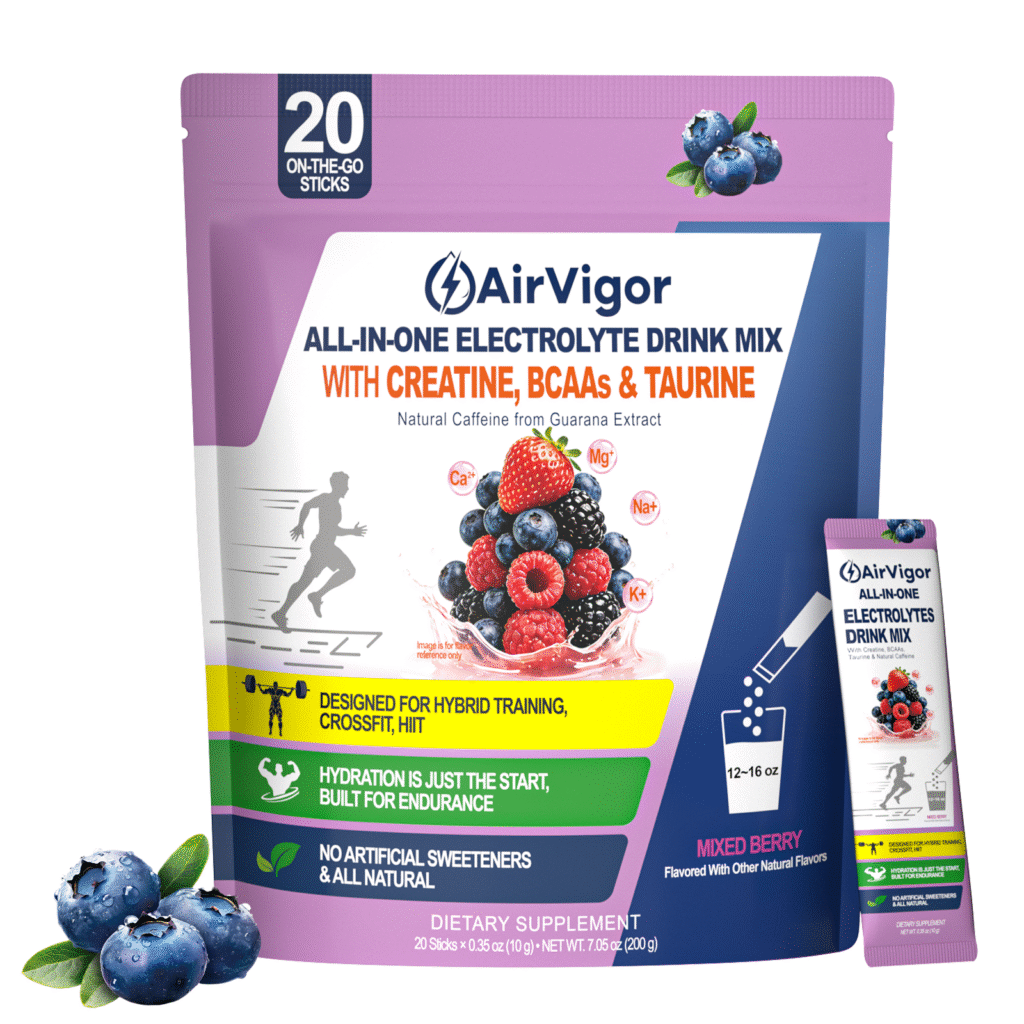
AirVigor approaches this by focusing on:
- High-purity ingredient sourcing
- No dilution of key active components
- Structured quality control systems
- Stable production environments
For users, this translates into a simple outcome:
The product works the same way every time you use it
And for something used regularly, that reliability becomes one of the most important factors in long-term satisfaction.
What Do Electrolytes with Amino Acids Do?
Electrolytes with amino acids support hydration, muscle function, and recovery by combining fluid balance with amino acid delivery in one step. They are most useful when the body is losing fluids and experiencing muscle stress at the same time, such as during exercise, long workdays, or irregular routines. A well-structured formula helps maintain more stable energy, reduces recovery delays, and improves consistency across repeated activity.
Do electrolytes with amino acids improve hydration?
Electrolytes with amino acids can improve how effectively the body absorbs and retains fluids, especially in situations where sweat loss is involved. Drinking water alone may not be sufficient when sodium and other minerals are depleted, because fluid balance depends on electrolyte presence, not just intake volume.
In real use, this becomes noticeable in the following situations:
- During workouts longer than 45–60 minutes
- In hot or humid environments
- When sweating is frequent across the week
- When hydration habits are inconsistent
A practical comparison:
| Hydration Method | Result in Real Use |
|---|---|
| Water only | May not fully restore electrolyte balance |
| Electrolytes only | Improves fluid retention |
| Electrolytes + amino acids | Supports hydration while addressing physical stress |
Users often describe the difference in simple terms: less dryness, more stable energy, and fewer sudden drops in performance. The effect is not immediate or extreme, but becomes more noticeable with consistent use over time.
Do electrolytes with amino acids support recovery?
Electrolytes with amino acids support recovery by addressing two key factors at the same time: rehydration and muscle repair support. Recovery is not a single event that starts after exercise ends; it begins during activity and continues afterward. When fluid balance is not restored and amino acid intake is delayed, recovery can become less efficient.
Amino acids provide the building blocks associated with muscle repair and adaptation. Essential amino acids are particularly important because they must be obtained through diet or supplementation. Electrolytes, on the other hand, help restore the internal environment needed for recovery processes to function properly.
In practical terms, this combination helps reduce common recovery gaps:
- Delayed protein intake after workouts
- Incomplete hydration after sweating
- Reduced appetite immediately after exercise
- Irregular recovery routines due to time constraints
Typical user experience improvements include:
| Recovery Issue | Practical Change Observed |
|---|---|
| Persistent soreness | Reduced accumulation over the week |
| Fatigue between sessions | Faster return to baseline |
| Irregular recovery habits | More consistent routine |
This is especially relevant for individuals training multiple times per week. When recovery is incomplete, performance tends to decline gradually. Supporting hydration and amino acid intake together helps reduce that decline and maintain a more stable training rhythm.
Do electrolytes with amino acids help maintain performance?
Electrolytes with amino acids support performance primarily by reducing the factors that cause performance to drop, rather than by directly increasing peak output. For most users, performance issues are related to fatigue, dehydration, and recovery gaps rather than lack of strength or effort.
Electrolytes help maintain fluid balance and nerve signaling, both of which are essential for sustained muscle function. Amino acids support the body under repeated stress, helping reduce the rate at which fatigue builds during activity.
This combined effect becomes noticeable in:
- Later sets during strength training
- Final intervals during high-intensity sessions
- Long-duration activities such as running or cycling
- Repeated sessions across the same week
A practical performance view:
| Performance Challenge | Role of Combined Formula |
|---|---|
| Early fatigue | Supports hydration stability |
| Sudden drop in output | Helps maintain internal balance |
| Declining session quality | Supports recovery between sessions |
| Inconsistent training | Improves routine stability |
The benefit is not an immediate increase in strength or speed. Instead, users often experience fewer sharp declines and more consistent output across sessions. Over time, this consistency contributes more to progress than short-term performance spikes.
How do electrolytes with amino acids affect daily energy and consistency?
Beyond workouts, electrolytes with amino acids can support overall daily stability, especially for individuals with demanding schedules or inconsistent routines. Energy fluctuations are often linked to hydration levels, recovery status, and nutrient timing rather than a single factor.
When hydration is incomplete or recovery is delayed, users may experience:
- Midday fatigue
- Reduced focus
- Slower physical response
- Increased perceived effort during normal tasks
By supporting both hydration and recovery in one step, these formulas help reduce those fluctuations.
Situations where this becomes relevant include:
- Long workdays with limited water intake
- Travel across time zones
- Physically active jobs
- Days with both training and work demands
In these contexts, the benefit is subtle but practical:
- Energy feels more stable across the day
- Less reliance on stimulants for short-term energy
- Reduced buildup of fatigue across multiple days
This is one reason many users adopt these products not only for workouts, but also as part of a broader daily routine.
What results should users realistically expect?
Electrolytes with amino acids are not designed to produce immediate or dramatic changes. Their value comes from improving consistency over time. Users who benefit most are those who experience regular fluid loss, physical stress, or recovery challenges.
Realistic expectations include:
- More stable hydration during and after activity
- Reduced fatigue accumulation across the week
- Improved consistency in training performance
- Easier maintenance of recovery routines
Less realistic expectations include:
- Instant performance increases
- Replacement of proper nutrition or rest
- Significant results from occasional use
A practical expectation framework:
| Usage Pattern | Expected Outcome |
|---|---|
| Occasional use | Limited noticeable effect |
| Consistent use during activity | Improved stability |
| Integrated into routine | Better long-term consistency |
The key factor is not intensity of use, but alignment with actual need. When used in the right situations, electrolytes with amino acids help reduce common weak points in hydration and recovery, making daily performance easier to sustain.
Which Electrolytes with Amino Acids Work Best?
The best electrolytes with amino acids are not the ones with the longest ingredient list or the strongest marketing claims. They are the formulas that deliver consistent hydration support, meaningful amino acid intake, and can actually be used every day without friction. In real use, effectiveness comes from balance, clarity, and how well the product fits into a routine.
Which electrolytes with amino acids formulas matter most?
What really determines whether a formula works is not how many ingredients it contains, but whether those ingredients are present at levels that match real-world needs. During exercise or physically demanding days, the body loses fluids, sodium, and other minerals, while also experiencing muscle stress. A useful formula should address both sides in a balanced way.
In practice, effective formulas usually share a few common characteristics:
- Sodium is present at a level that actually supports hydration, not just taste
- Potassium is included to maintain muscle and nerve function
- Magnesium is added in moderate amounts to support muscle relaxation
- Amino acids are included in grams, not milligrams
Many products fall short because they are built around label appearance rather than function. For example, a formula may list electrolytes and amino acids, but if sodium is too low or amino acids are only included in trace amounts, the user is unlikely to notice any real difference.
A more reliable approach is to look for balance rather than intensity. A moderate formula that can be used consistently often delivers better long-term results than a highly concentrated product that feels difficult to use regularly.
Which amino acids in electrolytes with amino acids are most effective?
Not all amino acids contribute equally, and this is where many users get confused when comparing products. The type of amino acids included affects whether the formula supports full recovery or only part of the process.
There are three common approaches used in the market:
- Formulas based on essential amino acids (EAA), which provide a complete profile
- Formulas based on branched-chain amino acids (BCAA), which focus on muscle breakdown
- Formulas that include additional functional amino acids like taurine or glutamine
From a practical standpoint, EAA-based formulas tend to be more complete because they cover a wider range of recovery needs. BCAA formulas can still be useful, especially during workouts, but they are more limited in scope.
Another important point is total dosage. It is common to see products list several amino acids, but without clearly stating the total amount. In real use, a formula with around 5–10 grams of amino acids per serving is more likely to provide noticeable support than one with only small, scattered amounts.
Users often feel the difference over time rather than immediately. Better amino acid structure usually shows up as:
- Less buildup of fatigue across the week
- More stable recovery between sessions
- Reduced feeling of “starting from zero” each workout
How to identify weak or underdosed formulas?
One of the biggest issues in this category is that many products look functional but are not built at effective levels. The front label often emphasizes features, while the actual ingredient panel tells a different story.
There are a few practical signs that a formula may be underdosed:
- Electrolytes are listed, but without clear mg values
- Amino acids are included, but total grams are not specified
- Serving size is very small, limiting actual intake
- The ingredient list is long, but each component is present in minimal amounts
In real use, these formulas tend to feel “light” or inconsistent. Users may not notice much difference between using the product and not using it.
On the other hand, a well-dosed formula is usually easier to recognize:
- Ingredient amounts are clearly stated
- The formula looks simple rather than overloaded
- The product delivers a consistent experience each time
The goal is not complexity. The goal is clarity and effectiveness.
How to compare electrolytes with amino acids across brands?
Most comparisons focus on surface-level factors like flavor, branding, or price. While these matter, they do not determine whether the product actually works.
A more useful way to compare products is to think in terms of daily usability.
Ask simple questions:
- Can I drink this regularly without getting tired of the taste?
- Does it mix easily, or does it leave residue?
- Does it fit into my routine without extra effort?
- Do I actually feel more stable when I use it consistently?
A product that scores well in these areas is more likely to deliver long-term value.
There is also a practical trade-off that many users overlook:
- A stronger formula that is used inconsistently
- A balanced formula that is used every day
In most cases, the second option leads to better results.
This is because hydration and recovery are not one-time events. They depend on repeated, consistent support.
What makes a high-quality electrolytes with amino acids formula?
A high-quality formula is one that performs the same way every time it is used. This consistency is what allows users to build stable routines and trust the product over time.
From a user perspective, a strong product usually feels:
- Easy to drink without being overly sweet
- Light enough for regular use
- Consistent in taste and effect
- Reliable across different situations (workout, travel, daily use)
From a production perspective, this level of consistency comes from:
- Careful raw material selection
- Controlled manufacturing processes
- Stable formulation design
- Ongoing quality checks
For example, AirVigor builds its products around:
- Clearly defined ingredient structure
- No dilution of key active components
- Standardized production systems
- Consistent batch control
What this means in practice is simple:
The product does not change from one purchase to the next.
The user experience remains predictable.
And for something used regularly, predictability is what allows people to keep using it.
Which type of formula works best for different users?
There is no single formula that fits everyone. The best choice depends on how the product will actually be used.
A practical way to think about it:
- Someone training regularly benefits from a balanced formula with meaningful amino acid content
- Someone focused on endurance may prioritize higher electrolyte support
- Someone with a busy schedule may prefer a lighter, easy-to-drink formula that fits daily use
- Someone traveling frequently may value portability and quick preparation
Instead of asking which product is “best,” a more useful question is:
Which product fits my routine well enough that I will actually use it consistently?
Because in real life, the best formula is not the most advanced one.
It is the one that fits into your day without resistance and supports your routine over time.

Electrolytes with amino acids are most useful for people whose daily routines create a gap between hydration, recovery, and actual intake. This includes individuals who sweat regularly, train multiple times per week, work long hours, or have inconsistent eating and drinking patterns. The product is not limited to athletes. It is relevant to anyone whose body is frequently dealing with fluid loss and delayed recovery support.
Do athletes and regular gym users need electrolytes with amino acids?
Athletes and active individuals are among the most direct users because their routines consistently create both hydration loss and muscle stress. During training, the body can lose between 0.5 to 1.5 liters of fluid per hour depending on intensity and environment. Along with that fluid, sodium and other electrolytes are also lost, which affects performance and recovery if not replaced.
At the same time, repeated muscle contraction creates stress that requires recovery support. When both hydration and recovery are not addressed together, users often experience:
- Gradual fatigue across sessions
- Reduced training consistency
- Slower recovery between workouts
Electrolytes with amino acids help reduce this gap by supporting both systems in one intake.
Typical use scenarios include:
| Training Type | Why It Helps |
|---|---|
| Strength training | Supports recovery between sets and sessions |
| Running and cycling | Helps maintain hydration over longer durations |
| HIIT training | Addresses both sweat loss and rapid fatigue |
| Cross-training | Supports repeated performance across the week |
For individuals training 3–6 times per week, the benefit is not about increasing peak performance, but about maintaining stability and reducing performance drop-offs.
Do people with busy schedules benefit from electrolytes with amino acids?
People with busy or unpredictable schedules often benefit just as much as active users, even if they do not consider themselves “athletes.” In many cases, their routines create similar challenges:
- Meals are delayed or skipped
- Water intake is inconsistent
- Recovery is not prioritized
For example, someone may complete a workout and immediately return to work without eating. Others may spend long hours at a desk and forget to drink enough water throughout the day. Over time, these patterns can lead to:
- Low energy in the afternoon
- Slower recovery from physical activity
- Increased reliance on caffeine for short-term energy
Electrolytes with amino acids provide a practical solution because they are:
- Quick to prepare
- Easy to consume in liquid form
- Less dependent on perfect timing
Common use cases:
- Office workers with long desk hours
- Professionals with frequent meetings or travel
- Individuals balancing workouts with work and family responsibilities
The main value is not optimization, but consistency. A simple solution that fits into a busy routine is more likely to be used regularly than a complex one.
Do people who sweat a lot or live in hot climates need them?
Individuals who sweat frequently or live in hot and humid environments have higher electrolyte needs, even outside of structured exercise. Sweat contains a measurable amount of sodium, typically ranging from 300 to 1000 mg per liter depending on the individual.
In these conditions, relying on water alone may not be sufficient to maintain fluid balance. Common signs of inadequate electrolyte intake include:
- Feeling thirsty even after drinking water
- Light fatigue during normal activity
- Muscle tightness or reduced endurance
- Faster onset of fatigue in heat
Electrolytes with amino acids help address this by:
- Replacing sodium and other minerals lost through sweat
- Supporting hydration retention rather than rapid fluid loss
- Providing additional support for muscle recovery when activity is involved
This group includes:
| Situation | Relevance |
|---|---|
| Outdoor workers | High due to continuous sweat exposure |
| Athletes training in heat | High due to combined stress |
| People living in warm climates | Moderate to high depending on daily activity |
In these cases, regular electrolyte support can help maintain more stable hydration levels across the day, not just during workouts.
Do people with inconsistent eating habits need electrolytes with amino acids?
Individuals with irregular eating patterns often face gaps in both hydration and recovery support. This is common among people who:
- Skip meals due to time constraints
- Eat at inconsistent times
- Have low appetite after exercise
- Travel frequently or change time zones
In these situations, the body may not receive adequate nutrients at the time they are most needed. For example, after exercise, appetite is often reduced, and many people delay protein intake for 30–60 minutes or longer.
Electrolytes with amino acids help bridge this gap by providing:
- Immediate hydration support
- A source of amino acids in liquid form
- An easier intake option when solid food is not practical
This does not replace proper meals, but it reduces the impact of delayed nutrition.
A typical pattern:
| Situation | Without Support | With Combined Formula |
|---|---|---|
| Post-workout (no appetite) | Delayed recovery | Immediate support |
| Skipped meals | Lower nutrient intake | Partial support |
| Travel days | Irregular hydration | More stable intake |
For many users, the benefit is simply making recovery more accessible when routines are not ideal.
Is it useful for people focused on long-term consistency rather than performance?
Yes, and this is one of the most practical use cases. Not everyone is trying to maximize performance in a single session. Many users are focused on maintaining a stable routine over time.
Inconsistent hydration and recovery often lead to:
- Irregular workout schedules
- Fluctuating energy levels
- Reduced motivation due to fatigue buildup
Electrolytes with amino acids help reduce variability between days by supporting:
- More stable hydration
- More predictable recovery
- Less accumulation of fatigue
This is particularly relevant for:
- Individuals returning to regular exercise
- People maintaining moderate activity levels
- Users focused on long-term health and routine stability
Rather than creating noticeable short-term changes, the product helps maintain a more consistent baseline.
Over time, this consistency becomes the main benefit. Users are able to maintain their routines with fewer interruptions, which has a greater impact than occasional high-performance sessions.
Who may not need electrolytes with amino acids regularly?
Not every user requires daily use of these products. They are less relevant for individuals whose routines do not involve significant fluid loss or recovery demand.
Situations where use may be limited:
- Low activity levels with minimal sweating
- Consistent hydration habits and balanced diet
- Infrequent exercise without noticeable recovery issues
In these cases, water and regular nutrition may be sufficient.
A simple guideline:
- Higher demand → more useful
- Lower demand → optional use
Understanding this helps users avoid unnecessary supplementation and use the product more effectively when it is actually needed.
How to Use Electrolytes with Amino Acids?
Electrolytes with amino acids are most effective when used around periods of physical demand—such as workouts, heat exposure, long workdays, or travel—when the body is losing fluids and also needs recovery support. The goal is not to use them randomly, but to match intake with real situations where hydration and recovery are likely to fall behind.
When should you take electrolytes with amino acids?
Timing does not need to be strict, but it should follow how the body actually responds to activity. The most useful moments are when fluid loss is happening or when recovery support is likely to be delayed.
In practice, most users benefit from one of these timing approaches:
Before activity (about 20–30 minutes prior)
Helps prepare hydration status, especially if water intake has been low earlier in the day. This is useful for morning workouts or after long work hours.
During activity (for sessions longer than 40–60 minutes)
Helps maintain fluid balance and reduce performance drop-off. Particularly relevant for endurance training or high-sweat workouts.
After activity (within 30 minutes post-exercise)
Supports rehydration and provides amino acids when appetite is often low.
A simple comparison:
| Timing | Best Use Case | Practical Effect |
|---|---|---|
| Before | Low hydration before workout | Reduces early fatigue |
| During | Long or intense sessions | Maintains consistency |
| After | Delayed meals or low appetite | Supports recovery start |
Most users do not need to follow all three. Choosing one consistent timing—usually during or after activity—is often enough to see a difference.
How much electrolytes with amino acids should you take per day?
Daily intake should match activity level, not product instructions alone. Taking too little may not produce noticeable benefits, while taking too much does not necessarily improve results.
A practical intake guide:
| Activity Level | Suggested Intake |
|---|---|
| Low activity | 0–1 serving (optional) |
| Moderate training (3–4x/week) | 1 serving |
| High intensity training | 1–2 servings |
| Long-duration or heavy sweating | 2 servings |
Other factors that affect intake:
- Climate: hot or humid conditions increase electrolyte loss
- Body size: larger individuals may require slightly higher intake
- Duration: longer sessions increase fluid and mineral demand
Water intake is equally important:
- Mix one serving with 400–600 ml (13–20 oz) of water
- Increase water volume in high heat or longer sessions
Common usage mistakes include:
- Using very small servings that do not match actual need
- Mixing with too little water, reducing effectiveness
- Using multiple servings on low-activity days without benefit
A balanced approach based on real demand tends to produce more consistent results over time.
Can you use electrolytes with amino acids every day?
Daily use is appropriate when daily conditions create a need for it. This is common for individuals who train regularly, sweat frequently, or have inconsistent hydration and recovery habits.
Daily use makes sense when:
- Training occurs most days of the week
- Work or environment involves physical demand or heat
- Hydration habits are inconsistent
- Recovery feels slower than expected
Example usage pattern:
| Day Type | Suggested Use |
|---|---|
| Workout day | Yes |
| High activity / heat exposure | Yes |
| Travel day | Yes |
| Rest day (low activity) | Optional |
It is important to keep expectations realistic. These products are not a replacement for:
- Regular meals
- Protein intake from whole foods
- Basic hydration habits
Instead, they act as a support layer that helps reduce gaps when routines are not ideal.
How to use electrolytes with amino acids in real daily routines?
The most effective use comes from fitting the product into real-life situations rather than trying to follow a strict plan.
Common practical scenarios:
1. After a workout with no immediate meal
Many people do not eat right after training. Using a combined formula helps provide hydration and amino acids without relying on appetite.
2. During long workdays with low water intake
Office workers often underestimate how little water they drink. A prepared drink can make hydration easier to maintain.
3. During travel or flights
Dry environments and irregular schedules reduce hydration quality. A portable formula helps maintain consistency.
4. In hot environments or outdoor work
Sweat loss increases electrolyte needs even without formal exercise.
A simple routine example:
- Morning workout → use after training
- Midday fatigue → optional hydration support
- Travel day → one serving during the day
The key is flexibility. The product should adapt to the routine, not the other way around.
What should you avoid when using electrolytes with amino acids?
Correct use is not only about what to do, but also what to avoid. Misuse can reduce effectiveness or create unnecessary intake.
Common issues to avoid:
- Relying on the product instead of proper meals
- Using it in place of water rather than alongside hydration
- Overusing on low-demand days
- Expecting immediate or dramatic results
A clear perspective helps:
| Expectation | Reality |
|---|---|
| Instant performance boost | Gradual improvement in consistency |
| Replacement for nutrition | Support alongside nutrition |
| Higher intake = better results | Matching intake to need is more effective |
The most effective users tend to treat it as a tool rather than a solution for everything.
How long does it take to notice results?
The effects of electrolytes with amino acids are usually gradual rather than immediate. Some users notice improved hydration or reduced fatigue within a few uses, but the more consistent benefits appear over time.
Typical timeline:
- First few uses: improved hydration feeling, less dryness
- 1–2 weeks: more stable energy during workouts
- 2–4 weeks: improved recovery consistency and reduced fatigue buildup
Results depend on:
- Frequency of use
- Activity level
- Overall hydration and nutrition habits
Users who incorporate the product into a consistent routine are more likely to notice stable improvements than those who use it occasionally.
How to Choose Electrolytes with Amino Acids?
Choosing electrolytes with amino acids is less about brand names and more about whether the formula can actually support hydration and recovery in daily use. The most useful products are those with clear ingredient amounts, balanced composition, and a format that fits into real routines. A good choice should be easy to understand, easy to use, and consistent over time.
What should you look for on the label first?
The label is the most direct way to evaluate whether a product is functional or just well-packaged. Many products appear similar from the front, but the ingredient panel reveals whether the formula is built for real use.
Start with the core elements:
- Sodium should be clearly listed, typically within a practical range for hydration support
- Potassium should be present to support muscle and fluid balance
- Magnesium should be included in moderate amounts, not just trace levels
- Total amino acid content should be stated in grams, not hidden
A quick evaluation approach:
| Label Element | What to Check | Why It Matters |
|---|---|---|
| Sodium | Clearly listed (mg) | Indicates real hydration support |
| Potassium | Balanced with sodium | Supports muscle function |
| Amino acids | Total grams visible | Determines recovery support |
| Ingredient clarity | No hidden blends | Allows accurate comparison |
If key ingredients are not clearly quantified, it becomes difficult to judge effectiveness. A transparent label usually indicates a more reliable product.
How do you know if the formula is properly dosed?
Proper dosing is one of the most important factors, but it is often overlooked. A product can include the right ingredients but still be ineffective if the amounts are too low.
In real use, the body responds to quantity, not presence.
A practical way to evaluate dosing:
- Electrolytes should reflect actual sweat loss, not symbolic inclusion
- Amino acids should be present in gram-level amounts
- The serving size should match how the product is intended to be used
Typical functional ranges:
| Component | Practical Range (Per Serving) |
|---|---|
| Sodium | 150–400 mg |
| Potassium | 200–500 mg |
| Magnesium | 20–100 mg |
| Amino acids | 5–10 g |
Formulas that fall significantly below these levels may still be usable, but users are less likely to notice meaningful effects.
In practice, underdosed products often lead to feedback such as:
- “Didn’t feel much difference”
- “Works like flavored water”
- “Not sure if it’s doing anything”
A properly dosed formula, on the other hand, tends to feel more stable and predictable when used consistently.
Should you choose EAA or BCAA formulas?
This depends on how the product will be used and what the user expects from it. Both EAA and BCAA formulas are common, but they serve slightly different purposes.
A simple comparison:
| Type | Structure | Practical Use |
|---|---|---|
| EAA | Full essential amino acid profile | Broader recovery support |
| BCAA | 3 key amino acids | Focused on muscle breakdown reduction |
In real use:
- EAA formulas are more complete and suitable for general recovery support
- BCAA formulas are more targeted and often used during workouts
For most users, especially those training regularly or using the product as a daily support tool, a balanced EAA-based formula provides a more complete approach.
However, the choice is not only about type. Total amino acid amount still matters. A well-dosed BCAA formula may be more effective than a poorly dosed EAA formula.
How important is taste and mixability?
Taste and mixability are often underestimated, but they directly affect whether the product will be used consistently. A formula that is difficult to drink or does not mix well is less likely to become part of a daily routine.
In real-world use, users tend to prefer:
- Light, clean taste rather than overly sweet profiles
- Smooth mixing without clumping or residue
- A drink that can be finished easily during or after activity
Common issues that reduce usability:
- Strong artificial sweetness that becomes tiring over time
- Poor solubility, leaving powder at the bottom
- Thick texture that feels heavy during workouts
These factors may seem secondary, but they directly affect consistency. A product that is slightly less “perfect” on paper but easier to use daily often delivers better long-term results.
How does packaging and format affect usability?
Packaging is not just about appearance. It affects how easily the product fits into daily routines.
Different formats serve different needs:
| Format | Best Use Case |
|---|---|
| Stick packs | Travel, gym, on-the-go use |
| Large containers | Home use, frequent intake |
| Bottled products | Convenience, ready-to-drink |
For example:
- A person who travels frequently benefits from portable stick packs
- A regular gym user may prefer a larger container for daily use
- Someone with a busy schedule may prioritize convenience over cost per serving
The best format is the one that reduces friction. If the product is easy to carry, prepare, and consume, it is more likely to be used consistently.
What role does product consistency and manufacturing quality play?
Consistency is one of the most important but least visible factors when choosing a product. A formula may look good on paper, but if the quality varies between batches, the user experience becomes unreliable.
From a user perspective, consistency means:
- The taste remains the same
- The mixing behavior does not change
- The effect feels predictable
From a production perspective, this depends on:
- Raw material sourcing standards
- Manufacturing systems and controls
- Quality testing at multiple stages
A simplified view:
| Quality Factor | Impact on User Experience |
|---|---|
| Raw material purity | Affects taste and effectiveness |
| Manufacturing control | Ensures consistent composition |
| Quality checks | Reduces variation between batches |
AirVigor focuses on these aspects through:
- Strict raw material selection
- Clear formulation standards
- Controlled production processes
- Multi-stage quality verification
For users, this translates into reliability. The product performs the same way each time, which supports long-term use.
How do you choose the right product for your routine?
The best product is not necessarily the most advanced or the most expensive. It is the one that fits your routine well enough that you will use it consistently.
A practical selection approach:
- If training regularly → choose a balanced formula with meaningful amino acid content
- If focusing on endurance → prioritize electrolyte balance
- If managing a busy schedule → choose a simple, easy-to-use format
- If traveling often → prioritize portability
Instead of asking “Which product is the best?”, a more useful question is:
“Which product fits into my daily routine without effort?”
Because in real use:
- Consistency matters more than intensity
- Ease of use determines long-term results
- A simple, well-designed product often outperforms a complex one
When a product aligns with real habits, it becomes part of the routine rather than an extra step. That is what ultimately determines whether it delivers value over time.

Conclusion
Electrolytes with amino acids make sense because they support two needs that often overlap in real life: hydration and recovery. For people who train regularly, sweat often, travel frequently, or struggle with inconsistent routines, this kind of formula can make daily performance and recovery easier to manage.
The most useful product is not the one with the most complicated label. It is the one with clear dosing, balanced formulation, and reliable everyday use. AirVigor’s approach is built around that idea, with transparent ingredient standards, practical formula design, and stable quality control for long-term use.
Share:
Contact Expert Team
At AirVigor, performance becomes effortless. We transform advanced nutrition science into clean, effective supplements that help you hydrate, recover, and feel stronger every day. Shop AirVigor Supplements on Amazon and experience athlete-trusted formulas—backed by real science and supported by our world-class R&D and production capabilities.
Trust AirVigor
At AirVigor, turning your performance goals into reality is no longer a struggle—it’s a science-driven journey we build together. Whether you’re a runner, lifter, cyclist, yogi, outdoor athlete, or someone simply seeking better daily energy, AirVigor transforms advanced nutrition research into clean, effective, and trustworthy supplements you can feel.
Backed by our U.S. scientific team, global certifications, and world-class production standards, every formula is engineered to deliver real hydration, real recovery, and real performance. And when you’re ready to experience the difference, you’ll find AirVigor products available on Amazon and other major platforms—fast shipping, consistent quality, and a community of athletes already seeing results.
Behind the scenes, our R&D and manufacturing ecosystem also supports specialized formulation development, ensuring AirVigor continues to lead with innovation while keeping quality and safety uncompromised. But at the core, everything we create is built for you—your health, your performance, your momentum.
Choose AirVigor. Feel the science. Elevate your every day.


Subscribe to our newsletter
Sign up to our newsletter and we’ll keep you up to date with the latest arrivals.