Skip to content
Can Recovery Electrolyte with D3K2 Mix With Protein: A Complete Guide
# Your Trusted Dietary Supplement Brand In US
- Emily

Table of Contents
Many negative supplement reviews are not due to a weak formula. They are caused by a weak usage message. One customer mixes an electrolyte recovery stick into a thick whey shake and says it tastes strange. Another drinks it like a sports drink during a short workout and says it feels unnecessary. Another expects it to replace a full post-workout recovery shake and feels disappointed when it does not. That is why this question matters so much: can Recovery Electrolyte with D3K2 mix with protein powder, and if it can, when does that actually make sense? Current sports-nutrition guidance gives a practical answer. Cleveland Clinic notes that tough workouts often call for both electrolyte replacement and protein intake, while the International Society of Sports Nutrition supports post-exercise protein intake in the range of about 20 to 40 grams for many active adults. Research also shows that adding whey protein isolate to a carbohydrate-electrolyte drink did not reduce post-exercise rehydration under matched conditions. That means the real issue is usually not whether the two can coexist. The real issue is whether they are being used in the right situation, in the right format, and with realistic expectations.
Yes, Recovery Electrolyte with D3K2 can generally be used with protein powder, especially after training when hydration support and recovery nutrition are both useful. The better question is whether they should always be mixed in one shaker. In many cases, separate use gives a cleaner taste, lighter texture, and easier stomach feel, while combined use offers more convenience. Research supports that the pairing itself is not inherently a hydration problem.
That distinction matters for AirVigor because this is not only a nutrition question. It is a product-positioning question, a label-clarity question, and a review-prevention question. When users understand what the product is for, when to use it alone, and when to pair it with protein, complaint risk drops before the first sachet is even opened. And that is exactly where a stronger article can do more than educate. It can protect conversion, reduce confusion, and make the product easier to trust on Amazon, Shopify, and every other channel where the first-use experience shapes the review. The right answer here is not “always mix” or “never mix.” It is use it in the way that best matches the recovery job in front of you.
What Is Recovery Electrolyte with D3K2?
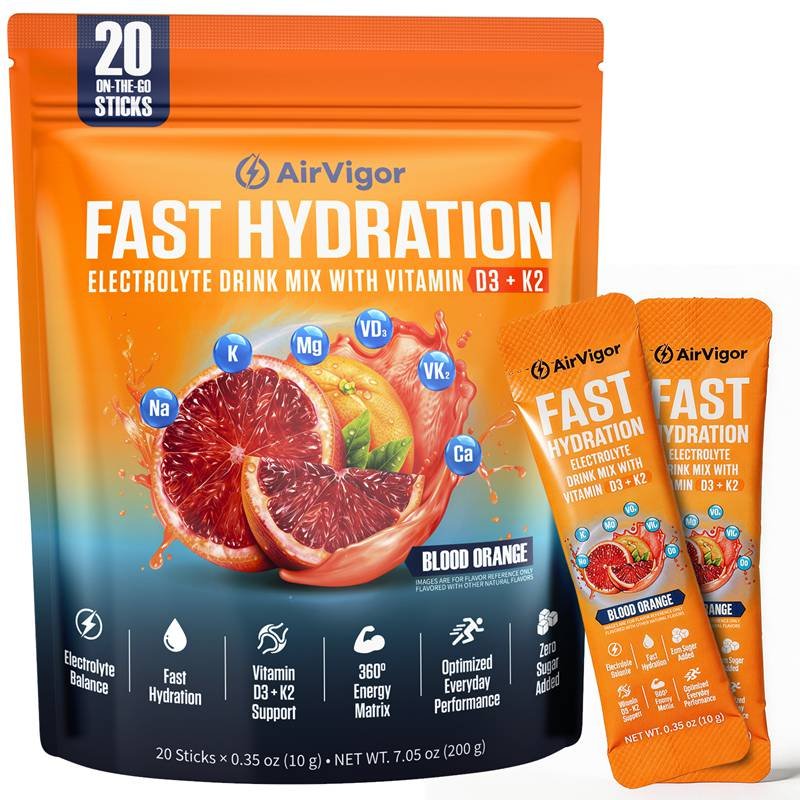
Recovery Electrolyte with D3K2 should be understood as a recovery hydration product. Its main role is to help support fluid balance after sweat loss and physical demand, while its D3K2 positioning gives it a broader wellness and recovery angle than a basic sports drink. Electrolytes help regulate body water and support nerve and muscle function, which is why they matter most when hydration demand rises.
What Does Recovery Electrolyte with D3K2 Do?
At a functional level, this product is there to support post-sweat recovery hydration, not to replace food, and not to act like a stimulant. MedlinePlus explains that electrolytes help balance the amount of water in the body and support nerve and muscle function. Cleveland Clinic likewise describes electrolyte beverages as useful in helping the body rehydrate and recover after hard exercise or illness.
That means Recovery Electrolyte with D3K2 sits in a very specific place in a user’s routine. It is more purposeful than plain water in high-sweat situations, but it is still lighter and more hydration-focused than a full protein shake. This is where many customers get confused. They see “recovery” on the pack and assume it should cover hydration, muscle recovery, satiety, and even energy in one step. That expectation is too broad. The product can support recovery, but primarily by helping cover the hydration side of recovery.
A simple role chart makes this clearer:
| Product type | Main job | What it does not fully replace |
|---|---|---|
| Water | Basic hydration | Electrolyte replacement in higher-loss situations |
| Recovery Electrolyte with D3K2 | Recovery hydration support | Full protein recovery nutrition |
| Protein shake | Protein intake after training | Hydration support after sweat loss |
| Sports drink | Longer exercise hydration plus carbs | A targeted recovery electrolyte product |
For AirVigor, this distinction is commercially valuable. The clearer the product role, the easier it becomes for users to choose the right moment to use it, and the lower the chance that a disappointed review is really just a disappointed expectation.
Who Needs Recovery Electrolyte with D3K2?
This product is not only for endurance athletes. The strongest fit is much broader. It can serve gym users, runners, cyclists, hot yoga users, outdoor workers, travelers, and active people who feel noticeably drained after sweat-heavy activity. Cleveland Clinic points out that electrolyte beverages can help after a tough workout, while Mayo Clinic still emphasizes that water is generally enough for many lower-demand situations, which is a useful reminder that need depends on context.
The best-fit users usually share one thing: hydration after effort matters enough that plain water does not always feel like a complete answer. That can happen in several very normal situations:
| User group | Why this product may fit |
|---|---|
| Gym users | Sweat loss plus post-workout recovery routine |
| Runners and cyclists | Longer or sweat-heavy sessions |
| HIIT / CrossFit users | High output and repeat recovery demand |
| Hot-yoga users | Strong sweat loss in a short time |
| Outdoor workers | Heat and repeated fluid loss |
| Travelers | Dry air, disrupted hydration, and fatigue |
This is where AirVigor’s wider brand story helps. Because the brand already positions itself around real ingredient inclusion, clear formula expression, and stable quality management, it makes sense for the product to be presented as a practical tool for people whose hydration needs are more demanding than average, not as something every person must take every day.
Is Recovery Electrolyte with D3K2 for Daily Use?
It can be used daily, but daily use should still follow real demand rather than an automatic habit. Mayo Clinic says water is generally the best way to replace lost fluids, and Cleveland Clinic warns that electrolyte drinks are specialty drinks rather than something to grab every time you are thirsty.
That matters because customers often make one of two mistakes. They either treat electrolyte products like daily essentials, no matter what their day looks like, or they avoid them completely because they think they are only for sports. The more practical answer is in the middle. Daily use can make sense on days with exercise, heat, travel, poor hydration routines, or noticeable sweat loss. It may be much less important on a calm, low-sweat indoor day where food and water intake are already solid.
A daily-use matrix helps simplify it:
| Daily pattern | Does daily use make sense? |
|---|---|
| Low activity, mild weather | Sometimes optional |
| Training day | More useful |
| Long hot day | More useful |
| Travel day | Often useful |
| Recovery day after heavy sweat | Often useful |
| Sedentary indoor day | Less essential |
For review prevention, this is important. A product becomes easier to trust when the brand is honest about context. Saying “use when hydration demand is higher” is more believable than pretending every user needs it every morning without exception.
Is Recovery Electrolyte with D3K2 for Post-Workout Use?
Yes. Post-workout is one of the strongest and clearest use cases. Cleveland Clinic’s workout-recovery guidance highlights both electrolyte replacement and protein as important parts of recovery after hard exercise. The ISSN protein position stand supports 20–40 g of high-quality protein after training for many active people, which makes the post-workout window the most natural place where users begin thinking about both hydration and protein together.
This is exactly why the product name and usage message matter. If Recovery Electrolyte with D3K2 is presented only as a hydration product, users may not see how it fits into the broader post-workout routine. If it is presented too broadly, they may assume it replaces protein, which it does not. The stronger message is more specific: this product helps cover the hydration side of post-workout recovery and may be paired with protein when recovery nutrition is also needed.
A practical post-workout table:
| Post-workout need | Better approach |
|---|---|
| Mild thirst, low sweat | Water may be enough |
| Sweat loss, hydration focus | Recovery Electrolyte with D3K2 |
| Protein-focused recovery | Protein shake |
| Hydration + protein recovery | Both can fit |
| Full meal replacement | Neither one alone is enough |
This is one of the most valuable things AirVigor can clarify in content. Once users understand that hydration support and protein recovery are two different jobs, they stop expecting one product to behave like both.
Can Recovery Electrolyte with D3K2 Mix With Protein Powder?
In most cases, yes. Recovery Electrolyte with D3K2 can generally be used with protein powder, especially after training. The more useful question is not whether the combination is “allowed.” The more useful question is whether combining them in one bottle is the best choice for taste, texture, convenience, and stomach comfort. Research on whey protein added to carbohydrate-electrolyte beverages found that whey protein isolate neither enhanced nor impaired post-exercise rehydration under matched conditions. GSSI also notes that milk or other carbohydrate/protein-based drinks can serve as effective rehydration beverages when there is enough time between exercise bouts.
Can Recovery Electrolyte with D3K2 and Protein Powder Work Together?
Yes, because they do different jobs that often belong to the same recovery window. Cleveland Clinic’s post-workout guidance recommends replenishing electrolytes after tough exercise and also powering recovery with protein. The ISSN position statement supports protein intake after exercise, especially in the range of about 20 to 40 grams, to help support training adaptation and recovery.
From a practical standpoint, that means the two products are not competing with each other. One mainly supports hydration. The other mainly supports recovery nutrition. Many users naturally need both after hard sessions. This is why the question shows up so often in search: not because the pairing is strange, but because the pairing is logical.
A compatibility chart makes the logic clearer:
| Combination | Main purpose |
|---|---|
| Electrolytes only | Hydration support |
| Protein only | Recovery nutrition |
| Electrolytes + protein | Hydration + recovery support |
| Electrolytes + protein + carbs | More complete recovery beverage |
The real product-use challenge is not a science conflict. It is experience design. If the combo tastes harsh, feels too thick, or sits badly in the stomach, the user may still leave a poor review even when the combination is functionally reasonable.
Should Recovery Electrolyte with D3K2 Be Mixed or Drunk Separately?
Both methods can work, but they solve different customer priorities. Mixing them together is more convenient. Drinking them separately often gives better flavor control, cleaner texture, and easier stomach comfort. Research supports that whey can be incorporated into a carbohydrate-electrolyte beverage without harming rehydration under matched conditions, but that does not automatically mean every electrolyte-plus-protein combination will feel pleasant to drink.
This is where many reviews go wrong. A user mixes a fruit-forward electrolyte stick into a heavy dessert-flavored whey and then interprets the result as a product failure. In reality, the problem may simply be that convenience was prioritized over drink quality.
A practical decision grid:
| Priority | Better method |
|---|---|
| Best taste clarity | Drink separately |
| Lightest texture | Drink separately |
| One-bottle convenience | Mix together |
| Sensitive stomach | Start separately |
| Fast post-workout routine | Either can work, depending on tolerance |
For AirVigor, the best first-use guidance is simple and low-risk: Use alone for lighter hydration support. Pair with protein after training if needed. If mixing for the first time, start with a lighter protein and more water. That kind of instruction is more useful than a generic “mix with your favorite shake.”
Which Protein Powder Fits Recovery Electrolyte with D3K2 Best?
Lighter protein powders usually fit better than heavier ones. Whey isolate and lighter whey blends tend to be easier starting points than thick casein formulas, mass gainers, or strongly dessert-style proteins. The research base around whey in recovery beverages is stronger than it is for many other protein types, which makes whey a practical starting category in post-workout use discussions.
The reason is not only absorption. It is also drink behavior. A lighter protein usually creates a cleaner, thinner result, which better matches what many users want from a recovery electrolyte product. A heavy or creamy protein can easily overpower a fruit-style electrolyte flavor, making the drink feel confusing or unpleasant.
A simple fit table:
| Protein format | Likely fit with electrolyte powder |
|---|---|
| Whey isolate | Strong |
| Light whey blend | Good |
| Unflavored protein | Often very good |
| Casein | Heavier texture |
| Mass gainer | Higher complaint risk |
| Sweet dessert-style whey | Higher flavor-conflict risk |
This is exactly the kind of practical instruction that reduces preventable complaints. The product does not need to “work with every protein” equally well to be successful. It needs to work well enough with sensible pairings and give users clear instructions before they improvise badly.
Does Recovery Electrolyte with D3K2 Affect Protein Absorption?
There is no strong evidence from the sources reviewed here that pairing an electrolyte drink with whey protein creates a meaningful problem for protein use in a normal post-exercise setting. Research on whey added to a carbohydrate-electrolyte drink showed that whey did not reduce rehydration under matched conditions. The ISSN protein position stand also supports the use of protein around exercise, especially in the 20–40 g range, without suggesting that electrolyte pairing itself is a major absorption concern.
That means the more realistic customer concerns are different:
| Concern type | Is it the real issue? |
|---|---|
| “Will electrolytes block protein?” | Usually no |
| “Will protein ruin hydration?” | Not necessarily |
| “Will it taste strange?” | Often yes, depending on pairing |
| “Will it feel heavy?” | Sometimes yes |
| “Will my stomach like it?” | Depends on dose, timing, and protein type |
This is actually good news for AirVigor. It means the question is more manageable than many users think. Most problems can be reduced with clearer pairing guidance, clearer timing guidance, and more realistic instructions around flavor, texture, and stomach comfort.

When Should You Use Recovery Electrolyte with D3K2?
The best time to use Recovery Electrolyte with D3K2 is when hydration is part of the recovery problem. That usually means after sweat loss, after training, after heat exposure, after travel, or after a day where water intake was clearly not enough. It does not need to be forced into every routine. Mayo Clinic still draws a practical line here: water is generally the first choice for most exercise, while electrolyte-containing sports drinks become more useful when exercise goes beyond about 60 minutes or when conditions are more demanding.
From a customer-use perspective, this matters because bad reviews often come from bad timing, not bad formulas. A person may use the product before a short indoor session and feel it was unnecessary. Another may wait until after a long, sweaty workout and feel it works exactly as expected. The product did not change. The context did. That is why timing guidance should be concrete, not vague.
A practical use chart makes the point clearer:
| Situation | Is Recovery Electrolyte with D3K2 a strong fit? | Main reason |
|---|---|---|
| After a sweaty workout | Yes | Hydration support is directly relevant |
| After heat exposure | Yes | Sweat loss usually raises electrolyte need |
| Morning after travel | Often yes | Routine disruption and dehydration risk are higher |
| Before a short light workout | Often optional | Water may already be enough |
| Rest day with low sweat | Sometimes optional | Need depends on actual hydration demand |
How Should You Use Recovery Electrolyte with D3K2 After Training?
After training is the clearest use case. Cleveland Clinic notes that after a tough workout, replenishing electrolytes can help rehydrate and recover, while post-workout protein is also commonly recommended as part of recovery. The ISSN protein position stand supports roughly 20–40 grams of protein after exercise for many active adults, which is why so many users naturally ask whether they can use the two together.
The smarter way to explain this is to separate the recovery job into two parts. Hydration support and protein support are not the same thing. If the session was short, indoor, and not very sweaty, protein may matter more than electrolytes. If the session was long, hot, or sweat-heavy, hydration support becomes much more important. If both are true, using both products makes good sense. This is where the product can be positioned clearly: Recovery Electrolyte with D3K2 covers the hydration side of recovery, while protein covers the recovery-nutrition side.
A useful post-workout guide looks like this:
| Post-workout situation | Best approach |
|---|---|
| Light workout, low sweat | Water or protein may be enough |
| Hard workout, high sweat | Recovery Electrolyte with D3K2 fits well |
| Hard workout, high sweat, recovery nutrition needed | Recovery Electrolyte with D3K2 + protein can fit |
| Sensitive stomach after training | Often better to start with separate use |
This is one of the most important review-prevention points for AirVigor. Customers tend to be happiest when the product is explained as part of a recovery system, not as a single product that replaces every other post-workout step.
Can Recovery Electrolyte with D3K2 Be Used in the Morning?
Yes, but morning use works best when there is a real reason for it. Good examples include waking up after poor sleep, after travel, after a hot night, after a previous day of heavy sweating, or before a demanding day when hydration will be easy to neglect. Cleveland Clinic describes electrolyte beverages as specialty drinks rather than all-day drinks for everyone, which is a helpful reminder that even a useful product should still be used for a reason.
For many users, morning use falls into two groups. The first group is active users training early, especially in heat or after waking up slightly dehydrated. The second group is lifestyle users who wake up dry, tired, or behind after flights, long commutes, poor hydration, or heat exposure. In those cases, Recovery Electrolyte with D3K2 can be more useful than plain water alone because it adds structure to rehydration. But it still should not be framed like a universal morning ritual for everyone.
A practical morning-use table:
| Morning pattern | Is it a good fit? |
|---|---|
| Normal morning, well hydrated | Often optional |
| Morning after travel | Good fit |
| Morning after a long sweaty day | Good fit |
| Morning before hot training | Good fit |
| Low-activity indoor morning | Less necessary |
This is where honest messaging helps. When the brand says clearly that morning use depends on hydration needs rather than hype, the product feels more trustworthy.
Should Recovery Electrolyte with D3K2 Be Used Before Exercise?
Sometimes, yes, but mainly for hydration reasons. Mayo Clinic says water is generally enough for many workouts, while longer sessions over about 60 minutes make electrolyte-containing drinks more useful. That means pre-workout use can make sense when the user is going into heat, knows they sweat heavily, or is starting a longer session already a little behind on hydration.
This is also where mixing with protein needs more caution. Using Recovery Electrolyte with D3K2 before exercise can be helpful in the right setting. Using it with a thick protein shake right before a hard session is often a different story. The issue is not that protein is “wrong.” The issue is comfort. A thicker drink can feel heavy, especially before running, HIIT, or high-intensity training. That is why pre-workout combined use should not be the default recommendation unless the user already knows the pairing works well for their stomach.
A practical pre-workout guide:
| Before-training situation | Better choice |
|---|---|
| Short indoor session | Water is often enough |
| Long hot session | Recovery Electrolyte with D3K2 may help |
| Heavy sweater | Electrolyte support makes more sense |
| Sensitive stomach | Avoid thick mixed drinks pre-workout |
| Early session after poor hydration | Electrolyte use may be helpful |
This matters because many complaints about “feeling too heavy” or “not sitting right” come from timing mistakes rather than product defects.
Can Recovery Electrolyte with D3K2 Be Used on Rest Days?
Yes, but rest days should still be judged by recovery need, not by the word “rest.” A rest day after a very sweaty training block, a hot weekend, outdoor work, or long travel may still be a meaningful hydration-recovery day. On the other hand, a quiet indoor day with low sweat and normal food and water intake may not call for much more than water. Cleveland Clinic explicitly warns against treating electrolyte-heavy drinks like all-day drinks when the body does not need them.
This is especially useful for long-term customer trust. A product feels more credible when the brand does not insist on daily use regardless of context. That kind of honesty also improves retention, because customers learn how to use the product intelligently instead of feeling pushed into overuse.
A rest-day use table:
| Rest-day pattern | Strong fit? |
|---|---|
| Recovery day after heavy sweat | Yes |
| Travel recovery day | Yes |
| Hot outdoor day | Often yes |
| Low-sweat indoor day | Sometimes optional |
| Normal hydration, mild conditions | Less essential |
Why Does Recovery Electrolyte with D3K2 Get Complaints?
Most complaints about mixing Recovery Electrolyte with D3K2 with protein powder are not about whether the formula “works.” They usually come from one of four real-world problems: the flavor pairing feels wrong, the texture gets too thick or clumpy, the stomach feels heavy, or the user expected the product to do a different job. Cleveland Clinic’s consumer guidance on electrolyte drinks is useful here because it reminds people that these drinks serve specific purposes. When people use them outside those purposes, confusion grows fast.
This is a major ecommerce issue because customers rarely write reviews like formulation scientists. They describe outcomes: “too sweet,” “too thick,” “felt weird,” “didn’t work for me,” or “I don’t know if I mixed it right.” Those are experience problems, and they need experience-based solutions.
A complaint map makes the real causes easier to see:
| Complaint | What usually causes it |
|---|---|
| Tastes strange | Flavor conflict between electrolyte profile and protein flavor |
| Too thick or clumpy | Protein format, low water volume, or poor mixing |
| Stomach discomfort | Timing, lactose sensitivity, dose, or heaviness |
| “Not what I expected” | Weak product education |
Why Does the Taste Go Wrong?
Taste complaints usually happen because two acceptable products create a bad pairing when forced into one bottle. Electrolyte drinks often taste tart, fruity, or slightly salty. Many protein powders are creamy, dessert-like, milky, or very sweet. Neither one is necessarily flawed, but the pairing can feel unnatural if the flavor systems fight each other. This is why a light fruit electrolyte can taste fine alone and still taste strange when combined with a heavy vanilla, chocolate, or cookies-and-cream whey. That is a pairing issue, not automatically a formula issue.
A useful flavor guide:
| Protein flavor style | Mixing risk with electrolyte powder |
|---|---|
| Unflavored | Lower |
| Mild vanilla | Moderate |
| Light fruit whey | Lower |
| Heavy dessert flavor | Higher |
| Strong chocolate milkshake style | Higher |
For customers, this is one of the easiest complaints to avoid. The safest first test is a lighter or less sweet protein rather than the most indulgent flavor in the cabinet.
Why Does the Texture Get Worse?
Texture complaints usually come from the protein side of the mix. A recovery electrolyte is usually expected to be light and clean. A protein powder, especially a thicker blend, can quickly change that. If the bottle is too small, the water volume is too low, or the protein type is heavy, the finished drink can feel chalky, thick, foamy, or clumpy. That creates disappointment because the user was expecting something closer to a refreshing hydration drink.
A texture-risk table helps explain this:
| Mixing choice | Texture risk |
|---|---|
| More water | Lower |
| Small shaker bottle | Higher |
| Whey isolate | Lower |
| Thick whey blend | Moderate |
| Casein or gainer | Higher |
| Drinking right away | Lower |
| Letting it sit too long | Higher |
This is exactly the kind of information that should appear in customer education. A product can be functionally correct and still earn complaints if the brand does not warn users that texture changes are normal when protein is added.
Why Do Some Users Feel Stomach Discomfort?
Stomach discomfort is usually the result of the full drinking situation, not one ingredient in isolation. Common reasons include lactose sensitivity, drinking too fast, using too much powder at once, combining the product with milk instead of water, or taking a thick mixed drink too close to hard exercise. Cleveland Clinic notes that dairy-based products can cause digestive symptoms in people with lactose intolerance, and that matters because many whey products still vary in lactose content.
A practical stomach-comfort guide:
| Possible cause | Why it matters |
|---|---|
| Lactose sensitivity | Whey concentrate may feel worse than isolate |
| Large protein dose | Can feel heavy fast |
| Very fast drinking | May worsen discomfort |
| Mixed with milk | Often increases heaviness |
| Taken right before intense exercise | Higher chance of discomfort |
This is why pre-workout combined use should be treated more carefully than post-workout combined use. After training, the user usually has more room to tolerate a heavier drink. Right before training, that same drink can feel like a mistake.
How Can You Prevent Mixing Complaints?
The best prevention strategy is simple: start with the lightest, clearest method first. Use Recovery Electrolyte with D3K2 alone so the user learns the base taste and feel. Then, if needed, pair it with a lighter protein option after training. ISSN-supported post-exercise protein intake around 20–40 g gives a reasonable protein target for many active users, but that does not mean every person should immediately build a very thick all-in-one shake.
A prevention table works better than generic advice:
| Complaint risk | Better prevention step |
|---|---|
| Taste conflict | Start with unflavored or lighter protein |
| Thick texture | Use more water |
| Stomach discomfort | Start with separate use |
| Pre-workout heaviness | Avoid combining before hard sessions |
| Confusion | Give clear mixing instructions on label and listing |
This is one of the strongest practical lessons for AirVigor: a good product experience often depends on good first-use guidance. When customers know how to use the product in a low-risk way first, complaint rates usually fall.

How Should AirVigor Explain Recovery Electrolyte with D3K2?
AirVigor should explain Recovery Electrolyte with D3K2 as a recovery hydration product that may be paired with protein after training when recovery nutrition is also needed. That positioning is much clearer than calling it a general wellness drink, a sports drink, or a complete post-workout replacement. It matches two separate needs that often show up in the same recovery window: replacing fluid and electrolytes after sweat loss, and adding protein when muscle recovery nutrition matters. Sports-nutrition guidance continues to support roughly 20–40 g of post-exercise protein for many active adults, while hydration guidance keeps electrolytes in the lane of fluid-balance support rather than meal replacement.
This message also helps prevent the kind of complaints that do not come from poor formula quality, but from poor role clarity. If a shopper thinks the product is supposed to replace a protein shake, they may feel underwhelmed. If they think it should always be mixed with whey, they may blame the product when the flavor pairing feels wrong. If they think it is a sports drink for every workout, they may use it in low-need situations and conclude it is unnecessary. The product role should therefore be framed around one practical sentence: use it to support hydration recovery after sweat, and pair it with protein when a more complete recovery routine is needed. That message is more credible, easier to understand, and more likely to create a good first-use experience.
A useful communication map looks like this:
| User question | Best AirVigor answer |
|---|---|
| What is this product for? | Recovery hydration after sweat, training, heat, or travel |
| Does it replace protein? | No, protein and electrolytes do different jobs |
| Can it be used with protein? | Yes, especially after training |
| Should it always be mixed with protein? | No, separate use is often lighter and cleaner |
| Why do some users complain? | Flavor pairing, texture, timing, and stomach comfort |
This is the kind of structure that works well across landing pages, Amazon listings, product inserts, and FAQ content because it answers the real decision points before confusion becomes a review.
What Should AirVigor Say About Recovery Electrolyte with D3K2?
The main message should be short, specific, and useful in real life. A strong version would be: Recovery Electrolyte with D3K2 supports hydration after sweat and can be paired with protein after training when you want recovery nutrition too. That wording is better than broad lines like “advanced total recovery” because it tells the user exactly where the product fits. FDA guidance on dietary supplement claims allows structure/function language that describes the role of a nutrient or dietary ingredient in affecting normal structure or function, but the wording must remain truthful and non-misleading. That makes precision more valuable than exaggeration.
A second message should explain what the product does not do. It should make clear that Recovery Electrolyte with D3K2 is not a meal replacement, not a protein product, and not something that must be mixed with protein to “work.” This kind of boundary-setting often improves conversion because it reduces uncertainty. Shoppers tend to trust a product more when the brand explains what the product is built for and where its limits are. That is especially important in the supplement category, where unclear positioning often leads to unrealistic expectations. FDA’s labeling framework emphasizes that the identity statement and claims on the label should appropriately describe the product and avoid misleading presentation.
A practical wording comparison helps show the difference:
| Weak wording | Stronger wording |
|---|---|
| Total recovery formula | Recovery hydration support after sweat |
| Complete post-workout nutrition | Hydration support that can be paired with protein |
| Daily performance drink | Best used when hydration demand is higher |
| Mix with anything | Pairs best with lighter protein options after training |
This kind of language does not make the product sound smaller. It makes the product sound more reliable. That usually helps trust, retention, and review quality over time.
What Should the Recovery Electrolyte with D3K2 Label Make Clear?
The label should make five things obvious at a glance: what the product is, when to use it, how to use it, how it can be paired with protein, and what it should not be expected to replace. FDA’s dietary supplement labeling guide states that dietary supplements must include required label statements such as the statement of identity, net quantity of contents, nutrition labeling, ingredient list, and the name and place of business of the manufacturer, packer, or distributor. FDA also says the statement of identity should use “dietary supplement” or an appropriately descriptive term that makes the product’s nature clear.
For AirVigor, this means the label should do more than carry ingredients and serving size. It should actively reduce misuse. A strong label framework would clearly present the product identity as a recovery electrolyte supplement, indicate the main use case as post-sweat or post-workout hydration support, and add a simple usage note that the product may be taken alone or paired with protein after training. It should also state clearly that the product is not intended to replace balanced meals or full protein recovery nutrition. This is not only a user-experience improvement. It also helps keep the product identity aligned with the FDA’s approach to appropriate product naming and truthful labeling.
A practical label-content model could look like this:
| Label section | What it should say clearly |
|---|---|
| Front panel | Recovery Electrolyte with D3K2 dietary supplement |
| Main use cue | Hydration support after sweat, training, or heat |
| Directions | Mix with water; may be paired with protein after training |
| Clarifier | Use alone for lighter hydration support |
| Expectation guardrail | Not a meal replacement or full protein product |
That kind of label reduces the chance that customers invent their own instructions or force the product into the wrong role.
How Should Amazon Explain Recovery Electrolyte with D3K2?
Amazon content should answer the protein question directly, early, and visually. That means the product page should not wait for the shopper to search the Q&A section or read negative reviews to discover how the product fits into a recovery routine. The page should clearly explain that Recovery Electrolyte with D3K2 can be used alone for hydration support or paired with protein after training when a fuller recovery routine is needed. That message is supported by the broader recovery guidance that treats electrolytes and protein as complementary rather than conflicting after hard exercise.
The content should also separate three ideas that shoppers often blur together: hydration support, recovery nutrition, and sports-drink fuel. If those categories are not separated, the product can easily be misunderstood. A clear Amazon explanation should therefore tell the shopper that this product is more hydration-focused than a protein shake and lighter than many sports drinks built around carbohydrate delivery. The goal is to help the shopper immediately understand where the product fits in a real post-workout routine. That is especially important because, on marketplace pages, unclear positioning usually increases both hesitation before purchase and disappointment after purchase. FDA’s structure/function framework reinforces the importance of making product roles clear without turning them into disease or misleading claims.
A useful Amazon content structure would answer these questions in order:
| Amazon shopper question | Best on-page answer |
|---|---|
| Is this a sports drink? | No, it is a recovery hydration supplement |
| Is this a protein shake? | No, but it can be paired with protein |
| Can I mix it with whey? | Yes, especially after training |
| Do I have to mix it with whey? | No, using it alone is often lighter and cleaner |
| Who is it for? | People recovering from sweat, training, heat, or travel |
For AirVigor, this is not just content polish. It is one of the most direct ways to reduce preventable complaints. The more clearly the page answers the protein question, the less likely the shopper is to buy with the wrong expectation.
How Can AirVigor Build Recovery Electrolyte with D3K2 for OEM?
This topic is not only valuable for retail conversion. It is also a strong OEM and ODM opportunity. The question behind the article, “Can I mix this with protein powder?”, can become a product-development brief for B2B clients. Some brands may want a recovery electrolyte that pairs better with whey. Some may want a companion protein product designed specifically to work with the electrolyte’s flavor system. Others may want a hybrid post-workout system with clearer hydration-plus-recovery positioning. AirVigor’s own company profile supports this opportunity because the brand already has a broad development and manufacturing base, including 25+ researchers, 20,000+ formulation models, 300+ patents, 30+ quality staff, a 30,000+ square meter manufacturing footprint, 1000+ personnel, standard sample timing of about 3–7 days, MOQ from 500 pcs, and common production timing around 15–30 days. Those in-house facts make this a realistic development lane rather than a vague idea.
For OEM and ODM positioning, AirVigor can turn this topic into several commercial directions:
| OEM / ODM direction | Why it is commercially strong |
|---|---|
| Electrolyte formula designed to pair better with whey | Solves a real customer complaint source |
| Recovery electrolyte + collagen concept | Easier sensory fit for some users than whey pairing |
| Two-step recovery system | Clearer role separation between hydration and protein |
| Marketplace-focused recovery formula | Built around real Q&A and review prevention |
| Region-specific flavor adaptation | Better match with local protein flavor habits |
This is where AirVigor can stand out from generic factories. Instead of only offering a stock electrolyte powder, the company can help partners build a recovery-hydration concept with better pairing logic, clearer usage language, and lower complaint risk. That is a more valuable commercial story because it connects formula work directly to customer experience.
Final Thoughts
The most useful answer to this whole topic is straightforward. Recovery Electrolyte with D3K2 can generally be used with protein powder, especially after training, but the best method depends on the user’s goal. If the goal is lighter hydration support, using it alone often gives the cleanest experience. If the goal is hydration plus recovery nutrition after exercise, pairing it with protein can make very good sense. Current sports-nutrition guidance supports post-exercise protein intake for active adults, and research on whey combined with carbohydrate-electrolyte beverages does not suggest that the pairing itself creates a fundamental rehydration problem under matched conditions.
What usually goes wrong is not the science. It is the execution. The drink may taste too sweet because the flavor pairing is poor. It may feel thick because the protein type is too heavy. It may feel uncomfortable because it was taken too close to intense exercise or because the user is sensitive to lactose. Those are all preventable problems when the product is explained clearly before purchase and used properly after purchase.
A final decision table makes the article easy to act on:
| Real need | Best move |
|---|---|
| I only need hydration support after sweat | Use Recovery Electrolyte with D3K2 alone |
| I need hydration and recovery nutrition after training | Pair it with protein |
| I want the lightest taste and feel | Drink them separately |
| I want a simple one-bottle routine | Mix them if flavor and tolerance work |
| I had past stomach issues with whey | Start with separate use first |
For retail customers, the next step is choosing the method that fits your own recovery routine. For business clients, the next step is broader: building a clearer, lower-complaint recovery product system from the start.
If you want to order AirVigor-branded products, discuss Recovery Electrolyte with D3K2, or explore a custom recovery-hydration formula through OEM or ODM, this category is a strong place to start. AirVigor can support product orders, sample requests, private-label development, packaging work, and launch-ready recovery concepts built around real user questions rather than generic supplement claims.
Share:
Contact Expert Team
At AirVigor, performance becomes effortless. We transform advanced nutrition science into clean, effective supplements that help you hydrate, recover, and feel stronger every day. Shop AirVigor Supplements on Amazon and experience athlete-trusted formulas—backed by real science and supported by our world-class R&D and production capabilities.
Trust AirVigor
At AirVigor, turning your performance goals into reality is no longer a struggle—it’s a science-driven journey we build together. Whether you’re a runner, lifter, cyclist, yogi, outdoor athlete, or someone simply seeking better daily energy, AirVigor transforms advanced nutrition research into clean, effective, and trustworthy supplements you can feel.
Backed by our U.S. scientific team, global certifications, and world-class production standards, every formula is engineered to deliver real hydration, real recovery, and real performance. And when you’re ready to experience the difference, you’ll find AirVigor products available on Amazon and other major platforms—fast shipping, consistent quality, and a community of athletes already seeing results.
Behind the scenes, our R&D and manufacturing ecosystem also supports specialized formulation development, ensuring AirVigor continues to lead with innovation while keeping quality and safety uncompromised. But at the core, everything we create is built for you—your health, your performance, your momentum.
Choose AirVigor. Feel the science. Elevate your every day.


Subscribe to our newsletter
Sign up to our newsletter and we’ll keep you up to date with the latest arrivals.