Skip to content
Most people think hydration is simple: drink water, feel better, move on. In real life, it is more complicated than that. A person can carry a large bottle all day and still feel tired, flat, cramp-prone, or unusually drained after training or heat exposure. That is because hydration is not just about liquid going into the body. It is about whether the body is holding enough usable fluid, circulating it well, and maintaining the right fluid-and-electrolyte balance to support temperature control, blood flow, muscle function, and mental clarity. MedlinePlus continues to list thirst, dry mouth, darker urine, tiredness, dizziness, headache, and muscle cramps among common signs of dehydration, and ACSM continues to emphasize that physical and mental performance are better supported when the body is in fluid and electrolyte balance rather than relying on water intake alone.
Hydration means maintaining enough body fluid and enough electrolyte balance to support normal function. Good hydration is not identical to drinking more water. It is the result of matching intake to losses from sweating, breathing, heat exposure, daily activity, and exercise. That is why some people do well with plain water, while others perform and recover better with added electrolytes or broader post-workout support.
This difference matters because hydration is now a real decision category, not just a health slogan. An office worker with long indoor hours, a CrossFit athlete, a cyclist, a hiker, a frequent traveler, and someone working outdoors in heat do not all need the same hydration strategy. Some need consistency. Some need electrolyte replacement. Some need a formula that covers hydration plus recovery. Once that becomes clear, the question shifts from “Am I drinking enough?” to “Am I hydrating in a way that actually matches my day?” That is where smarter supplement choices begin.
What Is Hydration?
Hydration means keeping enough water and enough electrolyte balance in the body to support circulation, temperature regulation, nutrient transport, muscle contraction, and nerve signaling. Water is the base, but hydration is the broader body state created when fluid intake, fluid loss, and mineral balance stay in a workable range. That is why hydration is bigger than the simple instruction to “drink more water.”
What Does Hydration Mean?
Hydration means the body has enough fluid available to do its daily jobs well. Those jobs include moving nutrients through the bloodstream, helping release heat, supporting normal sweat response, protecting circulation, and keeping muscles and nerves working smoothly. When hydration starts to drop, the body often shows it quickly. Common signs include thirst, darker urine, dry mouth, low energy, headache, dizziness, and muscle cramps. These are not rare or advanced warning signs. They are practical day-to-day clues that fluid balance may already be slipping.
The easiest way to understand hydration is to separate the action from the result:
| Term | What it means |
|---|---|
| Water intake | The fluid you drink |
| Hydration | The body state created when fluid balance is adequate |
| Dehydration | A state where fluid loss exceeds what the body needs |
That distinction helps explain a common complaint: “I drink a lot, but I still don’t feel well hydrated.” In many cases, the issue is not whether fluid entered the mouth. The issue is whether intake matched sweating, environment, sodium loss, and daily demand. Hydration is the outcome, not the container size.
Why Does Hydration Matter?
Hydration matters because nearly every physical and mental task feels harder when fluid balance drops. In training, people often notice this as heavier effort, worse pacing, faster fatigue, and slower recovery. Outside training, it often shows up as afternoon sluggishness, headache, lower concentration, irritability, or a “worn out” feeling that seems out of proportion to the day. ACSM notes that exercise feels easier when the body is well hydrated, and that major systems such as muscles, heart, lungs, and brain work less efficiently when exercise begins from a dehydrated state, especially in heat.
A practical impact table makes this clearer:
| Area | What poor hydration can affect |
|---|---|
| Work day | Focus, alertness, comfort, productivity |
| Exercise | Effort, endurance, heat tolerance, repeat output |
| Recovery | Post-workout fatigue, next-session readiness, overall bounce-back |
For customers, this is important because hydration is not only about avoiding a problem. It is also about maintaining a better baseline. When hydration is handled well, the whole day usually feels more stable.
What Counts as Good Hydration?
Good hydration is best judged by a pattern, not a single rule. In real life, people are usually doing well when several signs line up together:
- thirst stays manageable
- urine is not consistently dark
- energy stays steadier through the day
- workouts feel more controlled
- recovery after heat or sweat does not feel unusually rough
- headaches, dizziness, or cramping are less frequent
ACSM also points to body-weight change during exercise as a useful way to estimate sweat loss in training settings. Even a roughly 2% body-weight loss from exercise-related fluid loss can make exercise feel harder and raise physiological strain.
A practical hydration-check table:
| Sign | What it may suggest |
|---|---|
| Light-yellow urine much of the day | Often a better hydration pattern |
| Darker urine | Possible underhydration |
| Large body-weight drop after exercise | Meaningful sweat loss likely occurred |
| Feeling flat, dizzy, or headachy | Hydration may need review |
| Heavy thirst late in the day | Intake may be lagging behind demand |
For customers, the best working rule is simple: good hydration usually feels like stability. The body handles heat better, effort feels more manageable, and recovery does not feel as rough.
Is Hydration More Than Water?
Yes. This is one of the most important ideas in the whole article.
Water is essential, but hydration also depends on electrolytes, especially in situations where sweat losses rise. Sweat removes both water and minerals. That means some situations can be handled well with plain water, while others are better supported by a product that also helps replace electrolyte losses. ACSM continues to frame effective hydration around fluid and electrolyte balance together, especially during or after significant sweating.
A simple comparison makes this easier to understand:
| Situation | What may be enough |
|---|---|
| Light indoor day, little sweat | Plain water may be enough |
| Short light workout | Water may still work well |
| Longer workout with visible sweat loss | Water plus electrolytes may work better |
| Heat, repeated sessions, outdoor labor | Electrolyte support becomes more relevant |
| Post-workout thirst plus hunger | Broader recovery support may help more |
For customers, this explains why hydration can feel easy on some days and frustrating on others. Sometimes the body only needs fluid. Sometimes it needs fluid plus a better replacement strategy.
How Does Hydration Work?
Hydration works by helping the body maintain blood volume, circulate nutrients, regulate temperature, support sweat response, and keep muscles and nerves functioning normally. Water provides the fluid medium. Electrolytes help regulate how that fluid is distributed, retained, and used. As sweat losses rise, hydration becomes less about “drinking something” and more about replacing what was lost in a usable way.
How Does Hydration Work in the Body?
Hydration supports several systems at the same time. First, it helps maintain blood volume. That matters because blood carries oxygen and nutrients and helps remove waste products. Second, it supports temperature control through sweating and heat transfer. Third, it supports muscle contraction and nerve signaling, which is why fluid and electrolyte balance affects both physical output and how the body feels during effort.
When hydration falls, the body often responds in ways people can feel almost immediately:
- exercise begins to feel harder
- heart rate may rise faster
- heat feels less tolerable
- effort feels less efficient
- recovery after the session feels slower
ACSM notes that underhydration can impair the efficiency of multiple body systems during exercise, particularly in hot environments.
A body-function table helps:
| Body function | Why hydration matters |
|---|---|
| Blood circulation | Helps move oxygen and nutrients |
| Temperature control | Supports sweating and heat release |
| Muscle function | Supports contraction and physical output |
| Brain function | Supports focus and mental steadiness |
For customers, the key point is that hydration is not a narrow topic. It affects how the whole system performs.
How Does Hydration Work With Electrolytes?
Electrolytes help make hydration usable. Water adds fluid. Electrolytes help the body regulate that fluid properly.
This becomes especially important when sweating increases. Sweat removes fluid, but it also removes sodium and other minerals. That is why plain water works well in some settings but feels less effective in others. If the body has lost a meaningful amount of fluid and sodium, electrolyte support can make hydration more effective than water alone. ACSM continues to emphasize that sweat loss and sodium loss vary widely between people and activities, which is one reason hydration needs are so individual.
A practical table helps separate the roles:
| Component | Main role |
|---|---|
| Water | Replaces fluid volume |
| Electrolytes | Help regulate fluid balance and function |
| Sweat loss | Removes both fluid and minerals |
For customers, this is where the hydration strategy gets smarter. The goal is not always “more water.” The goal is replacing losses in a way that the body can actually use well.
How Does Hydration Affect Energy?
Hydration affects energy in a very practical way: when the body is behind on fluid balance, everything tends to feel heavier. ACSM discusses research in which athletes with around a 2% body-weight loss from dehydration during exercise showed higher heart rate, higher perceived effort, and greater physiological strain. That is important because the effect people notice first is often not “I am dehydrated.” It is “Why does this feel so much harder today?”
Common real-life signs include:
- low afternoon energy
- feeling “flat” in training
- lower heat tolerance
- slower mental sharpness
- more fatigue during repeated efforts
A simple effect table helps:
| Hydration status | How effort may feel |
|---|---|
| Better fluid balance | More stable energy and clearer focus |
| Underhydrated | Heavier effort and earlier fatigue |
For customers, hydration is often one of the first basic things to improve when energy feels inconsistent, but sleep and food are not the whole problem.
How Does Hydration Affect Recovery?
Hydration affects recovery because the body has to restore fluid losses before it can fully settle back into a better post-exercise state. That matters for body temperature, circulation, comfort, and how ready someone feels later in the day or the next day. ACSM notes that replacing fluids and electrolytes after significant losses helps support the body’s ability to transport nutrients and regulate temperature, and that reducing dehydration during exercise can improve how recovery feels afterward.
In real life, poor post-exercise hydration often feels like this:
- lingering heaviness
- unusual tiredness after a session
- headache or irritability
- feeling “not recovered” even when the workout itself was manageable
A recovery table helps:
| Post-workout situation | What hydration may influence |
|---|---|
| Heavy sweating | Need for fluid and electrolyte replacement |
| Heat-based training | Recovery comfort and next-day readiness |
| Long session plus low appetite | Broader recovery support may be useful |
What Are the Common Hydration Mistakes?
A lot of hydration problems do not start with neglect. They start with oversimplified advice. People hear “drink more water,” “wait until you feel thirsty,” or “electrolytes are only for athletes,” and then apply those ideas to every situation. That is where things go wrong. Hydration needs change with heat, sweat rate, training duration, work conditions, travel, and even how consistently a person eats and drinks during the day. MedlinePlus continues to list thirst, dry mouth, darker urine, tiredness, dizziness, headache, and muscle cramps as common dehydration signs, while ACSM continues to emphasize that performance and comfort are better supported when fluid and electrolyte balance are both handled well.
Most hydration mistakes fall into four patterns:
- treating water and hydration as the same thing
- assuming more water is always better
- thinking only athletes need electrolyte support
- relying on thirst as the only signal
A simple table helps show the difference between the myth and the real issue:
| Common mistake | What is usually more accurate |
|---|---|
| “Hydration just means drinking water.” | Hydration depends on fluid and electrolyte balance. |
| “The more water I drink, the better.” | Too much plain water can also be unhelpful in the wrong setting. |
| “Electrolytes are only for endurance athletes.” | Heat, sweat, travel, and long demanding days can raise needs too. |
| “If I’m not thirsty, I’m fine.” | Thirst matters, but it is not the whole picture. |
For customers, this section matters because many people do not have a hydration product problem first. They have a hydration logic problem first. Once that is corrected, product choice becomes much easier.
Is More Water Always Better for Hydration?
No. More water is not always better.
Water is essential, but hydration is about balance, not volume alone. MedlinePlus continues to explain fluid and electrolyte balance as a body system issue, which means the question is not only “how much did you drink?” but also “did intake match the kind of loss you had?” In light daily conditions, plain water may be enough. In long, sweaty, hot, or repeated-demand situations, plain water may not be the smartest strategy by itself.
This becomes more practical when you look at real situations:
| Situation | Better way to think about it |
|---|---|
| Light indoor day | Plain water is often enough |
| Short light workout | Water may still work well |
| Long workout with visible sweat loss | Water plus electrolytes may fit better |
| Heat exposure or repeated sessions | Electrolyte support often becomes more relevant |
| Large amounts of plain water after heavy sweating | Not always the most balanced approach |
For customers, the useful rule is this: drink according to demand, not just according to habit. A giant bottle is not automatically a better hydration strategy than a smaller, better-matched one.
Are Water and Hydration the Same Thing?
No. Water is the input. Hydration is the outcome.
This is one of the most important ideas in the article because it explains why some people say, “I drink all day, but I still feel off.” Water matters, but hydration is the body state created when fluid intake, fluid retention, sweat loss, and electrolyte balance all line up well enough to support normal function. ACSM continues to frame hydration around fluid and electrolyte balance, not water intake alone.
A clean distinction helps:
| Term | What it means |
|---|---|
| Water | The fluid you drink |
| Hydration | The body state created when fluid balance is adequate |
| Electrolyte balance | The mineral support side of hydration |
For customers, this is more than a technical distinction. It changes how you solve the problem. If you think hydration is only water, you may keep increasing fluid volume when the real issue is sweat loss, sodium loss, heat load, or poor recovery support.
Do Only Athletes Need Hydration Support?
No. Athletes are not the only people who benefit from better hydration support.
Exercise raises hydration demands, but so do many ordinary situations: hot commutes, outdoor work, long office days with low fluid awareness, frequent travel, festivals, walking in heat, and busy schedules that make regular intake inconsistent. MedlinePlus continues to make clear that dehydration can happen outside sports and can result from heat, low intake, illness, or other daily-life conditions.
A practical user table shows how broad this topic really is:
| User group | Why hydration support may matter |
|---|---|
| Gym users | Sweat loss and training output |
| Office workers | Long hours, low intake awareness, mental fatigue |
| Outdoor workers | Heat and sustained fluid loss |
| Travelers | Dry environments, schedule disruption, irregular intake |
| Event and festival attendees | Walking, heat, delayed meals, inconsistent drinking |
For customers, this removes one of the biggest barriers to making a good choice: the idea that hydration products are only for elite sports. In reality, many people need help with hydration because of lifestyle demand, not competitive training.
Can Thirst Alone Measure Hydration?
Not completely.
Thirst is useful, but it is not enough by itself. MedlinePlus continues to list thirst as one common dehydration sign, but it also lists darker urine, dry mouth, tiredness, dizziness, headache, and muscle cramps. That matters because some people wait until thirst is strong, while the body is already showing other signs that intake is lagging behind loss.
A more practical hydration check looks like this:
| Sign | What it may suggest |
|---|---|
| Thirst | A useful signal, but not the only one |
| Darker urine | Possible underhydration |
| Dry mouth | Fluid shortfall may be developing |
| Headache or unusual fatigue | Hydration may be one contributing factor |
| Muscle cramps | Fluid and electrolyte balance may need review |
For customers, the best rule is to use a pattern of signs, not one sign alone. Thirst is part of the picture. It is not the whole picture.
Which AirVigor Products Support Hydration?
Hydration is not one single use case, so it should not be treated like one single product category. Some people need support before or during hard training, where sweat loss and performance output happen together. Some need support after training, when they feel thirsty, depleted, and not ready for solid food. Others need something simpler for daily hydration support, especially when they are sweating more than usual but are not doing high-stimulus pre-workout training. That is why AirVigor’s three hydration-related products make sense as a system instead of as copies of each other.
A simple product-role table shows the logic:
| Hydration goal | Best-fit product path |
|---|---|
| Pre/during hard mixed training | Pre-workout hydration-performance support |
| Post-workout thirst plus nutrition needs | Recovery hydration support |
| Everyday sweat and light-to-moderate activity | Daily electrolyte hydration support |
For customers, this is important because hydration products can all look similar at first glance. The real difference is when the body needs support and what else the body needs along with fluid.

How Does Pre-Workout Support Hydration?
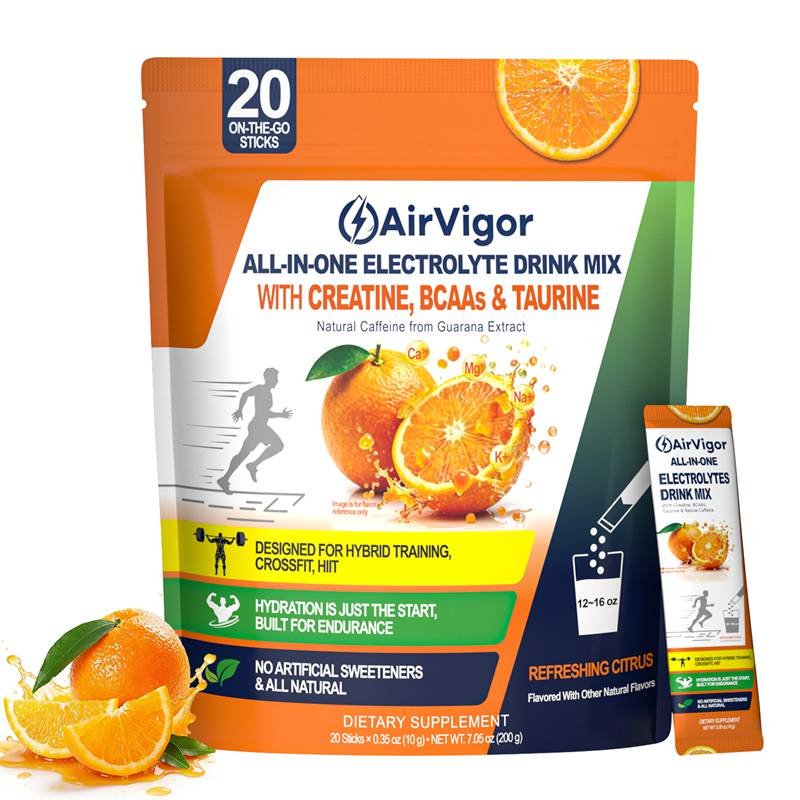
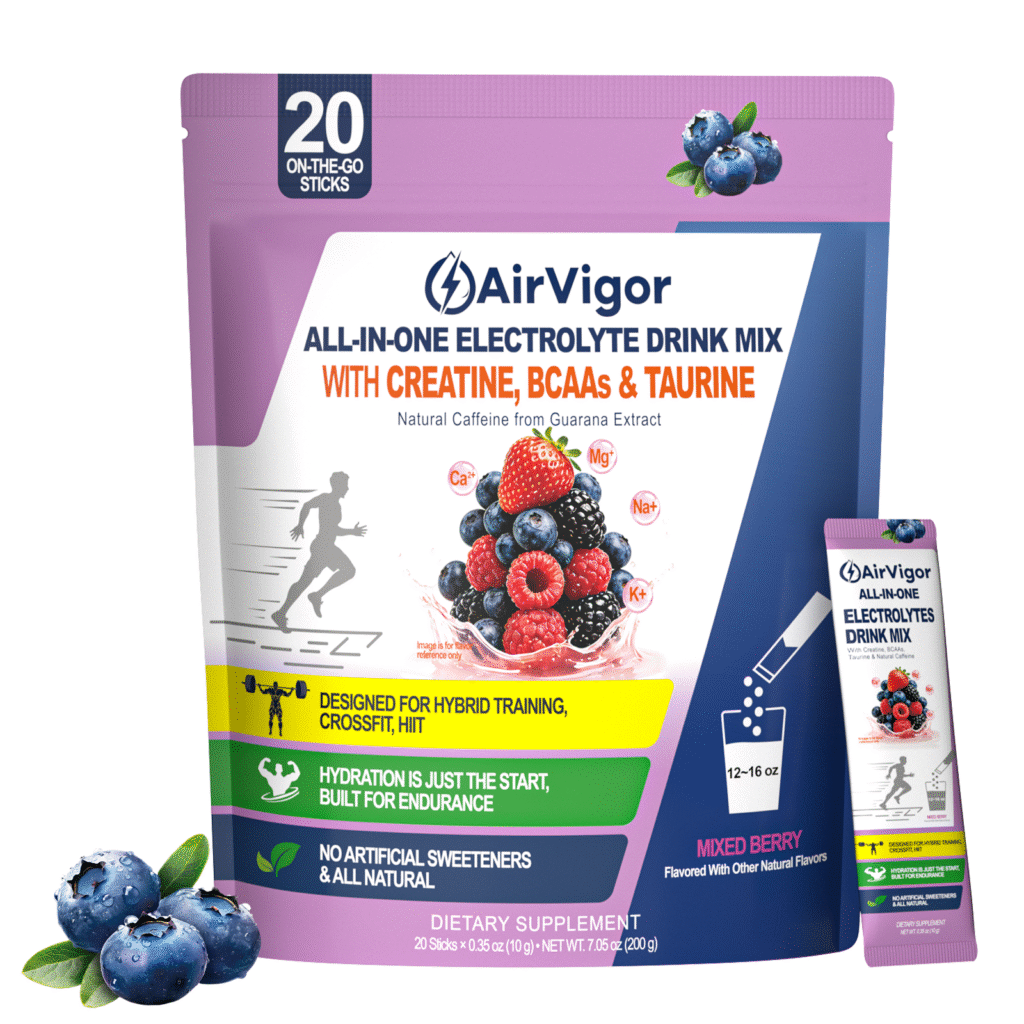
AirVigor’s first product, the Peak Performance Pre-Workout Powder, supports hydration in a training-performance setting. This is not a plain daily hydration formula. It is built for users who are sweating while also asking the body for strength, endurance, focus, and repeat effort in the same session.
Its formula includes:
- electrolytes
- creatine
- taurine
- amino blend
- BCAAs
- citrulline
- guarana extract
This matters because hard mixed training often creates overlapping demands. The user is not just losing fluid. They are also trying to sustain output across multiple rounds, intervals, or strength-endurance blocks.
A practical fit table:
| User need | Why this formula fits |
|---|---|
| Sweat plus high output | Electrolytes support fluid balance |
| Repeated hard rounds | Creatine and taurine support performance demands |
| Mixed aerobic + anaerobic training | Broader than a plain hydration product |
| Users wanting fewer separate supplements | All-in-one convenience |
For customers, this is the right category when the challenge is hydration plus performance, not hydration alone.

How Does Recovery Support Hydration?
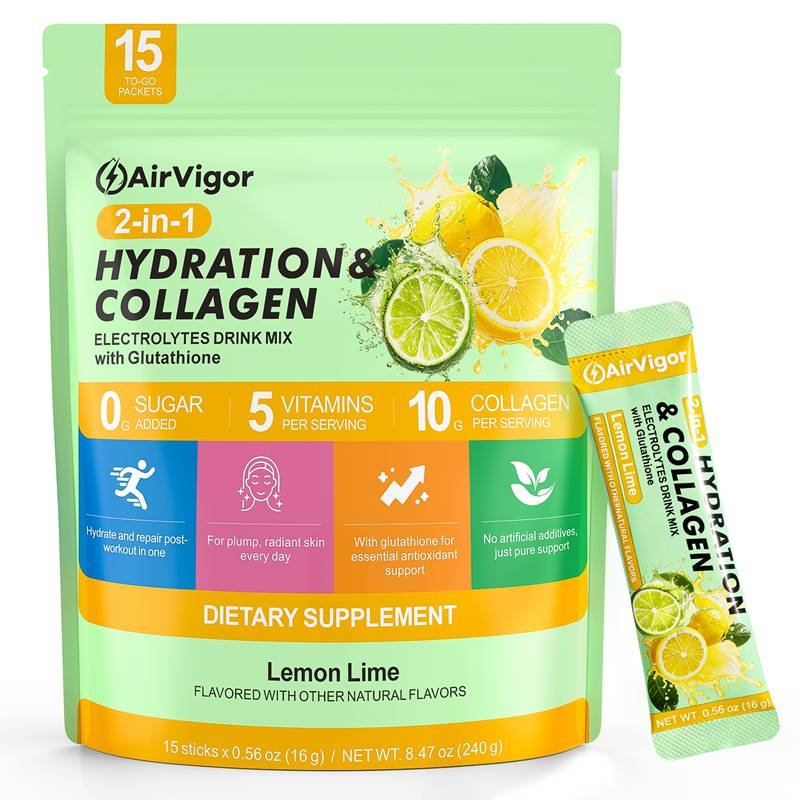
AirVigor’s second product, the All-in-One Sports Recovery & Hydration Formula, supports hydration in the moment when someone feels both thirsty and nutritionally drained after training.
This is a different job from a pre-workout formula. After exercise, many users do not just need fluid. They also need something that helps cover the recovery gap between the workout and the next meal. That is where this product stands out because it combines electrolytes with a collagen protein blend, vitamin C, B vitamins, and other recovery-oriented support.
A practical recovery fit table:
| User need | Why this formula fits |
|---|---|
| Post-workout thirst | Electrolytes support rehydration |
| Post-workout hunger or recovery gap | Protein blend adds nutritional value |
| Users who do not want solid food immediately | Easy liquid format |
| People wanting hydration plus repair support | Broader than plain electrolytes |
For customers, this is the stronger option when hydration is only part of the problem and the body also needs recovery support in the same window.

How Does Daily Electrolyte Support Hydration?
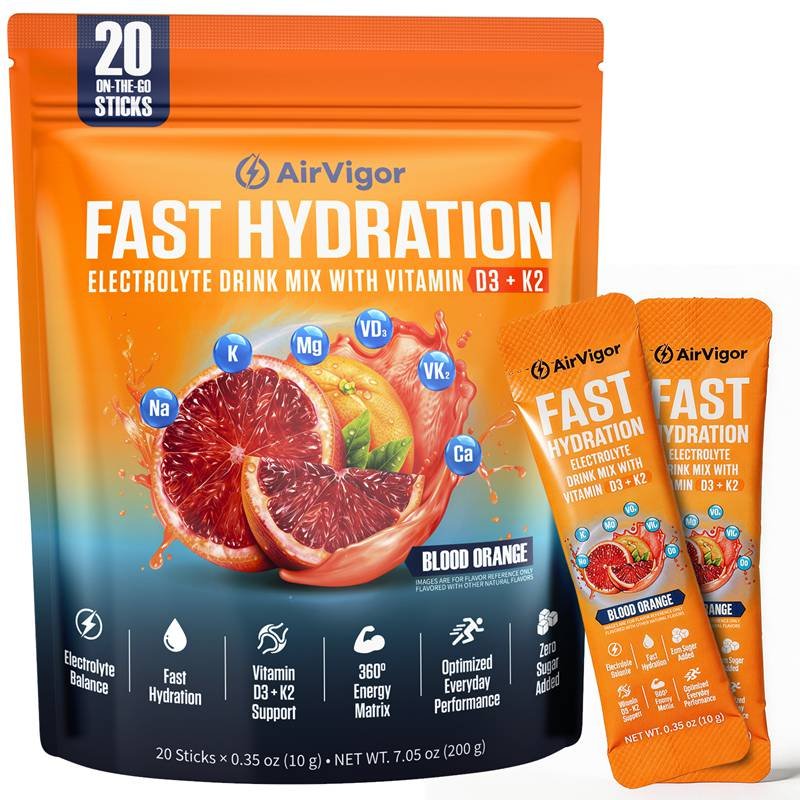
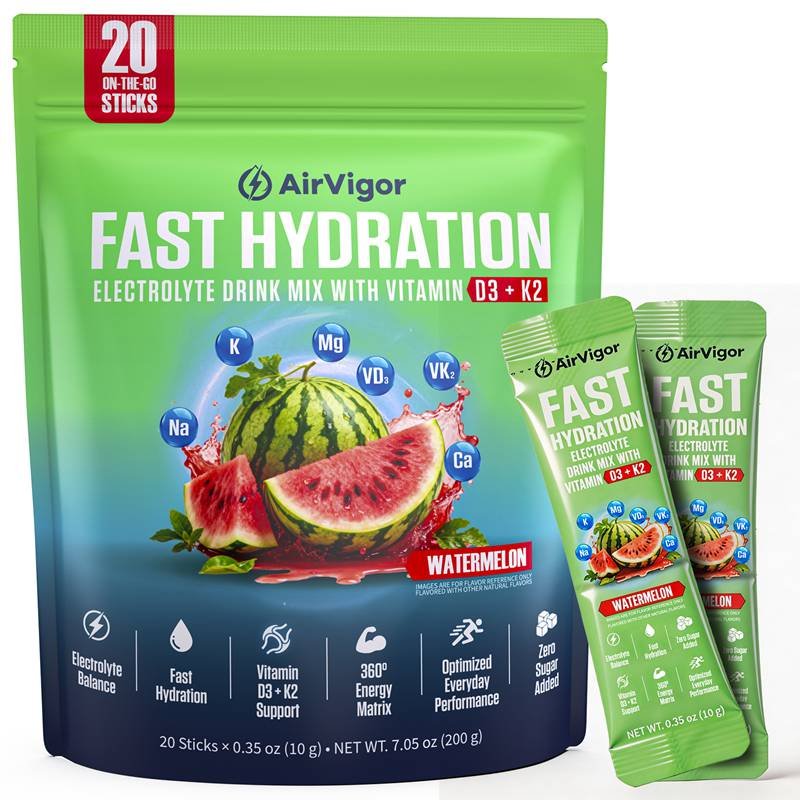
AirVigor’s third product, the Recovery Anti-Fatigue Electrolyte Formula, is the most direct daily hydration-support option of the three. It is the better fit for people who sweat and need electrolyte support, but do not necessarily need stimulants, pre-workout intensity ingredients, or a protein-centered recovery formula.
Its formula centers on:
- sodium
- potassium
- chloride
- calcium
- magnesium
- vitamin D3 + K2
This makes it especially practical for users in everyday high-sweat situations: walking in heat, light-to-moderate exercise, commuting, festivals, hiking, biking, outdoor activity, and general anti-fatigue hydration support.
A practical daily-use table:
| User need | Why this formula fits |
|---|---|
| Everyday sweating | Straightforward electrolyte support |
| Light-to-moderate activity | Broad daily-use practicality |
| Users avoiding stimulant formulas | Simpler hydration focus |
| General anti-fatigue hydration need | More direct than specialty performance formulas |
For customers, this is the most universal hydration option of the three because it fits the broadest range of non-extreme but still meaningful hydration needs.
Which AirVigor Product Fits Your Hydration Goal?
This is where the product decision becomes clear. The best hydration product is not the one with the most ingredients. It is the one that matches the job.
A simple product-choice table helps:
| Your main goal | Best AirVigor fit |
|---|---|
| Hydration plus hard-training performance | Peak Performance Pre-Workout Powder |
| Hydration plus post-workout repair | All-in-One Sports Recovery & Hydration Formula |
| Straightforward daily electrolyte hydration | Recovery Anti-Fatigue Electrolyte Formula |
For customers, the most useful buying rule is this:
- choose the pre-workout formula when the challenge is hard output
- choose the recovery formula when the challenge is thirst plus recovery gap
- choose the daily electrolyte formula when the challenge is simple, ongoing hydration support
That kind of clarity makes hydration easier to understand and much easier to buy correctly.
How Do You Know What Hydration You Need?
The most useful hydration question is not “Should I drink more water?” It is “What kind of hydration support matches what my body is actually losing?” That is a much better way to think because hydration needs are not fixed. They change with sweat rate, climate, activity level, work conditions, food intake, and recovery demands. MedlinePlus continues to list thirst, dry mouth, darker urine, tiredness, dizziness, headache, and muscle cramps as common dehydration signs, while ACSM continues to stress that hydration needs rise with sweat loss, heat, and exercise duration.
That means the same person may not need the same hydration strategy every day. A light desk day may need only regular water intake. A hard mixed-training session may call for electrolytes and performance support. A sweat-heavy workout followed by low appetite may be better served by a recovery formula that covers both fluid replacement and nutritional support. The smarter the fit, the more useful the product tends to feel in real life.
A quick decision table helps simplify the choice:
| Situation | What may fit best |
|---|---|
| Light activity, low sweat loss | Plain water may be enough |
| Heat, heavy sweat, or repeated sessions | Electrolyte support may help more |
| Hard mixed training | Pre-workout hydration-performance support may fit better |
| Post-workout thirst plus nutrition gap | Recovery hydration support may fit better |
For customers, the most practical rule is simple: match hydration support to the kind of loss and strain your day creates.
Who Needs More Than Basic Hydration?
People who need more than basic hydration are usually the ones facing more fluid loss, more sweat loss, or more physical demand than plain casual drinking covers well.
That often includes:
- people are training longer than usual
- people exercising in heat or humidity
- outdoor workers
- frequent travelers
- heavy sweaters
- people who feel wiped out, cramp-prone, or unusually flat after exertion
ACSM continues to point out that sweat rate varies widely between individuals and conditions, and sodium losses vary too. That matters because two people can do the same workout and not need the same hydration product. One may feel fine with water. Another may recover much better with electrolyte support.
A practical fit table makes this clearer:
| User type | Why basic hydration may not be enough |
|---|---|
| Heavy sweaters | Higher fluid and sodium losses |
| Heat-exposed users | Faster fluid loss and greater strain |
| Mixed-training athletes | Sweat plus performance demand |
| Outdoor laborers | Long hours of continuous fluid loss |
| Travelers | Dry air, schedule disruption, inconsistent intake |
For customers, the best test is not whether they “feel athletic enough” to use a hydration product. The better test is whether plain water still leaves them feeling under-recovered, crampy, foggy, or overly drained in demanding conditions.
Who Needs Daily Hydration Support?
Daily hydration support can matter even more than workout hydration for many people, especially those who are not training at a high level but are still mildly underhydrated across the week.
This often includes:
- office workers who forget to drink for long stretches
- people in warm climates
- commuters walking in the heat
- light-to-moderate exercisers
- people who frequently feel afternoon fatigue or low energy
- anyone whose schedule makes regular intake inconsistent
MedlinePlus continues to make clear that dehydration is not only a sports issue. It can result from inadequate fluid intake, heat, illness, or daily-life conditions. That is why some users benefit from a simpler daily electrolyte formula even when they are not doing intense training.
A practical daily-use table helps:
| Situation | Why daily support may help |
|---|---|
| Long desk days | Low fluid awareness and inconsistent intake |
| Daily walking or light training | Repeated low-level sweat loss |
| Warm climate living | Ongoing higher fluid demand |
| Busy schedules | Easier consistency with a structured product |
For customers, daily hydration support usually makes sense when the problem is not a single dramatic sweat event. It is a repeated pattern of small hydration misses that add up over days.
What FAQ About Hydration Matters Most?
These are some of the most useful hydration questions because they directly affect product choice and routine design:
Do I need electrolytes every day?
Not always. It depends on sweat loss, climate, activity level, and whether plain water is already working well.
Is thirst enough to guide hydration?
Helpful, but not enough alone. Urine color, fatigue, headache, dizziness, and cramping matter too.
Can I drink too much plain water?
Yes, balance matters. More is not automatically better if intake does not match electrolyte needs.
Do only athletes need hydration products?
No. Heat, travel, outdoor work, long workdays, and daily sweat can all raise hydration needs.
When is plain water enough?
Often, during low-sweat, low-demand days when intake is consistent, and the body is not under extra heat or exercise strain.
A compact FAQ table helps readers scan faster:
| Question | Practical answer |
|---|---|
| Do I always need electrolytes? | No, only when demand makes them useful |
| Is thirst enough? | No, it is just one signal |
| Is plain water enough sometimes? | Yes, often on lighter days |
| Are hydration products only for sports? | No |
For customers, the value of these questions is simple: they turn hydration from vague wellness advice into a clearer daily decision.
What Should You Check Before Buying Hydration Products?
Before choosing a hydration product, customers should check a few practical factors instead of buying the most complex formula on the shelf.
Start with these questions:
- How much do I actually sweat?
- Is my main issue performance, post-workout fatigue, or everyday low hydration?
- Am I mostly thirsty, or also under-fueled after exercise?
- Do I want a simple daily formula or a broader performance/recovery product?
- Will I use this product consistently enough for it to matter?
A buying checklist table makes this easier:
| What to check | Why it matters |
|---|---|
| Sweat level | Helps determine whether electrolytes matter more |
| Main use case | Prevents buying the wrong category |
| Timing need | Pre-, post-, or daily support changes the best fit |
| Ingredient preference | Helps match stimulant-free vs broader formulas |
| Flavor and convenience | Strongly affects consistency |
For customers, this is where smart purchasing begins. The goal is not to buy the “best” hydration product in the abstract. The goal is to buy the one that best matches your real hydration problem.

Working With AirVigor
Once hydration is understood correctly, product selection becomes much easier. Hydration is not one need and not one formula. Some users need a straightforward daily electrolyte product because they sweat more than usual, live in heat, or feel mildly underhydrated across the week. Some need a pre-workout formula because they want hydration plus performance support during hard mixed training. Some need a post-workout formula because they are not only thirsty — they are also depleted and need broader recovery support. That is why AirVigor’s hydration-related products work better as a system than as three isolated SKUs.
For end users, the practical questions are:
| Question | Why it matters |
|---|---|
| Do I mainly need fluid support, performance support, or recovery support? | Helps choose the right category |
| Do I sweat lightly or heavily? | Changes whether electrolytes matter more |
| Is my challenge daily consistency or workout recovery? | Changes the best formula fit |
| Do I need hydration only, or hydration plus nutrition support? | Helps avoid overlap and under-buying |
For business customers, hydration is also a strong category because the market is much broader than sports alone. Hydration now connects to:
- active-lifestyle users
- office and commuting users
- outdoor workers
- performance-focused athletes
- recovery-focused gym users
- travel and convenience-oriented consumers
That makes hydration one of the best categories for clear segmentation. One formula does not need to do everything. A better strategy is to build or position formulas around distinct needs: performance hydration, recovery hydration, and daily hydration support.
AirVigor is well-positioned to support both finished-product purchasing and custom development. With in-house R&D, testing systems, packaging control, OEM/ODM capabilities, and global supply experience, AirVigor can help build hydration products that are matched to real user behavior and market demand rather than copied from generic trends.
So whether you are:
- ordering AirVigor branded hydration products
- comparing which of the three hydration-related formulas best fits your audience
- building a private-label electrolyte or hydration line
- planning an OEM/ODM hydration formula for a specific customer group
If you want to move from education to action, AirVigor can support both ready-to-order products and custom hydration product development. The best hydration product is not the one that tries to do everything. It is the one that solves the right hydration problem for the right user.