Skip to content

Many people approach NAD-support products as if the only real choice is ingredient strength. In practice, format often decides whether the product becomes part of a routine at all. A liquid sachet can remove pill-swallowing resistance, reduce travel friction, and make a supplement feel easier to use during workdays, commutes, and busy mornings. A capsule can still be the better option for customers who want simplicity, no taste exposure, and a familiar supplement habit. The point is not that one format is universally better. The point is that different formats solve different behavior problems. That matters in the NAD category because the research conversation is already complex: current reviews suggest the stronger human evidence is generally for NAD+ precursors such as NR and NMN rather than broad assumptions about any oral NAD+ product, which makes routine fit and label clarity even more important when customers compare products.
Liquid NAD+ sachets usually make the most sense for people who dislike pills, want a more portable and single-use daily format, or need a supplement that is easier to remember and easier to keep using. They can be especially relevant for busy professionals, frequent travelers, NAD+ beginners, and customers who prefer a simpler, pill-free routine. Capsules often remain a better fit for people who already follow a stable supplement habit and want minimal taste involvement.
This distinction matters because daily adherence is often the hidden difference between a supplement that looks promising and one that actually gets used. A format that reduces resistance can create more practical value than one that sounds more technical but does not fit real life. Once the question shifts from “Which one sounds stronger?” to “Which one am I actually likely to keep taking?” the sachet format becomes much easier to evaluate.
What Makes Liquid NAD+ Sachets Different?
Liquid NAD+ sachets differ not only because they are liquid, but because they combine a pill-free format with single-use packaging. That changes convenience, portion control, portability, and routine friction. Compared with capsules or bottled drops, sachets often feel easier to carry, easier to dose, and easier to integrate into work, travel, and daily-use situations where consistency matters.
What is a liquid NAD+ sachet format?
A liquid sachet format usually means one sealed single-use portion of product, taken directly or used in a simple daily routine without measuring from a larger bottle. From a practical standpoint, this format gives the customer something closer to a pre-portioned daily serving than a conventional supplement bottle. FDA supplement labeling rules explicitly recognize “packets” as an appropriate serving-size expression for dietary supplements, which is relevant because sachets are fundamentally a packet-based delivery system rather than a scoop-based or bottle-drop system.
This matters because packaging format affects how people actually behave. A bottle may require measuring, a dropper may require more handling, and a capsule bottle may require remembering to bring the right number of capsules. A sachet reduces some of that friction by turning the daily portion into a single-use unit. That can be especially useful for customers who want a product that feels organized and self-contained rather than something they have to portion themselves. In other words, the sachet changes the routine before it changes anything else.
A practical comparison helps clarify the difference:
| Format | What the customer usually manages | Routine effect |
|---|---|---|
| Sachet | One pre-portioned unit | Lower measuring friction |
| Capsules | One or more pills | Familiar but pill-dependent |
| Bottled liquid | Dropper or poured amount | More flexible, but less self-contained |
The key advantage is not that sachets are automatically more advanced. It is that they make portioning and carrying simpler for a certain kind of user.
How is a sachet different from capsules or bottled drops?
Compared with capsules, sachets remove the need to swallow a pill. Compared with bottled drops, they remove most measuring and handling steps. Those two differences may seem small, but they directly affect convenience, cleanliness, and consistency. Research on pill aversion in adults shows that difficulty swallowing tablets and capsules is common enough to affect adherence, and related work has found that a substantial share of adults report difficulty swallowing pills whole. That makes a pill-free format more than a cosmetic alternative. For some users, it solves a real barrier.
Bottled drops create a different issue: they can be flexible, but they often require more handling, more measuring, and more routine attention. A sachet format is usually more controlled. The customer does not need to count drops, estimate teaspoons, or worry about whether they used more or less than intended. That can make the product feel easier to trust and easier to repeat, particularly for customers who want supplement use to feel simple rather than technical.
A direct comparison makes this clearer:
| Comparison point | Sachets | Capsules | Bottled drops |
|---|---|---|---|
| Pill-free | Yes | No | Yes |
| Pre-portioned | Yes | Yes | Less often |
| Measuring needed | No | No | Often yes |
| Taste exposure | Yes | No | Yes |
| Travel handling | Simple | Simple | More variable |
This is why sachets appeal most strongly to customers who want convenience without adding measurement steps back into the routine.
Why does single-serve packaging change the user experience?
Single-serve packaging changes the user experience because it reduces decision-making. The customer does not have to ask how much to take, whether the bottle leaked, whether the dropper stayed clean, or whether they already used their serving that day. In practical supplement use, small reductions in routine friction often matter more than brands expect. Research and review literature on pill aversion and medication-taking behavior support the broader idea that format-related discomfort and inconvenience can reduce consistency even when the user wants the benefit.
That is one reason single-serve formats often feel more suitable for:
- work bags and laptop bags
- airport carry-on use
- hotel stays
- desk-drawer routines
- busy mornings with limited attention
A customer who is already managing meetings, commuting, training, or childcare may respond better to a format that feels nearly frictionless. That does not make sachets universally superior, but it does explain why they can feel disproportionately convenient compared with formats that require either swallowing or measuring. In commercial terms, single-serve packaging often shifts the product from “supplement I should remember” to “supplement that is already ready.”
A useful routine comparison:
| Daily-use pressure point | Why single-serve sachets can help |
|---|---|
| Forgetting the serving | One visible daily unit |
| Travel inconvenience | Easier grab-and-go use |
| Measuring resistance | No portion calculation |
| Pill fatigue | Removes pill step entirely |
That change in experience is one of the strongest reasons the sachet format deserves its own comparison, rather than being grouped loosely with all other liquid products.
Who Is Most Likely to Benefit From Liquid NAD+ Sachets?
Liquid NAD+ sachets are often best suited to people who want lower routine friction, dislike capsules, travel frequently, or are new to NAD-support products and want a format that feels easier to adopt. They are especially relevant when convenience, portability, and consistency are likely to matter more than a traditional pill routine.
Who should choose liquid NAD+ instead of capsules?
The customers most likely to benefit from a liquid sachet are not necessarily the ones asking for the most technical product. They are often the ones who need a product that actually fits how they live. That includes people whose routines are fragmented, fast-moving, or already crowded with other supplement behaviors. Capsules may still work well for highly structured users, but sachets often make more sense for customers who need a more adaptable format.
In practical terms, liquid sachets often fit better for:
- busy professionals with unpredictable mornings
- frequent travelers
- NAD+ beginners who want an easier starting point
- people who dislike pills
- customers who want a more portable daily-use format
- users who value single-serve convenience over bottle-based dosing
This matters because many customers do not fail with supplements because they reject the idea of supplementation. They fail because the format adds just enough resistance to make consistency unstable. A sachet can remove one or more of those friction points at once. That is especially valuable in categories like NAD support, where customer interest is often high but scientific understanding is mixed enough that label clarity and routine consistency become even more important.
A practical fit table helps:
| Customer type | Why liquid sachets may fit better |
|---|---|
| Busy workday user | Easier to integrate into changing schedules |
| Frequent traveler | Portable and pre-portioned |
| Beginner to NAD-support products | Lower format friction |
| Pill-averse user | Removes capsule barrier |
| Existing pill-heavy supplement user | Offers a different routine experience |
This does not mean sachets are automatically superior. It means they solve a specific set of routine problems very well.
Are liquid sachets better for people who dislike pills?
For many of these users, yes. Pill aversion is a real and documented issue, not a minor preference. Reviews on pill aversion in adults without structural swallowing disorders describe it as a meaningful obstacle to medication and supplement use, and survey-based work has found that many adults report difficulty swallowing tablets or capsules whole. That means a liquid sachet can provide more than convenience. It can remove the main reason the routine fails.
The customers most likely to feel this advantage are often those who:
- delay taking capsules
- need water and preparation to feel comfortable swallowing pills
- avoid larger capsules
- already feel fatigue from multiple daily supplements
- stop using products they technically “like” because the format itself is irritating
A sachet usually reduces these problems by replacing swallowing with direct use. That does not eliminate all friction, because liquids can introduce taste preferences, but it often shifts the routine from resistance to usability. For many customers, that is enough to improve adherence more than any format-based “absorption” promise.
A simple comparison shows the tradeoff:
| Friction source | Liquid sachets | Capsules |
|---|---|---|
| Swallowing discomfort | Lower | Higher |
| Taste exposure | Higher | Lower |
| Format anxiety | Lower for pill-averse users | Higher for pill-averse users |
| Existing supplement familiarity | Lower | Higher |
That is why pill-disliking customers are one of the clearest target groups for sachets.
Which routines fit sachets best: work, travel, or busy mornings?
Sachets usually fit best where convenience and portability matter repeatedly rather than occasionally. That includes work routines, travel days, commutes, hotel stays, and mornings where a customer wants a fast, contained supplement step rather than a bottle, scoop, or pill organizer. The relevance of this convenience factor should not be underestimated. In real-world supplement behavior, small frictions often accumulate into missed days, inconsistent use, and eventual abandonment.
A sachet format often works especially well in the following routines:
| Routine type | Why sachets are often a strong fit |
|---|---|
| Busy mornings | Lower preparation friction |
| Office use | Easy desk-drawer storage |
| Travel days | Portable and pre-portioned |
| Hotel stays | No measuring equipment needed |
| Commuting | Easy grab-and-go use |
This is one reason sachets are often better understood as a behavior-friendly format than as just another liquid. They fit routines where the customer wants one decision already made for them: today’s serving is already portioned, already packed, and already ready to use. That clarity can make a real difference over a 15-day or 30-day routine, especially for customers who do not want a supplement protocol to feel like a project.
How Do Convenience and Consistency Affect the Choice?
Convenience and consistency are not secondary issues in the NAD-support category. They are often the reason one product becomes part of a long-term routine while another remains a short trial. A liquid sachet format can be especially useful when the customer wants a product that is easier to remember, easier to carry, and easier to use without the friction of capsules, droppers, or measuring steps. Research on medication and supplement behavior consistently shows that practical barriers such as swallowing difficulty, routine burden, and product format can affect adherence significantly.
Does a liquid format make daily use easier?
For many customers, yes. A liquid sachet can reduce several forms of routine friction at the same time. It removes the need to swallow a capsule, avoids measuring from a bottle, and gives the customer a pre-portioned serving that feels ready to use. That may sound simple, but in real life those small differences often decide whether a supplement remains in use after the first week. Studies on adherence barriers show that convenience and user burden affect whether people continue taking products over time. Pill aversion research also supports the idea that difficulty swallowing capsules is common enough to interfere with regular use.
A liquid sachet is often easier to use in situations such as:
- early mornings when time is limited
- workdays with an inconsistent schedule
- travel days with fewer routine anchors
- desk-based routines where a single visible serving helps memory
- multi-supplement routines where adding one more capsule feels burdensome
This does not mean the liquid format is automatically easier for every person. Some people strongly prefer pill-based simplicity and do not want taste exposure at all. But for customers who have already struggled with capsule adherence, the liquid format often has a real behavioral advantage. In that sense, the format can influence outcomes indirectly by improving routine consistency, even before any discussion of active ingredient performance begins.
A practical comparison shows why:
| Daily-use issue | Why liquid sachets may help |
|---|---|
| Forgetting the serving | One visible single-use packet is easier to track |
| Disliking pills | Removes capsule-swallowing resistance |
| Measuring fatigue | No scoops or droppers required |
| Changing schedule | Easier to carry and use anywhere |
| Overcomplicated supplement stack | Feels simpler and more self-contained |
This is one reason format should not be treated as cosmetic. For some users, it is the difference between a supplement they mean to take and one they actually take.
How do taste, portability, and routine friction change compliance?
These three factors usually have more influence than customers expect.
Taste matters because a liquid product creates a direct sensory experience every time it is used. If the formula tastes too harsh, too sweet, too artificial, or develops flavor fatigue quickly, consistency can drop even if the customer likes the concept of the product.
Portability matters because many supplement routines break down outside the home. A product may work well in theory but become inconvenient in airports, offices, hotel rooms, or commutes. Single-use sachets usually perform well here because they reduce packing complexity and eliminate the need for a bottle, scoop, or multiple capsules.
Routine friction matters because the most successful products are often the ones that ask the least from the user. In adherence research, even small repeated inconveniences can reduce long-term follow-through. That makes format a practical commercial variable, not just a packaging choice.
A useful comparison table:
| Compliance factor | Sachets | Capsules | Bottled liquid |
|---|---|---|---|
| Taste burden | Moderate | Low | Moderate |
| Portability | High | High | Moderate |
| Measuring needed | No | No | Often yes |
| Swallowing barrier | None | Present for some users | None |
| Visibility in daily routine | High | Moderate | Moderate |
This helps explain why some customers stay more consistent with sachets even when they have previously abandoned both capsules and larger bottled liquids. The single-use structure reduces friction in several places at once.
Why do some people stay more consistent with sachets?
Sachets often support consistency because they simplify the daily decision. The product is already portioned, already portable, and already framed as one clear serving. That reduces the number of decisions the customer has to make:
- how much to take
- whether to carry the bottle
- whether to bring multiple capsules
- whether the serving was already used that day
- whether the routine feels too complicated to continue
This matters especially for people whose interest in NAD-support products is high, but whose routines are unstable. That includes busy professionals, frequent travelers, new supplement users, and people who want a more lifestyle-friendly product rather than a highly clinical-feeling regimen. Research on adherence and patient preference supports the broader principle that simpler regimens tend to support better follow-through.
A practical fit table makes this clear:
| User pattern | Why sachets may support better consistency |
|---|---|
| Busy mornings | Lower preparation burden |
| Frequent travel | Easy pack-and-go use |
| New to supplementation | Feels less intimidating |
| Pill-averse | Removes main resistance point |
| Inconsistent routine | Single visible serving helps repetition |
That is one of the strongest arguments for sachet formats. Their value is not only that they are liquid. Their value is that they reduce daily friction in a way many customers can actually feel.
What Should You Check on the Label Before Choosing?
The first things to check are the active ingredient type, the amount delivered per serving, the serving format, and the role of supporting ingredients. In the NAD-support category, format is often overemphasized while label reading is underemphasized. A sachet can feel convenient, but the product still needs a clear active strategy. Current reviews suggest the strongest human supplementation literature is more developed for NAD+ precursors such as NR and NMN than for broad oral NAD+ claims alone, which makes label reading especially important.
Does the product contain direct NAD+ or NAD+ precursors?
This is usually the first serious label question.
A customer should determine whether the product contains:
- direct NAD+
- a precursor such as NR or NMN
- a combination formula
- broad “NAD complex” wording without clear specificity
This matters because the scientific discussion around NAD-support products is not equally strong for every approach. Reviews in recent years repeatedly note that the human evidence base is generally clearer for precursor supplementation strategies than for simple assumptions about direct oral NAD+ itself. That does not mean every direct NAD+ product is invalid. It means the label deserves closer reading and more careful interpretation.
A practical interpretation table helps:
| Label wording | What it often means for comparison |
|---|---|
| NAD+ only | Requires more cautious interpretation |
| NR clearly listed | Stronger connection to current human literature |
| NMN clearly listed | Also relevant to current NAD-support literature |
| NAD complex | Needs closer scrutiny of the actual actives |
This is why customers should not rely only on product names. In this category, the front-facing “NAD+” language may not tell the full formula story. The active line matters more.
How do you read serving size, dose, and support ingredients?
After identifying the main active, the next step is to understand what one real serving delivers. This includes:
- serving size
- number of servings per box or bottle
- dose per serving
- whether the serving is one sachet, multiple capsules, or a measured liquid amount
- what support ingredients are included and why
This matters because customers often compare products by front-label identity rather than by usable daily structure. A sachet-based product may provide one self-contained serving. A capsule product may require two or more capsules per day. A bottled liquid may require measuring several milliliters. Those differences directly affect both comparison and adherence. FDA supplement labeling rules require serving size and “other dietary ingredients” to be presented clearly in the Supplement Facts format, which helps customers compare daily use more accurately when they actually read the panel.
A practical comparison framework:
| Label element | Why it matters |
|---|---|
| Serving size | Tells you what all numbers are based on |
| Active dose per serving | Shows real delivery, not just title wording |
| Servings per container | Helps estimate routine duration and value |
| Support ingredients | Shows whether the formula is narrow or broader in design |
Support ingredients can be useful when they clearly deepen the formula. They become less useful when they distract from a weak or unclear primary active. That is why customers should always read the core active first, then decide whether the rest of the blend adds meaningful context or just marketing decoration.
Which claims should customers verify before buying?
Certain claims should always be checked directly against the label because they strongly shape buying expectations. These include:
- better absorption
- liposomal delivery
- advanced NAD support
- energy and focus support
- daily vitality
- clean formula
- all-in-one blend
- high strength
Each of these claims can sound persuasive, but they only become meaningful if the label provides the right context.
A practical verification table helps:
| Claim | What the customer should verify |
|---|---|
| Better absorption | Clear active ingredient and dose |
| Liposomal delivery | Whether the rest of the formula is still clearly explained |
| Energy support | Whether the actives support that positioning credibly |
| All-in-one | Whether the blend is focused or overcrowded |
| High strength | Whether the serving size and active dose justify it |
This is especially important in NAD-support products because the category is highly vulnerable to overstatement. A product can sound scientifically advanced while still being vague about what it actually provides. Customers who verify these claims on the panel usually make more stable purchasing decisions.

How Do You Know if Liquid NAD+ Sachets Fit Your Routine?
The right format usually becomes clear when the customer stops asking which delivery system sounds more advanced and starts asking which one actually fits daily life. Liquid NAD+ sachets are usually a better match when portability, pill-free use, and lower routine friction matter more than a traditional supplement experience. Capsules often remain the better fit for people who already follow a structured pill routine and want minimal taste involvement. The strongest decision is usually the one that reduces resistance and supports steady use over time.
Which people should start with sachets first?
Liquid NAD+ sachets usually make the most sense for customers whose routines are busy, inconsistent, or easily disrupted. In these situations, ease of use is not a small detail. It is often the difference between a product that becomes part of a routine and a product that stays half-used in a drawer.
The sachet format is often a strong fit for:
- people who dislike swallowing capsules
- professionals with long workdays and changing schedules
- frequent travelers
- customers new to the NAD-support category
- users who want a product that feels simpler and less clinical
- people who prefer a single-use, ready-to-take format
This is especially relevant because many customers do not fail with supplements because they reject the idea of supplementation. They fail because the format introduces too much friction. A product that requires multiple capsules, a bottle, a dropper, or repeated measuring may be scientifically acceptable and still perform poorly in real life because the user does not want to keep dealing with the routine burden.
A practical comparison helps:
| Customer Profile | Why Sachets Often Fit Better |
|---|---|
| Busy office worker | Easy to keep at a desk or in a bag |
| Frequent traveler | Single-use portability without measuring |
| NAD+ beginner | Lower routine friction and easier adoption |
| Pill-averse user | Removes the capsule-swallowing barrier |
| Lifestyle-oriented supplement user | Feels simpler and more approachable |
This is one of the clearest reasons to choose sachets first. They are often better suited to people who want a supplement to fit their day without demanding too much structure.
What routines are a poor fit for capsules but a good fit for liquids?
Capsules work well in many cases, but they are often a weak fit when the routine is unstable or when supplement use competes with other daily demands.
Capsules tend to perform less well when the user:
- forgets multi-step routines easily
- already feels overwhelmed by multiple daily pills
- dislikes large capsules
- needs something convenient during work or travel
- wants a format that can be used quickly without water or pill organizers
- wants a supplement that feels easier to continue over 15 to 30 days
In contrast, sachets usually fit well in routines such as:
- early work mornings
- commute-based schedules
- airport and hotel use
- conference or business travel
- high-brain-work days with limited routine flexibility
- desk-drawer daily wellness habits
A useful comparison table makes this clearer:
| Routine Situation | Why Capsules May Fit Poorly | Why Sachets May Fit Better |
|---|---|---|
| Busy morning | Easy to forget or postpone | Fast, visible, single-use format |
| Travel day | Capsules are portable but can still feel like “one more pill” | Easier grab-and-go use |
| Workday use | Less lifestyle-friendly for some users | Fits desk and bag routines well |
| Supplement fatigue | Adds to pill burden | Feels like a different, lighter ritual |
| Inconsistent schedule | Pill timing may break down | Easier to use when routine shifts |
This is why sachets are often not simply a “liquid version” of a capsule product. They solve a different behavioral problem. For some customers, that difference matters more than small differences in technical positioning.
How do more complete liquid formulas stand out?
In the NAD-support category, a useful liquid sachet product usually does more than remove the capsule. The stronger products combine a convenient format with a clearer formula structure and a more believable daily-use role.
Customers increasingly compare products by asking:
- Does the label clearly explain the active strategy?
- Is the serving size realistic?
- Does the formula feel focused or overloaded?
- Is it built for daily use or only designed to look advanced?
- Will I understand why I am taking it after the first few days?
That is why more complete liquid formulas usually stand out through:
- a clearly stated primary active or active combination
- a practical single-use serving format
- support ingredients that make sense for the positioning
- a formula structure that feels focused rather than crowded
- a user experience that supports consistency instead of novelty alone
A practical comparison helps:
| What Customers Want | What a More Complete Sachet Formula Usually Provides |
|---|---|
| Easier compliance | Portable, single-use daily format |
| Better understanding | Clear serving and active logic |
| More than one-dimensional positioning | Support ingredients with a clear role |
| Better routine fit | Work, travel, and daily-use convenience |
| More confidence before purchase | Cleaner, easier-to-read formula story |
This is where liquid sachets become much more than a packaging choice. They become a format that can support clarity, routine fit, and lower user resistance at the same time.
Final Thoughts
Liquid NAD+ sachets are not meant for everyone. They are usually the strongest fit for people who want a more convenient, pill-free, portable, and routine-friendly format. Capsules still make sense for users who prefer a traditional supplement structure, dislike flavored products, and already follow a stable pill routine.
The more useful decision is not:
- which one sounds more advanced
It is:
- which one is more realistic for the way I actually live
That means the best candidates for sachets are usually the people who value:
- easy daily use
- lower routine friction
- portability
- single-use convenience
- a format that feels more approachable than capsules
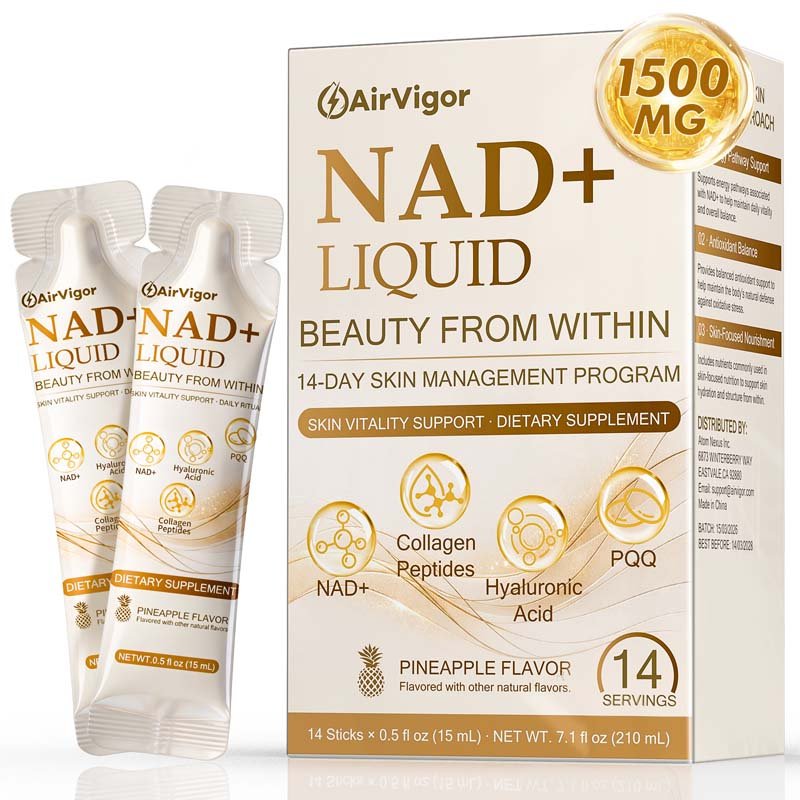
At this stage, a product such as AirVigor’s berry-flavored liposomal liquid NAD+ sachets fits naturally into this discussion because it is positioned specifically around busy adults, daily energy metabolism, focus, and vitality support, 15 portable liquid sachets, and a transparent formula structure built around NAD+ and NR rather than a vague high-dose story. It is also clearly framed as a more convenient, easier-to-maintain liquid sachet routine rather than a standard capsule experience.
Looking to Source or Customize a More Practical NAD+ Sachet Product?
If you are:
- comparing liquid NAD+ sachets with capsules
- looking for a finished NAD-support product
- building a more convenient daily-use format
- developing a product for Amazon, Walmart, Shopify, or other channels
- exploring OEM or ODM opportunities for a portable liquid NAD+ concept
Then a format like AirVigor’s liposomal liquid sachet approach is especially relevant because it combines single-serve convenience, portable daily-use packaging, a berry-flavored liquid format, and a formula positioned around daily energy, focus, and vitality support for busy adults. It is also intentionally differentiated from ordinary capsule formats through liquid sachet convenience, transparent formula logic, and easier routine adherence.
For both finished-product sourcing and custom development, that kind of structure gives the category a clearer commercial direction: not just another NAD+ product, but a format that is easier to explain, easier to position, and easier for customers to keep using consistently.