Skip to content
How Does Creatine Affect ATP Production in the Body?
# Your Trusted Dietary Supplement Brand In US
- Emily

Table of Contents
Most people think “energy” means caffeine, calories, or motivation. But if you train—even a little—you’ve probably felt a different kind of energy problem: you’re mentally ready, your technique feels solid, yet your body suddenly loses its pop. The bar slows down. Sprint speed drops. Your “second round” of intervals feels like it’s happening on a different planet. That moment isn’t about hype. It’s almost always about ATP availability—how much immediate fuel your muscles can access right now and how fast they can recycle ATP when demand spikes.
ATP (adenosine triphosphate) is the body’s instant “spendable” energy. The catch is brutal: your muscles store only a small amount. So performance doesn’t depend on how much ATP you have—it depends on how fast you can regenerate ATP from ADP under stress. That’s where creatine earns its reputation. Creatine is not a stimulant, not a hormone, and not a shortcut. It’s a cellular energy buffer that helps your body restore ATP quickly during short, high-intensity efforts—exactly the moments where performance is decided.
Creatine affects ATP production indirectly by increasing phosphocreatine in muscle. Phosphocreatine rapidly donates a phosphate to ADP to regenerate ATP during short, intense efforts. ATP does not require creatine to function, but creatine improves ATP availability when energy demand exceeds mitochondrial supply. Over time, supplementation can support higher training volume, better repeated-burst power, and faster between-set recovery—especially for strength, sprint, and HIIT training.
Here’s the story that keeps showing up in gyms: two people follow the same program. Same exercises, same rest, same effort. One stays sharp deep into the session. The other fades early and starts “surviving” sets instead of owning them. The difference is often not mindset—it’s energy recycling capacity. Let’s break down what ATP really is, where creatine fits, what it changes (and what it doesn’t), and how to use it in a way that actually helps you train better—week after week.
What Is ATP and Energy?
ATP is the body’s immediate energy currency. It powers muscle contraction, nerve signaling, and cellular work. Because stored ATP is limited, performance depends on how quickly ATP can be regenerated from ADP. Creatine isn’t required for ATP to exist, but it helps recycle ATP rapidly during short, intense efforts when energy demand rises faster than mitochondria can supply ATP.
What does ATP actually do?
ATP is the molecule your muscles “spend” to contract. When ATP is broken down (ATP → ADP + phosphate), energy is released and the muscle fiber can do work. This is not a metaphor—it’s a real biochemical transaction happening at high speed when you lift, sprint, jump, or grind through a hard set.
What surprises most people: ATP doesn’t last long. Your body keeps only a small, ready-to-use amount in muscle. That’s why a true all-out effort feels powerful for a few seconds and then quickly becomes challenging. Your performance is limited less by “running out of fuel” and more by how fast you can reload ATP.
ATP also supports:
- Nerve signaling (muscle recruitment, coordination)
- Ion pumps (sodium/potassium balance that keeps muscle firing)
- Cellular repair and transport (especially during recovery)
So ATP is not only “workout energy.” It’s your body’s universal energy currency.
Does ATP need creatine to work?
No. ATP works without creatine. Every human produces ATP continuously through multiple pathways:
- oxidative metabolism (mitochondria)
- glycolysis (breaking down glucose)
- the phosphocreatine system (ATP recycling)
Creatine is not required for ATP to exist. You could remove creatine supplementation and still make ATP.
But here’s the more useful answer for athletes: ATP does not need creatine, but high-power performance often benefits from creatine. Why? Because during max effort, you don’t have time to wait for slower ATP production. You need instant recycling. Creatine supports that instant recycling pathway.
Think of it like this:
- Mitochondria are a strong “engine” for steady energy.
- Creatine is a fast “battery buffer” for power spikes.
Where is ATP consumed fastest?
ATP consumption is highest during efforts that are:
- high intensity
- short duration
- high power
- repeatable with short rests
Examples:
- heavy sets (1–8 reps)
- sprint starts and accelerations
- repeated jumps
- HIIT intervals with short recovery
- CrossFit-style repeated bursts
That’s why people who train “hard and fast” tend to notice creatine more than people who only do easy steady-state cardio.
| Training Style | Effort Pattern | ATP Use Rate | Why It Matters |
|---|---|---|---|
| Heavy lifting (1–8 reps) | explosive + short | Very high | ATP depletes quickly; rapid recycling helps |
| Sprinting / jumping | max power | Very high | ATP-PC dominates early; repeatability matters |
| HIIT / circuits | burst + short rest | High | faster ATP recycling improves round-to-round output |
| Steady cardio | moderate + long | Moderate | mitochondria dominate; creatine less dramatic |
What Is Creatine Exactly?
Creatine is a naturally occurring compound stored mostly in muscle as free creatine and phosphocreatine. Its key performance role is supporting rapid ATP recycling during short, intense exercise. You obtain creatine from internal synthesis and foods like meat and fish, but supplementation can raise muscle creatine stores above typical baseline and improve repeated-burst performance.
What is creatine made from?
Creatine is synthesized in the body using amino acids (primarily glycine and arginine, with methionine involved in the process). It’s also found in animal foods. People who eat little or no meat often start with lower creatine stores—which can make supplementation effects more noticeable.
But “naturally produced” doesn’t mean “fully optimized for training.” If you train hard, your demand for rapid ATP recycling is high. Supplementation helps because it raises creatine availability in the exact tissue that uses it most—skeletal muscle.
Where is creatine stored in the body?
Roughly 95% of creatine is stored in skeletal muscle. Inside muscle, creatine exists as:
- Free creatine
- Phosphocreatine (PCr)
Phosphocreatine is the “charged” form that’s ready to donate a phosphate to help regenerate ATP. In practical terms, phosphocreatine is what helps you keep power output high when you’re pushing near max.
Creatine is also present in the brain and other tissues. That’s why some users ask about “creatine and mental energy,” though the strongest sports evidence remains in muscle performance.
Why is creatine linked to ATP?
Because creatine directly supports the fastest ATP recycling system you have: the ATP-PC (phosphagen) system.
When ATP breaks down to ADP during intense effort, phosphocreatine helps convert ADP back into ATP quickly. That’s why creatine is popular among:
- lifters
- sprinters
- CrossFit/HIIT athletes
- team sports players
- anyone who depends on repeated bursts
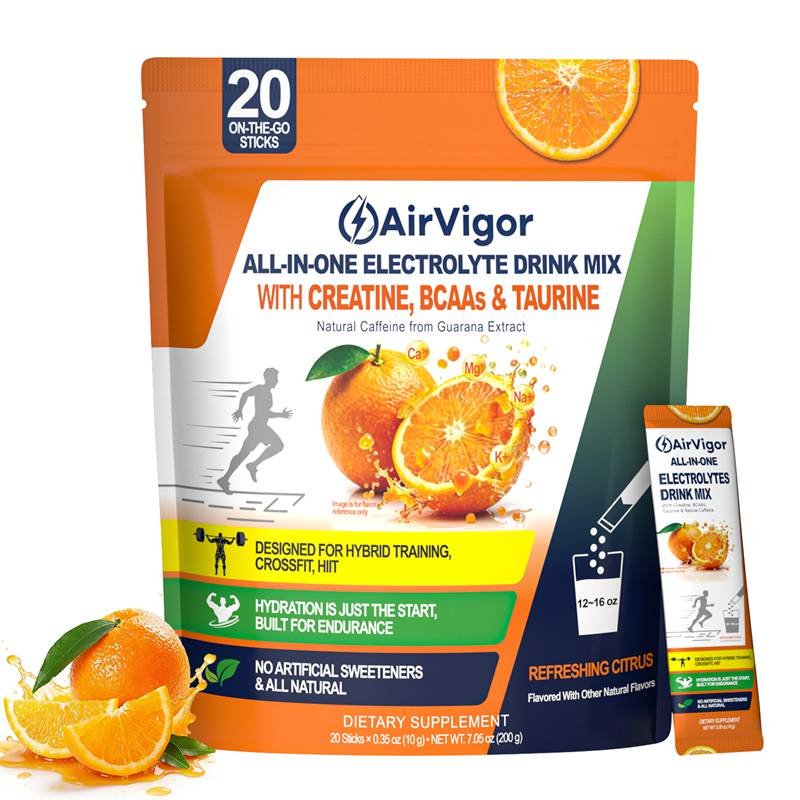
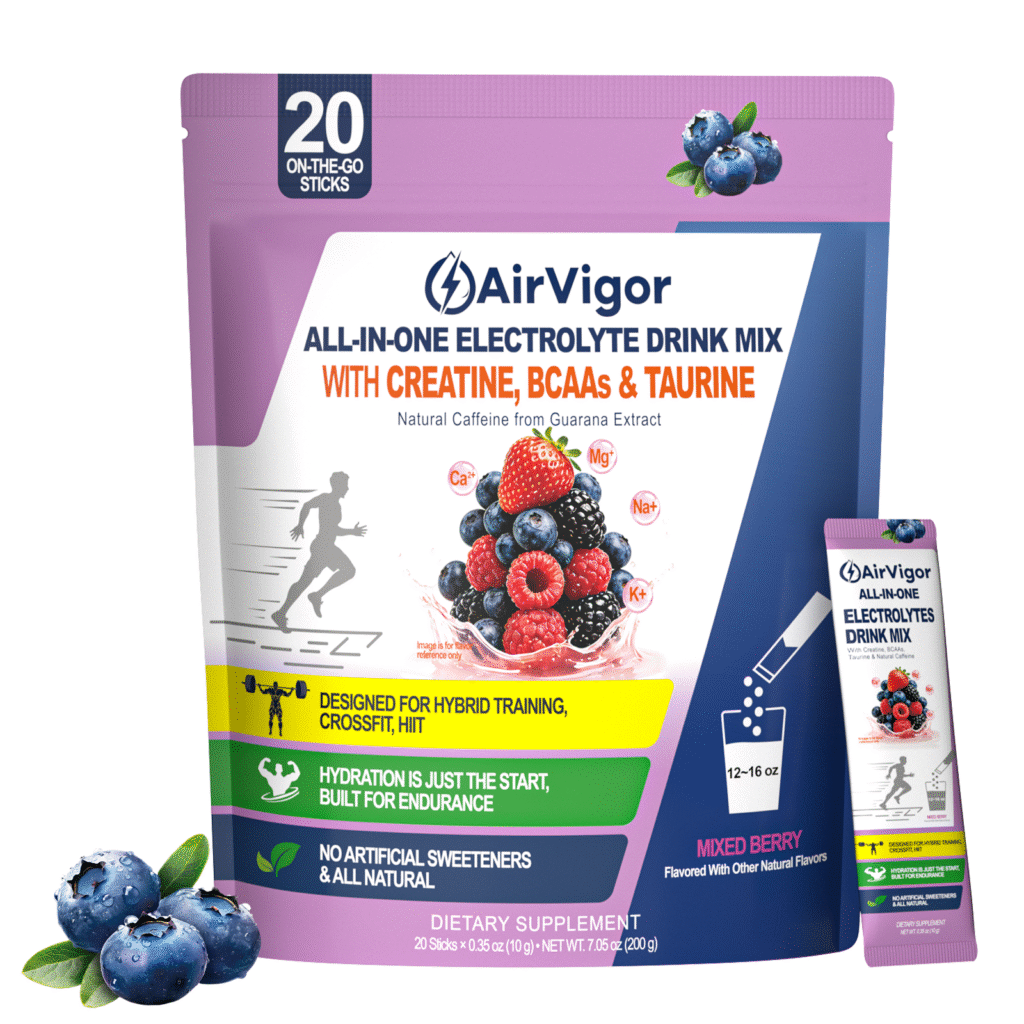
Where AirVigor fits naturally: AirVigor is built for performance-focused users. Creatine is one of the simplest, most evidence-backed ways to support repeatable training output—especially when paired with hydration support (electrolytes) and recovery nutrition (protein).
| Supplement Type | Feels Like | Primary Role | Best Use |
|---|---|---|---|
| Caffeine / stimulants | immediate “kick” | nervous system stimulation | acute alertness, pre-workout |
| Carbs | steady fuel | glycolysis + endurance fuel | long sessions, high volume |
| Creatine | subtle, cumulative | ATP recycling capacity | strength, power, repeated bursts |
| Electrolytes | stability | hydration + muscle signaling | sweat, heat, long sessions |
How Does Creatine Support ATP?
Creatine supports ATP availability by increasing phosphocreatine stores in muscle. Phosphocreatine rapidly donates a phosphate to ADP to regenerate ATP during high-intensity efforts. Creatine doesn’t “create” ATP like mitochondria do, but it improves the speed and capacity of ATP recycling during short bursts, often supporting better training volume and repeated-round performance.
Does creatine boost ATP production?
This is one of the most common search questions, and it deserves a clear answer:
Creatine does not boost ATP production in the same way mitochondria do. It doesn’t build ATP from calories. Instead, creatine boosts your ability to restore ATP quickly when you’re burning through it at maximum speed.
So if your question is “Does creatine make more ATP overall?” the honest answer is: it helps you maintain ATP availability during bursts, which can feel like “more energy,” especially in repeated sets or intervals.
A good mental model:
- Mitochondria = long-duration ATP production
- Phosphocreatine = rapid ATP recycling
Creatine strengthens the rapid pathway.
Does creatine help recycle ATP?
Yes—this is the core mechanism.
During intense exercise, ATP breaks down quickly:
- ATP → ADP + phosphate + energy
Phosphocreatine steps in:
- PCr donates phosphate to ADP → ATP is regenerated
This recycling happens fast and locally. That’s why creatine tends to help most when:
- rest periods are short
- effort is near-max
- performance requires repeatable bursts
In real training terms, this can show up as:
- one extra rep with the same weight
- slightly higher bar speed
- less drop-off across sets
- better output in later rounds
Those small differences matter because training results are driven by quality volume over time, not one heroic workout.
How does phosphocreatine regenerate ATP?
Here’s the simplest chain, without fluff:
- You start an all-out effort
- Stored ATP is spent immediately
- ATP becomes ADP
- Phosphocreatine donates phosphate to ADP
- ATP is restored quickly, supporting continued output
The limitation is that phosphocreatine is finite. It depletes during repeated max efforts. Supplementation helps by increasing baseline creatine/phosphocreatine stores—basically making the “buffer tank” larger.
| System | Speed | Dominates During | What You Feel |
|---|---|---|---|
| ATP-PC (phosphocreatine) | fastest | 0–10 seconds | explosive power, “pop” |
| Glycolysis | fast | 10–120 seconds | burning, heavy breathing |
| Oxidative (mitochondria) | slower | minutes–hours | steady effort, endurance |
AirVigor application: If your workouts include heavy sets, short sprints, or HIIT rounds, AirVigor Creatine is the most direct way to support the ATP-PC system—while AirVigor electrolytes help keep muscle firing stable when you sweat.
| If your training looks like this | Creatine relevance | Why it helps (or not) |
|---|---|---|
| Heavy lifting (1–8 reps) | Very high | ATP-PC system dominates; faster ATP recycling improves repeat sets |
| HIIT / CrossFit-style workouts | Very high | Short bursts + short rest rely on phosphocreatine availability |
| Team sports (soccer, basketball) | High | Frequent accelerations and sprints tax ATP recycling |
| Endurance with sprints or hills | Medium | Helps during surges, starts, and sprint finishes |
| Long steady cardio only | Low–Medium | Mitochondria dominate; creatine effect is less noticeable |
| No structured training | Low | Limited high-intensity ATP demand |

Which Activities Use Creatine Most?
Creatine matters most for short, explosive efforts and repeated bursts—heavy lifting, sprinting, jumping, and HIIT with short rest. These rely on the ATP-PC system where phosphocreatine regenerates ATP rapidly. Endurance athletes may benefit too, but effects are typically strongest when performance depends on repeatability, acceleration, and maintaining power output across rounds.
Which energy system uses creatine?
Creatine supports the ATP-PC system (phosphagen system). If your sport or workout is decided by powerful bursts—especially repeated bursts—creatine is in its strongest territory.
Clear examples:
- strength training sets
- repeated sprint drills
- short hill sprints
- intervals that start hard
- sports with constant stop-and-go
When the rest is short, creatine tends to be even more relevant, because you’re demanding ATP recycling before the body fully resets.
Why high-intensity work needs creatine?
High intensity creates a timing problem. Your mitochondria are excellent—just not instant. During max effort, ATP demand rises so fast that you need the phosphocreatine buffer to keep power output from collapsing.
So creatine isn’t “more energy.” It’s better timing of energy availability.
For many athletes, that means:
- stronger early reps and more consistent late reps
- less performance decay in later rounds
- the ability to train with higher quality volume
This matters for hypertrophy too: more quality reps over weeks is one of the most reliable drivers of muscle growth (when protein and sleep are adequate).
Do endurance sports use ATP-PC?
Yes—just in specific moments.
Even in endurance sports, ATP-PC matters for:
- starts
- surges
- accelerations
- hill attacks
- sprint finishes
So endurance athletes might use creatine to support “burst moments,” not steady pacing. That’s why some endurance athletes love creatine while others feel little difference—it depends on how their sport demands power spikes.
Customer-first note: If you mainly do easy steady cardio with no sprints, creatine may be less noticeable. If your training includes intervals, hills, or gym work, it becomes more relevant.
How Does Supplementation Change ATP?
Creatine supplementation increases muscle creatine and phosphocreatine stores, improving the capacity to regenerate ATP rapidly during intense effort. This often supports better repeated-burst power and higher training volume over weeks. Creatine’s main performance effect is through the ATP-PC system; mitochondrial effects are more indirect and should be viewed as secondary compared to phosphocreatine’s role in fast ATP recycling.
Does more creatine increase ATP capacity?
In practice, yes: it increases ATP recycling capacity for short bursts.
Higher creatine stores mean more phosphocreatine available to regenerate ATP quickly. That doesn’t create unlimited energy, but it can help you maintain performance longer before power drops.
What this often looks like:
- better “set-to-set” consistency
- improved repeatability in short sprints
- more productive volume per session
And over time, more productive sessions tend to equal more measurable results.
How fast does creatine affect ATP?
Creatine’s effects are usually cumulative, not instant. Many people notice changes within 1–3 weeks, depending on dose consistency and baseline stores.
Two common approaches:
- Loading approach: faster saturation (popular among athletes who want quicker results)
- Steady daily approach: slower saturation, simpler routine (best long-term habit)
The correct choice is the one you can follow consistently.
| Plan | Typical Pattern | Pros | Best For |
|---|---|---|---|
| Loading then maintain | higher early, then steady | saturates faster | athletes, performance deadlines |
| Steady daily | same daily dose | simplest, sustainable | most gym-goers |
| Only on workout days | inconsistent | often underperforms | not recommended |
AirVigor positioning (natural, not salesy): A performance brand should make compliance easy. Whether you pick tubs, stick packs, or bulk formats, the “best” creatine is the one you take daily and trust.
Does creatine affect mitochondria?
This is a trending AI-search question because mitochondria are the “energy buzzword.” The accurate answer is nuanced:
- Creatine’s primary effect is not “mitochondria making more ATP.”
- Creatine primarily supports rapid ATP recycling through phosphocreatine.
- Any mitochondrial connections are typically secondary or indirect, such as improved energy buffering, cellular phosphate handling, or improved training quality leading to better adaptations over time.
A helpful way to explain it without overclaiming:
If creatine helps you train with higher quality—more consistent reps, better output, less drop-off—your training stimulus improves. Better training stimulus can contribute to better long-term adaptations, including endurance-related changes. But that’s not the same as saying creatine directly turns mitochondria into a bigger engine.
Bottom line: Creatine is a “high-intensity energy buffer” first. Any mitochondrial benefits should be considered supportive, not the main reason to use it.
Is Creatine Safe for Energy Use?
Creatine is widely studied and generally safe for healthy adults when used as directed. It supports a natural ATP recycling pathway rather than forcing unnatural “energy output.” The most practical safety factors are product quality, consistent hydration, and appropriate dosing. People with kidney disease or under medical supervision should consult a healthcare professional before using creatine.
Is ATP cycling safe long term?
Creatine doesn’t override biology. It supports a normal system your body already uses. That’s why creatine’s safety profile is viewed differently from stimulants.
Most real-world “problems” users report are usually about execution:
- taking creatine inconsistently, expecting instant results
- neglecting hydration and electrolytes while training harder
- choosing low-quality products with poor testing transparency
This is where manufacturing standards matter. For serious buyers—athletes, coaches, teams, and long-term users—consistency and testing aren’t marketing. They’re the difference between a supplement that feels stable and one that feels random.
Does creatine overload energy systems?
Not really. Creatine increases the availability of phosphocreatine, improving ATP recycling capacity during bursts.
What can happen is behavioral: you can do more work, so you might accumulate more fatigue if your recovery is unchanged. That’s not “overloading” your energy system—it’s you training harder.
Customer-first guidance:
- If creatine improves your output, adjust your recovery like a grown-up: sleep, protein, hydration, deload weeks.
This is also why AirVigor’s product ecosystem makes sense for performance users:
- creatine for burst output
- electrolytes for training stability (especially sweat/heat)
- protein for tissue repair and adaptation
Who should limit creatine use?
Creatine isn’t a “no-thought” supplement for everyone. Consider extra caution if:
- you have diagnosed kidney disease
- you’re on complex medications
- you’re pregnant/nursing (ask a professional due to higher-stakes decisions)
- you’re under 18 (professional guidance recommended)
| Situation | Risk Level | What to Do |
|---|---|---|
| Healthy adult training regularly | low | follow standard daily use |
| High sweat / hot climate training | moderate | add electrolytes + water |
| Kidney disease history | higher | consult clinician first |
| Multiple medications | variable | consult clinician |
Why Creatine Is Not a Stimulant
Creatine is often misunderstood because people group all “energy supplements” together. Unlike caffeine or other stimulants, creatine does not increase heart rate, nervous system arousal, or perceived alertness. It does not force the body to “push harder” through stimulation.
Instead, creatine supports a natural intracellular energy buffer system that already exists in muscle cells. Its role is to help regenerate ATP more efficiently during short, intense efforts—not to artificially increase energy output beyond what the body can handle.
This distinction matters for safety and long-term use. Stimulants can mask fatigue signals, leading to overreaching or poor recovery if misused. Creatine does the opposite: it improves the efficiency of ATP recycling, which can make performance feel more stable rather than artificially elevated.
Because creatine works at the cellular energy level and does not stimulate the central nervous system, it is generally better tolerated for daily, long-term use when compared to stimulant-based pre-workouts. This is also why creatine stacks well with hydration strategies and adequate protein intake—it supports performance without disrupting sleep, appetite, or heart rate.
Understanding this difference helps users set realistic expectations and use creatine as a support tool, not a shortcut.

How Does Creatine Fit Sports Nutrition?
Creatine fits best as a foundational performance supplement for people who train with intensity and want better repeated-burst output, volume, and recovery between sets. It pairs well with protein for muscle repair and electrolytes for hydration and neuromuscular function—especially in hot climates or high-sweat training. Creatine isn’t a shortcut; it’s a reliable support tool that makes consistent training more productive over time.
Why athletes use creatine daily?
Creatine works best when muscle stores stay elevated. That’s why daily use is the norm: it’s not a “pre-workout high,” it’s a baseline support strategy.
What athletes often notice:
- improved repeatability
- less drop-off late in the session
- better training consistency week to week
Consistency is the real superpower. Creatine supports the physiology that makes consistency easier.
Creatine vs carbohydrates for ATP
Carbohydrates fuel glycolysis and support high-volume training and endurance. Creatine supports the fastest ATP recycling pathway for short bursts.
Instead of arguing “which is better,” use the smarter frame:
- carbs help you sustain effort
- creatine helps you reload power
Many athletes benefit from both, especially if their sport is a mix of strength + conditioning.
Creatine with electrolytes and recovery
This is one of the most practical combinations for real life.
If creatine helps you push more volume, you often sweat more and stress the neuromuscular system more. Hydration isn’t just water—it’s water + electrolytes that support fluid balance and muscle contraction signaling.
So a common athlete stack is:
- Creatine (daily): ATP recycling support
- Electrolytes (as needed): hydration stability during sweat
- Protein (daily): repair and growth support
This “system view” matches what AirVigor builds for: the athlete who wants performance that’s repeatable and sustainable—not gimmicks.
FAQ: Creatine, ATP, and Energy Metabolism
Does creatine boost ATP production?
Creatine doesn’t primarily increase ATP production by mitochondria. It increases phosphocreatine stores, which improves rapid ATP regeneration from ADP during short, intense efforts—effectively boosting ATP availability when demand spikes.
Does ATP need creatine?
No. ATP functions without creatine. Creatine helps recycle ATP faster during high-intensity bursts, which can improve repeat performance and training volume.
How does creatine affect mitochondria?
Creatine’s main effect is ATP recycling via phosphocreatine. Mitochondrial impacts are generally secondary or indirect (energy buffering and improved training quality), and should not be the primary reason most athletes supplement.
Does creatine help recycle ATP?
Yes. Phosphocreatine donates a phosphate to ADP to regenerate ATP rapidly, supporting short-burst power output and repeatability.
Conclusion: The Real Reason Creatine Works
Creatine isn’t magic. That’s exactly why it’s powerful.
It supports a basic truth of performance: the best athletes (and the best trainees) are not defined by their single best rep. They’re defined by how well they can repeat output—set after set, round after round, week after week. Creatine helps by strengthening your fastest energy recycling system, keeping ATP availability higher during the moments when intensity is highest.
If your training includes heavy lifting, sprints, HIIT, or repeated bursts, creatine is one of the simplest evidence-backed tools to support progress—especially when paired with hydration and recovery fundamentals.
Ready to Buy or Build With AirVigor?
1) Buy AirVigor (In Stock)
If you want a straightforward, athlete-focused option, search “AirVigor Creatine” on Amazon and choose the format that fits your routine. Most people get the best results by taking creatine daily, not only on workout days.
2) Request a Custom Quote
If you’re a brand owner, gym, distributor, or e-commerce seller and want to develop a creatine product (unflavored, flavored, stick packs, bulk tubs, or creatine + electrolytes blends), AirVigor (Atom Nexus Inc.) supports:
- OEM / ODM / private label
- MOQ from 500 pcs
- fast sampling and scalable production
- multi-market labeling and compliance support
- documentation options like COA / MSDS and quality systems aligned with international standards
Share:
Contact Expert Team
At AirVigor, performance becomes effortless. We transform advanced nutrition science into clean, effective supplements that help you hydrate, recover, and feel stronger every day. Shop AirVigor on Amazon and experience athlete-trusted formulas—backed by real science and supported by our world-class R&D and production capabilities.
Trust AirVigor
At AirVigor, turning your performance goals into reality is no longer a struggle—it’s a science-driven journey we build together. Whether you’re a runner, lifter, cyclist, yogi, outdoor athlete, or someone simply seeking better daily energy, AirVigor transforms advanced nutrition research into clean, effective, and trustworthy supplements you can feel.
Backed by our U.S. scientific team, global certifications, and world-class production standards, every formula is engineered to deliver real hydration, real recovery, and real performance. And when you’re ready to experience the difference, you’ll find AirVigor products available on Amazon and other major platforms—fast shipping, consistent quality, and a community of athletes already seeing results.
Behind the scenes, our R&D and manufacturing ecosystem also supports specialized formulation development, ensuring AirVigor continues to lead with innovation while keeping quality and safety uncompromised. But at the core, everything we create is built for you—your health, your performance, your momentum.
Choose AirVigor. Feel the science. Elevate your every day.


Subscribe to our newsletter
Sign up to our newsletter and we’ll keep you up to date with the latest arrivals.