Skip to content

The time printed on a clock can make supplement use feel more complicated than it needs to be. Many people hear that NAD+ belongs in the morning because it is connected with cellular energy, while others believe nighttime is better because the body performs important maintenance during sleep. Both ideas sound logical, yet neither one fully reflects how individual schedules, ingredient forms, food intake, sleep sensitivity, and complete formulas influence the experience.
For most adults, morning or the first half of the waking period is the most practical place to begin taking an NAD+ supplement. Morning use is easier to connect with breakfast, skincare, commuting, or the start of work, and it allows more time to notice digestive comfort or changes in alertness. Nighttime use is not automatically unsuitable, but people who feel more awake after supplementation should move the serving earlier.
The best schedule is not always 8:00 a.m. or another fixed hour. A nurse beginning a night shift at 7:00 p.m., a traveler crossing several time zones, and an office employee waking at 6:30 a.m. live according to different internal and external schedules. The real goal is to find a repeatable timing window that supports consistent use without disturbing sleep, meals, medication schedules, exercise, or everyday life.
What Is the Best NAD+ Timing?
Morning is a useful starting point for many adults, but no single dosing hour has been proven best for everyone. Product form, labeled directions, sleep schedule, meal timing, sensitivity, and consistency matter more than following a rigid universal rule.
Is Morning the Best Time to Take NAD+?
Morning NAD+ use is popular because it fits the active part of the day, supports routine building, and makes it easier to monitor alertness, digestion, and sleep later.
NAD+ participates in cellular reactions involved in processing nutrients and supporting normal energy metabolism. This connection explains why morning use feels intuitive, especially for people who associate NAD+ supplements with daytime focus, activity, healthy aging, or general vitality. However, the biological importance of NAD+ does not mean an oral supplement acts like coffee or creates an immediate surge of energy after one serving.
The strongest reason to begin in the morning is practical. A serving can be connected to a stable behavior such as eating breakfast, drinking the first glass of water, completing skincare, packing a work bag, or arriving at the office. Existing habits reduce the number of decisions required each day, making it easier to follow the same schedule for several weeks.
Morning timing also creates a longer observation period before bedtime. If a new user experiences nausea, headache, digestive discomfort, or unexpected alertness, the reaction is easier to notice and manage during waking hours. Starting near bedtime makes it more difficult to separate the supplement’s possible effect from stress, screen exposure, late caffeine, alcohol, or an irregular sleeping environment.
Is Night a Good Time to Take NAD+?
Nighttime NAD+ use may suit some adults, but it is better tested only after daytime tolerance is understood and when the complete formula does not interfere with sleep.
Taking NAD+ at night is not automatically harmful. Some adults report no difference in alertness regardless of timing, while others prefer evening supplementation because it is easier to remember after dinner. Limited human research has also explored afternoon or later-day use of NAD+ precursors, showing that morning is not the only schedule researchers have considered.
Nighttime use becomes less suitable when the user feels mentally active, physically restless, warm, uncomfortable, or unusually awake after taking the product. These reactions do not prove that NAD+ works as a stimulant, but personal response matters when protecting sleep. Even a modest change in bedtime comfort can make an otherwise reasonable supplement routine difficult to sustain.
The complete product formula should guide the decision. A supplement may include caffeine, green tea compounds, energizing botanicals, B vitamins, acidic flavoring, sweeteners, collagen, minerals, or other active ingredients. A product labeled around NAD+ may therefore behave differently from an isolated ingredient used in a research study. Consumers should read the entire Supplement Facts panel before selecting an evening schedule.
Does Daily NAD+ Timing Matter?
Daily timing matters mainly because a consistent schedule improves adherence, simplifies personal tracking, and reduces confusion about whether changes come from the supplement or from other lifestyle factors.
NAD+-related supplements are generally used repeatedly rather than taken for an immediate, short-lived effect. Human studies commonly examine daily supplementation over several weeks, measuring biological markers, physical performance, fatigue, metabolic outcomes, or sleep-related changes. This research pattern supports the idea that consistency deserves more attention than identifying a supposedly perfect minute.
Irregular use makes personal evaluation unreliable. When a supplement is taken at breakfast one day, after lunch the next day, and near bedtime on the weekend, it becomes difficult to interpret any change in sleep or daytime energy. The same problem occurs when users change the serving amount, caffeine intake, diet, and exercise schedule at the same time.
A simple timing window often works better than an exact clock time. For example, “within two hours after waking” or “with the first meal” allows enough flexibility for weekends and travel while preserving consistency. The schedule should be realistic enough to continue during busy mornings, workdays, family responsibilities, and changes in location.
What NAD+ Timing Is Best for Beginners?
Beginners usually benefit from taking the labeled serving during the first half of their waking period, using one stable routine, and avoiding several new supplements at the same time.
A first-time user should begin with the serving amount shown on the product label. Taking more than recommended does not provide a better test and may increase the chance of discomfort. The first serving should also be separated from bedtime, especially when the formula contains several active ingredients or the user has a history of sleep sensitivity.
The term “NAD+ supplement” covers different forms, including direct NAD+, NADH, nicotinamide riboside, nicotinamide mononucleotide, nicotinamide, and multi-ingredient formulas. Research on one form should not automatically become dosing advice for every other form. Delivery format also matters because liquids, capsules, powders, gummies, and tablets may include different supporting ingredients and serving instructions.
Beginners should track only a few useful points: serving time, meal timing, stomach comfort, bedtime, time needed to fall asleep, and unusual symptoms. This simple record is usually more helpful than trying to monitor every small physical sensation throughout the day.
| Timing Window | Best Suited For | Main Advantage | What to Monitor |
|---|---|---|---|
| After waking | New users and early risers | Easy daytime observation | Alertness and stomach comfort |
| With breakfast | Users with sensitive stomachs | Convenient meal pairing | Nausea and digestion |
| Late morning | People who skip breakfast | Still far from bedtime | Hunger and energy changes |
| Early afternoon | Midday routine users | Flexible alternative | Evening alertness |
| Evening | Shift workers or experienced users | Fits nontraditional schedules | Sleep onset and restfulness |
| Near bedtime | Users following suitable label directions | Convenient for a small group | Restlessness and reflux |
The table offers a starting framework rather than a medical schedule. The label, complete formula, personal health circumstances, medications, and advice from a qualified healthcare professional should take priority over general timing preferences.
How Does NAD+ Timing Affect Your Body?
NAD+ metabolism is connected with the body’s internal clock, but current human evidence does not establish one precise dosing hour. Light exposure, meals, activity, sleep, tissue metabolism, and individual routines influence how timing is experienced.
How Does NAD+ Timing Follow Your Body Clock?
The body clock coordinates sleep, hormones, appetite, temperature, and metabolism, while NAD+ participates in pathways that communicate with several circadian proteins and cellular processes.
The circadian system is a network of biological clocks operating throughout the brain and body. Light is the strongest environmental signal, but eating, exercise, social schedules, and sleep timing also help regulate the system. NAD+ is involved in metabolic pathways that interact with circadian proteins and NAD-dependent enzymes, creating a relationship between cellular energy status and time-of-day biology.
This relationship is important, but it is often simplified into the claim that an NAD+ supplement must be taken at one exact hour. Natural NAD+ activity inside cells is not controlled only by supplement timing. Different tissues maintain distinct NAD+ pools, and the body regulates synthesis, recycling, consumption, and transport through several pathways.
A person’s main circadian signals still come from consistent wake times, morning or waking-period light exposure, regular meals, physical activity, and reduced bright light before sleep. An NAD+ supplement may be placed within this structure, but it should not be presented as a replacement for a stable sleep-wake routine.
Does Morning NAD+ Timing Support Energy?
Morning use may fit daytime energy goals, but NAD+ supports cellular metabolism rather than acting as a fast stimulant, so noticeable effects may be subtle and develop gradually.
Cells require NAD+ for oxidation-reduction reactions that help convert nutrients into usable energy. NAD+ also supports enzymes involved in cellular signaling, mitochondrial function, and stress-related processes. These roles explain why people often choose a morning serving when their goals include daytime vitality, active aging, work performance, or maintaining a consistent wellness routine.
The word “energy” can create unrealistic expectations. A user may expect an immediate sensation similar to caffeine, even though NAD+ and caffeine work through different mechanisms. Changes in perceived energy can also come from eating breakfast, improving hydration, getting more sleep, walking outside, or reducing late-night screen use.
A better evaluation looks at function over time. Users can ask whether they are more consistent with daily activities, whether afternoon tiredness has changed, whether exercise feels easier to maintain, and whether the supplement fits comfortably into the routine. One dramatic morning is less useful than a stable pattern observed across several weeks.
Can Nighttime NAD+ Timing Feel Stimulating?
Some people feel more alert after NAD+-related supplements, while others notice no immediate change, making individual response and the complete ingredient list more important than general assumptions.
NAD+ does not block adenosine receptors in the way caffeine does, so it should not automatically be described as a conventional stimulant. Even so, consumers sometimes report feeling more awake, mentally engaged, or restless after taking NAD+-support formulas. Personal experience cannot establish a universal mechanism, but it should still influence timing decisions.
The reaction may come from another ingredient. Some multi-ingredient supplements contain caffeine, tea extracts, B vitamins, PQQ, botanicals, sweeteners, acids, or flavor systems that affect alertness, digestion, or bedtime comfort. A person may blame NAD+ when the complete formula or the late serving itself is responsible.
Users who notice a repeated pattern should move the serving to the morning rather than continuing to test it immediately before bed. Keeping the dose, caffeine intake, dinner, and bedtime stable for several days makes the result easier to interpret. Persistent or severe symptoms are a reason to stop use and consult a healthcare professional.
Does NAD+ Timing Change Its Benefits?
Current evidence does not prove that morning NAD+ use provides stronger overall benefits than afternoon or evening use, although timing can influence comfort, adherence, sleep, and daily consistency.
Research has examined different timing schedules, including morning, afternoon, once-daily, and divided servings. A limited study in older adults found selected advantages for afternoon use of one NAD+ precursor, but the results were connected to a specific population, dose, ingredient form, and group of outcomes. They do not establish afternoon as the best time for everyone.
Timing may affect the value of a product indirectly. A morning serving that is remembered every day may produce a more useful routine than a theoretically ideal evening serving that is frequently missed. Similarly, a dose that causes nausea on an empty stomach may work better with lunch, even when the ingredient itself is unchanged.
Product quality also matters more than timing alone. Clear ingredient amounts, accurate labels, stable manufacturing, appropriate packaging, and realistic claims help consumers make informed decisions. A perfect clock schedule cannot compensate for unclear dosing, incomplete quality information, or a formula that does not match the user’s needs.

Does NAD+ Timing Affect Sleep?
NAD+ biology is linked with circadian regulation, but evidence does not show that every NAD+ supplement improves sleep or causes insomnia. Morning timing is usually the easier starting choice because it separates supplementation from bedtime.
Can Taking NAD+ at Night Disrupt Sleep?
Nighttime NAD+ use does not cause insomnia in every user, but people who repeatedly feel alert or restless after an evening serving should move it earlier.
Large human trials directly comparing breakfast and bedtime use are limited. This means consumers should avoid strong claims in either direction. It is inaccurate to say that NAD+ always disrupts sleep, but it is also unreasonable to dismiss a repeated personal response simply because the research remains incomplete.
Sleep depends on many factors that are more powerful than one supplement serving. Caffeine consumed in the afternoon, alcohol, late meals, stress, room temperature, bright screens, pain, irregular shifts, and untreated sleep disorders can all affect sleep onset and sleep quality. One restless night does not identify the cause.
A useful test requires several stable days. The user can take the same serving earlier, maintain a similar bedtime, and limit changes in caffeine or alcohol. If sleep improves after moving the supplement, morning timing may be more appropriate. If sleep remains poor, the cause may be unrelated and deserves broader attention.
Can Morning NAD+ Timing Support Better Sleep?
Morning timing may protect sleep by keeping the serving away from bedtime, although it should not be described as a proven treatment for insomnia or poor sleep quality.
Taking an NAD+ supplement earlier can reduce uncertainty. When the serving occurs many hours before bed, the user is less likely to wonder whether a nighttime dose contributed to restlessness. Morning use also fits the active period of the day, when eating, light exposure, work, exercise, and other stimulating activities normally occur.
Some early human research on NAD+ precursors has reported changes in sleep quality, drowsiness, or sleep-related measurements. However, these findings come from limited populations, varying formulas, and different research methods. They do not prove that every NAD+ product improves sleep or that morning intake is responsible for the observed changes.
People with persistent insomnia, heavy snoring, breathing interruptions, severe daytime sleepiness, or frequent nighttime waking should seek professional evaluation. A supplement routine should not delay diagnosis of sleep apnea, mood-related sleep problems, medication effects, or other medical conditions.
Does NAD+ Timing Affect the Sleep-Wake Cycle?
NAD+ participates in molecular pathways connected with circadian regulation, but supplement timing alone cannot reliably reset jet lag, reverse sleep deprivation, or correct an unstable schedule.
The sleep-wake cycle is shaped by the interaction between circadian timing and sleep pressure. Circadian signals influence when the body feels alert, while sleep pressure increases the longer a person remains awake. NAD+ is connected with several molecular processes inside this system, but it represents only one part of a much larger network.
Light exposure remains one of the strongest tools for adjusting the body clock. Regular wake times, appropriate meal timing, planned exercise, reduced evening light, and controlled naps also play major roles. A supplement cannot replace these behaviors, especially for rotating shift workers or travelers crossing several time zones.
People interested in NAD+ timing should avoid changing every lifestyle factor at once. Select one serving window, keep the wake time stable when possible, and track sleep for at least several days. This approach produces more useful information than moving the supplement between morning and night after every difficult bedtime.
What Should You Do If NAD+ Affects Sleep?
Move the serving earlier, review the complete ingredient list, keep the dose unchanged, and stop using the product if sleep problems remain persistent or severe.
The first adjustment should be meaningful. Moving a serving from bedtime to breakfast is easier to evaluate than shifting it by only thirty minutes. Maintain the new schedule for several days while keeping evening caffeine, alcohol, exercise, and bedtime reasonably consistent.
The next step is to read the label carefully. Check for caffeine, tea extracts, stimulating botanicals, large amounts of B vitamins, sugar, acids, or ingredients that may cause reflux. Nighttime digestive discomfort can feel like stimulation even when the primary issue is stomach irritation.
Users should not increase the dose in an attempt to adapt. More is not automatically better, and research doses are not personal recommendations. Stop use and seek medical advice when sleep disruption is severe, persistent, or accompanied by palpitations, rash, vomiting, marked dizziness, mood changes, breathing difficulty, or other concerning symptoms.
| What You Notice | First Timing Adjustment | Other Factors to Review |
|---|---|---|
| Trouble falling asleep | Move the serving to morning | Caffeine, screens, stress |
| Waking during the night | Avoid late-evening use | Alcohol, reflux, room temperature |
| Morning grogginess | Test an earlier daytime window | Sleep duration and sleep quality |
| Afternoon sleepiness | Compare morning and early afternoon | Meals, hydration, sleep debt |
| Nighttime nausea | Take earlier with food if allowed | Acids, sweeteners, serving size |
| No noticeable change | Keep timing stable before judging | Product form and expectations |
How Should You Take NAD+ Each Day?
The product label should guide daily use. Food, dosage, ingredient form, exercise, co-ingredients, medications, and personal tolerance can all change the most suitable timing and serving method.
Should You Take NAD+ With Food?
Taking NAD+ with food can improve comfort for some users, while strong evidence does not show that every NAD+ supplement must be taken with or without a meal.
A light breakfast or lunch may reduce nausea and make the routine easier to remember. This can be particularly useful for flavored liquids, acidic formulas, capsules that feel uncomfortable on an empty stomach, or products containing several active ingredients.
Claims that fasting always improves absorption are not supported across every NAD+ form and delivery system. Human research uses different doses, products, meal conditions, and study designs. A fasting protocol in a clinical study may be used to standardize measurements rather than prove that fasting is required for everyday use.
Consumers should prioritize the label and personal comfort. A routine that causes repeated nausea is unlikely to remain consistent. When the label allows use with food, pairing the serving with the same meal each day can simplify tracking and reduce uncertainty about digestive reactions.
Can You Take NAD+ on an Empty Stomach?
Some adults tolerate NAD+ supplements without food, but users with nausea, reflux, or stomach sensitivity may find a meal-based schedule more comfortable and sustainable.
Empty-stomach use can be convenient for people who skip breakfast or prefer taking supplements immediately after waking. The suitability depends on the product form, flavoring system, acidity, sweeteners, capsule materials, and other ingredients in the formula.
A first-time user should not assume that discomfort must be endured to improve absorption. If nausea, burning, reflux, or stomach pain appears, the serving can be moved to breakfast or lunch when the label permits. Persistent digestive symptoms are a reason to stop use and seek professional guidance.
People with gastrointestinal conditions, diabetes, ulcers, reflux, or medicines that must be coordinated with food should speak with a physician or pharmacist. General timing advice cannot account for every medical condition or medication schedule.
How Should You Time a Split NAD+ Dose?
Split dosing should be used only when the product label or a qualified professional recommends it, because dividing servings can affect measurement accuracy, convenience, and sleep.
Some clinical studies and commercial products use once-daily schedules, while others divide the total amount into two servings. This variation does not prove that split dosing is more effective. The best approach depends on ingredient form, dose, formulation, and intended use.
When two daily servings are permitted, morning and early afternoon are easier starting points than morning and bedtime. Keeping the second serving several hours away from sleep helps users observe whether later use changes alertness or restfulness.
Single-use liquid sticks should not be divided unless the manufacturer provides clear instructions. Opening a packet, estimating half, and saving the remainder can create dosing errors, leakage, contamination, or stability concerns. Pre-measured packaging is designed to simplify use, and that advantage is lost when the serving is divided informally.
Should You Take NAD+ Before Exercise?
NAD+ is involved in energy metabolism, but NAD+-support supplements should not be treated as rapid pre-workout stimulants unless the complete formula is designed and labeled for that purpose.
Research has explored NAD+ precursors in relation to physical performance, walking ability, fatigue, and aerobic function. These studies usually examine repeated use over several weeks rather than an immediate effect from taking a serving minutes before exercise.
Active adults can choose timing based on comfort and routine. A morning serving may fit before a morning workout, while an early-afternoon serving may suit someone training after work. People who experience stomach discomfort should avoid taking a flavored liquid or large capsule immediately before intense movement.
Hydration, carbohydrates, protein, electrolytes, sleep, and training structure have more immediate effects on workout readiness and recovery. NAD+ supplementation can be part of a broader wellness routine, but it should not replace basic sports nutrition or adequate rest.
Can Other Ingredients Change NAD+ Timing?
Yes. The full formula may influence alertness, digestion, meal pairing, and bedtime comfort more than the words “NAD+” displayed on the front label.
Multi-ingredient products may include collagen peptides, hyaluronic acid, PQQ, quercetin, vitamins, botanical extracts, sweeteners, acids, or flavoring systems. Each component can change how the product fits into a daily schedule.
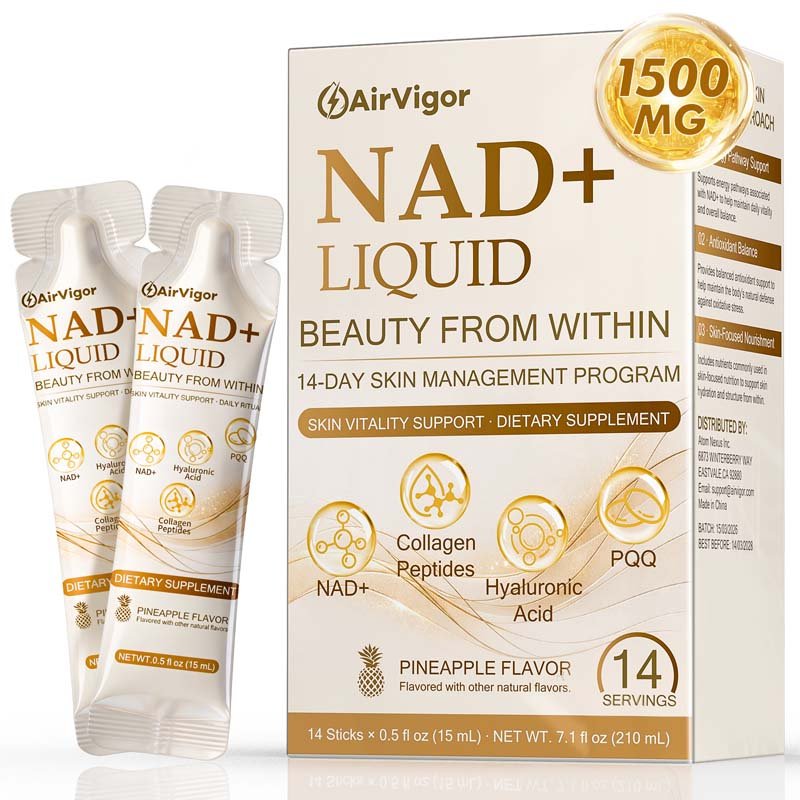
AirVigor’s NAD+ liquid supplement combines NAD+ with collagen peptides, hyaluronic acid, PQQ, and quercetin in a portable liquid stick format. Because the product contains several ingredients, consumers should follow the labeled directions and evaluate the formula as a whole rather than applying advice developed for isolated NR or NMN ingredients.
Users should also compare the label with other beauty, vitality, multivitamin, or healthy-aging products. Ingredient duplication can occur when several formulas are used together. Clear Supplement Facts, serving amounts, allergen statements, and storage instructions are essential for building a responsible routine.
| Daily Factor | Timing Question to Ask |
|---|---|
| Ingredient form | Is the product NAD+, NADH, NR, NMN, or a blend? |
| Serving directions | Is it once daily or divided? |
| Food | Does the label recommend meal-based use? |
| Co-ingredients | Does the formula contain stimulating ingredients? |
| Exercise | Will the serving feel comfortable before movement? |
| Other supplements | Are ingredients duplicated elsewhere? |
| Sleep | Does evening use change sleep onset? |
| Portability | Which time is easiest to remember? |
Which NAD+ Timing Fits Your Routine?
The best schedule follows the user’s actual waking period rather than a conventional clock. Early risers, night-shift workers, travelers, busy parents, and sensitive users may need different timing windows.
What NAD+ Timing Works for Early Risers?
Early risers often prefer breakfast or late morning because the serving becomes part of a stable routine and remains far enough away from bedtime.
A person waking at 5:30 a.m. does not need to take a supplement immediately. The serving can be connected to breakfast, the first work break, or another reliable behavior that occurs during the first half of the day.
A timing range is often more sustainable than an exact minute. “Between breakfast and 10:00 a.m.” allows flexibility on weekends without creating a completely different schedule. This is helpful for people whose morning responsibilities change from day to day.
Evaluation should compare similar days. A quiet weekend cannot be fairly compared with a stressful workday involving short sleep, skipped meals, and extra coffee. Look for patterns across several weeks, including missed servings, stomach comfort, afternoon energy, sleep timing, and how easily the routine fits into real life.
What NAD+ Timing Works for Night-Shift Workers?
Night-shift workers should treat the beginning of their personal waking period as morning and keep the serving away from the main sleep window while testing tolerance.
Someone waking at 4:00 p.m. for a 7:00 p.m. shift may choose a serving after waking or with the first meal. The clock says evening, but the body is beginning its active period. This makes a conventional morning-only rule unhelpful.
The main goal is to separate the serving from intended sleep. A worker sleeping from 9:00 a.m. to 4:00 p.m. may prefer a 5:00 p.m. serving instead of taking it immediately after work. A repeatable rule such as “within two hours after waking” is easier to follow than a fixed clock time.
Shift workers experiencing chronic insomnia, severe sleepiness, heavy caffeine use, or suspected sleep apnea should seek professional advice. Ongoing fatigue may reflect a schedule or medical problem rather than a need for a larger supplement serving.
How Should Travelers Adjust NAD+ Timing?
Travelers can usually keep their home schedule for short trips and move the serving to the first half of the destination waking period after major time-zone changes.
A travel day can become much longer than a normal day, making it easy to take two servings too close together. Users should not double the amount simply because the clock has changed. Missed-serving instructions on the label should guide the decision.
Light exposure, sleep planning, meal timing, hydration, and controlled naps have a stronger effect on jet lag than NAD+ timing alone. A supplement may fit into the adjustment routine, but it cannot replace the basic signals that help shift the body clock.
Portable liquid sticks can make travel use easier because they reduce measuring steps and take up little space. AirVigor’s individual packets can be stored in a work bag, travel pouch, or carry-on, but they should still be protected from excessive heat, moisture, punctures, and prolonged storage inside a hot vehicle.
When Should Sensitive Users Take NAD+?
Sensitive users should begin earlier in the waking period, follow the labeled serving, avoid introducing several new products, and monitor sleep and digestion carefully.
Sensitivity may include a history of nausea, reflux, headaches, insomnia, strong reactions to supplements, or difficulty tolerating flavored liquids and capsules. A morning schedule gives more time to observe these responses before bedtime.
People taking prescription medicines, preparing for surgery, managing chronic conditions, or using several supplements should speak with a physician or pharmacist. Ingredient forms within the NAD+ category are not interchangeable, and individual health circumstances may change what is appropriate.
Pregnant or breastfeeding adults should also seek professional guidance before using a new dietary supplement. Natural positioning, convenient packaging, or familiar nutrients do not remove the need for individualized safety review.
How Can You Keep NAD+ Timing Consistent?
Consistency improves when the serving is connected to an existing habit, stored in an appropriate visible location, and supported by a simple reminder during the first few weeks.
A user might take the serving after the first meal, after morning skincare, on arrival at the office, or within two hours after waking. One clear rule reduces decision fatigue and makes the routine easier to continue.
The product should be stored where it is visible but protected from children, heat, moisture, and direct sunlight. A work drawer, breakfast area, travel pouch, or wellness cabinet can work when the storage directions allow it.
Phone reminders are helpful at the beginning, but the long-term goal is to connect the serving to a behavior that already happens naturally. A short record of timing, meal pairing, sleep, and stomach comfort can help users identify patterns without turning the routine into an exhausting daily experiment.
| Lifestyle | Suggested Starting Window | Main Reason |
|---|---|---|
| Early office schedule | Breakfast to late morning | Easy daytime routine |
| Work-from-home schedule | First meal or planned break | Prevents forgetting |
| Afternoon training | Morning or early afternoon | Keeps use away from bedtime |
| Overnight shift | Within two hours after waking | Matches the active period |
| Frequent travel | First half of destination day | Reduces missed or doubled servings |
| Sleep-sensitive user | Morning during the first trial | Easier sleep assessment |
| Irregular meals | Use a waking-time cue | Avoids dependence on breakfast |
| Busy parent | Pair with a household routine | Reduces daily decisions |

Conclusion
For most adults, morning or the first half of the waking period is the most sensible place to begin taking an NAD+ supplement. It supports habit building, leaves time to observe tolerance, and reduces concern about taking a new formula near bedtime. Nighttime use is not automatically wrong, but it should be approached carefully when the user notices greater alertness, reflux, restlessness, or changes in sleep.
The most effective routine is the one that matches the product label, complete ingredient list, meal pattern, health circumstances, and daily schedule. Current evidence does not prove that one clock hour creates stronger benefits for everyone. Consistency, appropriate serving size, clear labeling, transparent ingredients, stable manufacturing, and realistic expectations remain more important than chasing a perfect dosing minute.
AirVigor develops dietary supplements around clear formula expression, convenient delivery, ingredient transparency, and structured quality management. Consumers interested in AirVigor NAD+ products can contact support@airvigor.com or call +1 (626) 682-8868 for product availability, ordering support, ingredient information, or usage guidance based on the product label.
Businesses, wellness brands, retailers, distributors, and product developers may also contact AirVigor for private-label, OEM, ODM, formula development, flavor adjustment, packaging support, and multi-market product planning. Standard custom projects may begin from 500 pieces, with sample preparation commonly requiring 3–7 days, depending on raw material availability, formula complexity, dosage form, packaging requirements, and regional compliance needs.
This article is intended for educational purposes and does not replace personalized medical advice. Anyone who is pregnant, breastfeeding, taking prescription medication, preparing for surgery, managing a medical condition, or experiencing persistent symptoms should consult a qualified healthcare professional before beginning a new dietary supplement.