Skip to content
How Does Creatine Work with Electrolytes in a High-Intensity Pre-Workout:Explained Guide
# Your Trusted Dietary Supplement Brand In US
- Emily

Table of Contents
Most “bad workouts” don’t start bad — they fall apart halfway. You feel fine in the warm-up, strong in the first 6–8 minutes, then suddenly your legs get heavy, your grip slips, your pace gets choppy, and your focus fades. In high-intensity training (HIIT, CrossFit, sprint intervals, short-rest strength), that drop is often not a willpower issue. It’s a systems issue.
Here’s what’s happening under the hood: your body is trying to recycle ATP fast enough for repeated bursts, while sweat loss is quietly disrupting fluid balance and muscle firing. That’s why stimulant-only pre-workouts can feel great early, then crash hard — they don’t address the real bottlenecks.
Creatine supports high-intensity performance by increasing phosphocreatine in muscle, which helps recycle ATP for repeated bursts of power. Electrolytes (especially sodium, potassium, magnesium, and calcium) support fluid balance, nerve signaling, and muscle contraction. Together, creatine helps you produce power, while electrolytes help you keep that power steady and coordinated as sweat losses and fatigue rise.
What Is Creatine?
Creatine is a compound naturally stored in your muscles. About 95% of it lives inside skeletal muscle tissue, mostly in the form of phosphocreatine. Its main job is simple but critical: it helps regenerate ATP, the molecule your body uses for fast energy.
During high-intensity efforts — think:
- 10–30 second sprint intervals
- Heavy compound lifts
- Explosive Olympic movements
- Short rest supersets
ATP gets depleted quickly. Your body only stores enough ATP for a few seconds of maximal effort. Creatine helps recycle it faster.
Here’s why that matters:
| Effort Type | Primary Energy System | Creatine Involved? |
|---|---|---|
| 1–10 sec max sprint | Phosphagen | ✔ Yes |
| Heavy 3–6 rep lift | Phosphagen | ✔ Yes |
| 30–60 sec interval | Mixed | ✔ Partial |
| Long steady cardio | Oxidative | Minimal |
If your training includes repeated high bursts, creatine becomes relevant fast.
And here’s something practical:
The average omnivorous diet provides only 1–2 grams of creatine per day, mainly from red meat and fish. Muscle saturation typically requires around 3–5 grams daily intake. That gap is why supplementation is common among strength and HIIT athletes.
What Are Electrolytes in Simple Terms?
Electrolytes are minerals that carry an electrical charge in your body. That electrical charge allows your nerves and muscles to function properly.
The four main performance-related electrolytes are:
- Sodium (Na⁺)
- Potassium (K⁺)
- Magnesium (Mg²⁺)
- Calcium (Ca²⁺)
These minerals are not “optional.” They are required for:
- Muscle contraction
- Muscle relaxation
- Nerve signal transmission
- Fluid balance
- Blood volume stability
Without electrolytes, your muscles can’t fire efficiently — even if you have enough ATP.
Think of it like this:
- Creatine = energy reload
- Electrolytes = electrical wiring
If wiring is unstable, energy doesn’t translate into smooth output.
Why Sweat Changes the Equation
During high-intensity workouts, sweat loss can escalate quickly.
Average sweat rates:
| Training Scenario | Sweat Rate |
|---|---|
| Light indoor lifting | 0.5 L/hour |
| HIIT / CrossFit | 0.8–1.5 L/hour |
| Outdoor hot climate | 1.5–2.5 L/hour |
Now look at what’s lost in 1 liter of sweat:
| Mineral | Typical Loss per Liter |
|---|---|
| Sodium | 800–1,500 mg |
| Potassium | 150–300 mg |
| Magnesium | 5–25 mg |
| Calcium | 20–60 mg |
That means a heavy sweater in a 60-minute HIIT session can lose over 1,200 mg sodium.
Water alone does not replace this.
When sodium drops:
- Blood volume decreases
- Heart rate rises faster
- Muscles fatigue earlier
- You feel “flat”
That’s why electrolyte replacement matters — not just hydration volume.
How Do They Work Inside the Muscle Cell?
Inside your muscle cells, two important things are happening during training:
- ATP is being used and recycled.
- Electrical signals are triggering contractions.
Creatine increases phosphocreatine stores, allowing faster ATP regeneration.
Electrolytes regulate:
- The sodium-potassium pump (critical for nerve signaling)
- Calcium release inside muscle fibers (triggers contraction)
- Magnesium’s role in ATP-related enzyme reactions
Here’s a simplified breakdown:
| Component | Primary Role in Muscle |
|---|---|
| Creatine | Rapid ATP regeneration |
| Sodium | Initiates nerve impulse |
| Potassium | Restores membrane potential |
| Calcium | Triggers contraction |
| Magnesium | Supports relaxation + ATP enzymes |
If any one piece drifts out of balance, output becomes less stable.
That’s often why athletes say:
“I still had energy, but my body wouldn’t respond.”
It’s usually not motivation. It’s physiology.
Why Taking One Without the Other Can Feel Incomplete
Many people take creatine alone and feel stronger in early sets. But during long or sweaty sessions, they may still experience:
- Sudden fatigue drop
- Leg heaviness
- Mild cramping
- Brain fog late in session
On the other hand, athletes taking only electrolytes may feel:
- Better hydration
- Fewer cramps
- But no significant boost in repeated power
Here’s how different setups compare:
| Strategy | Energy Support | Hydration Support | Common Experience |
|---|---|---|---|
| Water only | Low | Low | Early fatigue |
| Creatine only | High | Low | Strong start, unstable finish |
| Electrolytes only | Low | High | Stable hydration, limited power |
| Creatine + Electrolytes | High | High | Strong + steady |
This is especially noticeable in:
- CrossFit metcons
- EMOM circuits
- Sprint repeats
- Heavy supersets
- Hot environment training
The combination doesn’t create a stimulant spike.
It creates stability.
And stability is what serious athletes actually value.
How Do Creatine + Electrolytes Boost Performance?
When people talk about “boosting performance,” they usually mean one of three things:
- More power
- More repeatability
- Less drop-off
Creatine and electrolytes improve performance in different but complementary ways. Creatine supports fast energy recycling inside muscle. Electrolytes maintain the electrical and fluid balance that allows that energy to translate into clean contractions.
If you train at high intensity — especially with short rest or high sweat loss — both systems are under stress at the same time.
Let’s break down what that means in practical terms.
How Do They Improve Repeated Power Output?
High-intensity training depends heavily on the phosphagen system.
That system fuels:
- 5–15 second sprints
- Heavy triples and fives
- Explosive Olympic lifts
- Short rest interval bursts
Your body stores only enough ATP for a few seconds of maximal effort. Creatine increases phosphocreatine stores, which allows faster ATP recycling between efforts.
Research consistently shows that creatine supplementation can improve:
| Performance Variable | Average Improvement Range |
|---|---|
| Peak power output | 5–15% |
| Repeated sprint performance | 3–8% |
| Total work volume | 5–15% |
| Lean mass retention (training phase) | Improved vs placebo |
But here’s the important part:
Creatine helps most when efforts are repeated.
That’s why athletes notice it more in:
- HIIT
- CrossFit
- Strength circuits
- Repeated sled pushes
- Sprint repeats
However, power alone isn’t enough. If muscle firing becomes unstable due to electrolyte imbalance, output drops even if ATP is available.
That’s where electrolytes protect the system.
How Do They Reduce the “Mid-Workout Drop”?
Almost every high-intensity athlete knows this moment:
Round 1–2: Strong
Round 3: Manageable
Round 4: Sudden drop
This drop usually happens when:
- Phosphocreatine levels dip
- Sweat loss reduces sodium
- Plasma volume declines
- Muscle firing precision decreases
Creatine helps delay phosphocreatine depletion.
Electrolytes help maintain fluid balance and nerve signaling.
Let’s look at what sweat can do in 45–60 minutes:
| Condition | Sodium Loss (Est.) |
|---|---|
| Moderate sweat | 600–1,000 mg |
| Heavy sweat | 1,000–1,800 mg |
When sodium falls:
- Heart rate climbs faster
- Muscles fatigue sooner
- Coordination feels off
Many athletes interpret this as “conditioning weakness.”
In reality, it’s often hydration + energy mismatch.
When creatine and electrolytes are both supported:
- Output drop tends to happen later
- Pace feels more stable
- Recovery between rounds improves
This doesn’t mean you won’t fatigue.
It means fatigue arrives more gradually, not abruptly.
How Do They Improve Neuromuscular Control?
Performance is not just energy — it’s signal transmission.
Every muscle contraction requires:
- A nerve impulse
- Sodium influx
- Potassium efflux
- Calcium release inside muscle
- ATP-driven contraction
- Magnesium-supported relaxation
If any of these steps become unstable, contractions feel:
- Shaky
- Weak
- Delayed
- Tight
Electrolytes stabilize this process.
Creatine ensures ATP is available for the contraction cycle.
Here’s a simplified breakdown:
| Component | Role in Contraction |
|---|---|
| Sodium | Initiates nerve signal |
| Potassium | Resets nerve signal |
| Calcium | Triggers contraction |
| Magnesium | Allows relaxation |
| Creatine | Supports ATP for contraction cycle |
When athletes describe:
“I still had energy, but my reps felt sloppy.”
It’s often neuromuscular instability.
Proper electrolyte balance improves contraction quality — not just quantity.
How Do They Support Work Capacity?
Work capacity is the total amount of quality output you can produce before performance drops below useful levels.
Creatine improves:
- Number of quality reps
- Sprint repeatability
- Training volume tolerance
Electrolytes improve:
- Hydration efficiency
- Blood volume stability
- Reduced cramp risk
- Reduced dizziness post-session
Together, they support sustained workload.
Here’s how different strategies often feel in practice:
| Strategy | Early Rounds | Late Rounds | Post-Workout Feel |
|---|---|---|---|
| Water only | OK | Steep drop | Headache / drained |
| Creatine only | Strong | Inconsistent | Full but fatigued |
| Electrolytes only | Stable | Limited peak | Hydrated but flat |
| Creatine + Electrolytes | Strong + steady | Gradual decline | More balanced |
For athletes training 4–6 times per week, this consistency matters more than short-term stimulation.
Do They Help Recovery Between Sessions?
Yes — and this is often overlooked.
High-intensity training stresses:
- ATP turnover
- Glycogen storage
- Muscle microtrauma
- Fluid balance
Creatine supports:
- Cellular hydration
- Glycogen storage efficiency
- Reduced markers of muscle damage (in some studies)
Electrolytes support:
- Fluid restoration
- Reduced cramping
- Stable blood pressure post-exercise
Athletes often report:
- Less “crash” feeling after sessions
- Reduced next-day heaviness
- Fewer dehydration headaches
- Better ability to train again within 24 hours
For competitive or high-frequency trainers, that recovery consistency becomes a performance multiplier over time.
The Real Performance Advantage
Creatine gives you more usable energy during repeated effort.
Electrolytes make sure that energy translates into:
- Stable contractions
- Controlled movement
- Reduced sudden fatigue spikes
- Better hydration under stress
The benefit isn’t flashy.
It’s reliable.
And in high-intensity training, reliability beats stimulation every time.

How Do Creatine + Electrolytes Support Hydration?
Hydration is not just about how much water you drink.
It’s about:
- Where that water goes
- How long it stays there
- Whether your body can use it efficiently during stress
Creatine and electrolytes influence hydration in different but complementary ways. Creatine improves intracellular water retention inside muscle cells. Electrolytes regulate fluid distribution, nerve signaling, and blood volume.
When both systems are supported, hydration feels stable — not bloated, not sloshy, not depleted.
Let’s break this down clearly.
What Is Intracellular Hydration and Why Does It Matter?
Creatine increases water content inside muscle cells. This is often called cell volumization.
When creatine stores increase, phosphocreatine concentration rises. This creates a mild osmotic pull, drawing water into the muscle cell.
Why that matters:
- Muscle cells function better when properly hydrated
- Enzyme reactions for ATP production run more efficiently
- Glycogen storage improves
- Protein breakdown may decrease
Research suggests creatine supplementation can increase total body water by 1–2 kg (2–4 lbs) during loading phases, largely from intracellular fluid shifts.
But here’s the key point:
This is not just “water weight.”
It is functional water stored where muscle performance happens.
Athletes often describe intracellular hydration as:
- Muscles feel fuller
- Pumps last longer
- Less “flat” feeling during longer sessions
However, intracellular hydration only works well if extracellular fluid balance is stable.
That’s where electrolytes come in.
How Do Electrolytes Control Fluid Distribution?
Your body maintains fluid balance across compartments:
- Intracellular (inside cells)
- Extracellular (blood + surrounding tissue)
Sodium is the primary driver of extracellular fluid retention.
If sodium levels drop during heavy sweating:
- Blood volume decreases
- Circulation efficiency declines
- Heart rate rises faster
- Oxygen delivery becomes less efficient
Typical sodium loss during sweat:
| Sweat Rate | Sodium Loss per Hour |
|---|---|
| 0.5 L/hr | 400–700 mg |
| 1.0 L/hr | 800–1,500 mg |
| 1.5 L/hr | 1,200–2,200 mg |
Many HIIT and CrossFit athletes sweat between 0.8–1.5 liters per hour, especially in humid gyms.
Drinking water alone can dilute sodium levels further, which may cause:
- Headache
- Lightheadedness
- Early fatigue
- “Heavy legs” sensation
Electrolytes help retain fluid in circulation, not just in the stomach.
This is why hydration should mean “water + minerals,” not water alone.
How Do They Affect Nerve Signaling and Muscle Contraction?
Hydration is not just fluid volume — it’s electrical stability.
Every muscle contraction requires:
- A nerve impulse
- Sodium entering the cell
- Potassium exiting
- Calcium release to trigger contraction
- Magnesium supporting relaxation
If electrolyte balance drifts during heavy sweating:
- Contractions feel shaky
- Coordination becomes sloppy
- Reaction time slows
- Cramping risk increases (especially under fatigue)
Creatine ensures ATP is available for contraction cycles.
Electrolytes ensure those contractions happen smoothly.
Here’s how each component contributes:
| Mineral | Hydration Role | Performance Effect |
|---|---|---|
| Sodium | Maintains plasma volume | Supports endurance & stability |
| Potassium | Balances sodium | Prevents “dead leg” feeling |
| Magnesium | Supports relaxation | Reduces tightness/twitch |
| Calcium | Triggers contraction | Supports force production |
Hydration without mineral balance is incomplete.
How Do They Reduce Dehydration Symptoms Mid-Workout?
Many athletes don’t realize mild dehydration can occur quickly.
Even 2% bodyweight fluid loss can reduce performance measurably.
For a 180 lb (82 kg) athlete:
- 2% = ~3.6 lbs (1.6 kg) fluid loss
That’s possible in a long, high-intensity, humid session.
Common dehydration-related symptoms:
| Symptom | Likely Cause |
|---|---|
| Sudden fatigue | Reduced blood volume |
| Rapid heart rate spike | Fluid loss |
| Brain fog | Mild dehydration |
| Headache | Electrolyte imbalance |
| Cramping | Fatigue + mineral shift |
Creatine supports intracellular hydration.
Electrolytes maintain extracellular stability.
When both are present:
- Blood volume holds steadier
- Muscle firing remains consistent longer
- Perceived exertion may rise more gradually
- Post-workout dizziness decreases
Athletes often describe this as:
“More stable energy, not necessarily more energy.”
That difference matters.
Why Water Alone Often Feels “Incomplete”
Many athletes say:
“I drank a lot of water, but I still felt drained.”
That usually means one of two things:
- Sodium loss wasn’t replaced
- ATP recycling couldn’t keep up
Water dilutes electrolytes if sodium intake is too low.
Creatine without electrolytes may increase intracellular water without supporting plasma stability.
Here’s a simplified comparison:
| Hydration Strategy | Intracellular Support | Plasma Volume Support | Practical Result |
|---|---|---|---|
| Water only | Low | Low | Early fatigue |
| Creatine only | High | Low | Full muscles, unstable late session |
| Electrolytes only | Moderate | High | Stable hydration, limited power |
| Creatine + Electrolytes | High | High | Balanced, sustained output |
The combined approach creates:
- Better fluid retention
- Stable nerve signaling
- Improved ATP turnover
- More consistent pacing
That’s the real hydration advantage.
What Dose Works Best?
Most evidence supports 3–5 grams of creatine daily for maintenance, with optional short loading phases. In high-intensity pre-workouts, 2–3 grams per serving can support performance when taken consistently. Electrolyte dosing depends on sweat rate, with sodium typically ranging from 300–1,500 mg per hour of intense training. The right dose balances performance support without unnecessary excess.
How Much Creatine Do You Actually Need?
Most research and real-world data agree:
3–5 grams per day is the sweet spot for most adults.
You do not need extreme doses.
Here’s a practical breakdown:
| Strategy | Daily Amount | Who It Fits |
|---|---|---|
| 3 g/day | Smaller athletes, maintenance | 120–160 lbs |
| 4 g/day | Most active adults | 160–200 lbs |
| 5 g/day | Larger athletes | 200+ lbs |
| 20 g/day (short-term loading) | Optional | Fast saturation (5–7 days) |
Important points:
- You don’t have to load.
- Consistency matters more than timing.
- Benefits appear after muscle stores saturate (usually 2–4 weeks without loading).
Many pre-workout formulas include 2–3 g per serving.
That works — as long as you take it daily.
If you train 4–6 days per week, daily use makes more sense than cycling.
Is There a Safe Upper Limit?
For healthy individuals:
- 3–5 g daily is widely considered safe long term.
- 10 g daily short term is generally tolerated but unnecessary for most.
- GI discomfort becomes more common above 5 g per single dose.
Common concern: kidney stress.
Here’s what matters:
- Creatine increases creatinine levels in blood tests.
- Creatinine elevation does not automatically mean kidney damage.
- In healthy individuals, long-term studies have not shown kidney harm at standard doses.
People who should consult a physician:
- Diagnosed kidney disease
- Severe hypertension
- On diuretics or ACE inhibitors
- Pregnant or breastfeeding
For the average high-intensity athlete, 3–5 g daily is both effective and safe.
How Much Sodium Do You Need for High-Intensity Training?
Sodium needs are where most athletes underdose.
Electrolyte drinks often contain only 100–200 mg sodium, which is insufficient for serious sweat sessions.
Let’s personalize sodium needs based on sweat rate.
Step 1: Estimate Sweat Rate
Weigh yourself before and after training (without clothes).
Each pound lost ≈ 16 oz (0.47 L) of fluid.
Example:
- Pre-workout: 180 lbs
- Post-workout: 178.5 lbs
- Loss: 1.5 lbs ≈ 0.7 L
That’s moderate sweating.
Step 2: Estimate Sodium Loss
Average sodium loss per liter sweat: 800–1,500 mg
So at 0.7 L/hour:
- Sodium loss ≈ 560–1,050 mg
Practical Sodium Replacement Guide
| Sweat Level | Sodium Per Hour |
|---|---|
| Light sweat | 300–500 mg |
| Moderate sweat | 500–900 mg |
| Heavy sweat | 800–1,500 mg |
If you train in:
- Humid climate
- Poorly ventilated gym
- Fasted state
- Long sessions (60+ min)
You likely need the higher end.
Water alone will not replace this.
What About Magnesium, Potassium, and Calcium?
These minerals do not need extreme dosing — balance is key.
Practical Performance Ranges
| Mineral | Daily Supplemental Range | Why It Matters |
|---|---|---|
| Magnesium | 100–200 mg | Muscle relaxation, cramp control |
| Potassium | 100–300 mg | Fluid balance, contraction |
| Calcium | 100–300 mg | Contraction trigger |
Magnesium is particularly important for athletes who experience:
- Night cramps
- Calf tightness
- Twitching under fatigue
Too much magnesium at once may cause GI discomfort, so moderate dosing is ideal.
Potassium works with sodium — they must stay balanced. Massive potassium dosing without sodium balance is not helpful.
Electrolytes work as a system, not individually.
When Should You Take Them?
Creatine works by saturation.
Electrolytes work by timing.
Creatine Timing
- Any time daily is fine.
- Many athletes prefer pre-workout out of habit.
- Post-workout works too.
- What matters most is consistency.
Electrolyte Timing
Electrolytes are more timing-sensitive.
Best practice:
- 30–45 minutes pre-workout: start hydrated.
- During session (if >45–60 min): sip consistently.
- Post-workout: replace remaining losses.
For early morning trainers:
You wake up slightly dehydrated after 6–8 hours without fluid.
Pre-hydration is especially important.
For evening trainers:
Hydration during the workday affects performance later.
Example Dosing Scenarios
Example 1: 170 lb HIIT Athlete (Moderate Sweater)
- Creatine: 4 g daily
- Sodium: 600–800 mg during workout
- Magnesium: 150 mg daily
- Potassium: 200 mg
Example 2: 210 lb CrossFit Athlete (Heavy Sweater, Humid Climate)
- Creatine: 5 g daily
- Sodium: 900–1,200 mg during session
- Magnesium: 150–200 mg
- Potassium: 250–300 mg
Example 3: 150 lb Strength Athlete (Low Sweat, AC Gym)
- Creatine: 3 g daily
- Sodium: 300–500 mg
- Magnesium: 100–150 mg
- Potassium: 150 mg
The Most Common Mistakes
- Underdosing sodium
- Only drinking water
- Taking creatine inconsistently
- Taking huge single doses instead of steady daily intake
- Ignoring sweat rate differences
The right dose is not about extremes.
It’s about matching support to actual output and sweat.
The Bottom Line on Dosing
For most high-intensity athletes:
- Creatine: 3–5 g daily
- Sodium: 500–1,000 mg per hour of intense training
- Magnesium: 100–200 mg daily
- Potassium: 100–300 mg daily
Adjust based on:
- Body size
- Climate
- Sweat rate
- Session duration
When dosed properly, the combination supports:
- Stable power
- Controlled contractions
- Better pacing
- Reduced dehydration symptoms
- More consistent training week after week

Who Should Use Them?
Creatine + electrolytes are most useful for people performing high-intensity, repeated-effort training or training in hot environments. This includes HIIT athletes, CrossFit participants, sprint-based athletes, strength trainees with short rest periods, and heavy sweaters. Individuals with kidney disease, uncontrolled hypertension, or on specific medications should consult a healthcare professional before use.
Who Benefits Most from Repeated High-Intensity Training?
If your workouts include short rest periods and explosive movements, this combination makes sense.
This includes:
- HIIT participants
- CrossFit athletes
- Sprint-based athletes
- Strength trainees doing supersets or circuits
- Athletes doing repeated sled pushes, assault bike intervals, or row sprints
Why?
Because these formats stress:
- The phosphagen system (ATP turnover)
- Fluid balance (rapid sweat loss)
- Neuromuscular precision (fast contractions under fatigue)
Typical complaints from this group:
- “Round 4 drop”
- Grip fails early
- Legs feel heavy even though lungs feel fine
- Slight dizziness after workouts
- Calf or hamstring tightness
These symptoms often reflect:
- Phosphocreatine depletion
- Sodium loss
- Reduced plasma volume
- Electrolyte imbalance
Creatine helps refill the energy system.
Electrolytes help stabilize the contraction system.
That’s why this group sees the clearest benefit.
Who Sweats Enough to Need Them?
Sweat rate is one of the most overlooked factors.
If you leave visible sweat on the floor, soak shirts, or see salt marks on clothing, you are likely losing significant sodium.
Average sweat rates:
| Athlete Type | Sweat Rate |
|---|---|
| Light sweater | 0.4–0.6 L/hr |
| Moderate sweater | 0.7–1.0 L/hr |
| Heavy sweater | 1.0–1.8 L/hr |
| Very heavy sweater (humid heat) | 1.5–2.5 L/hr |
Now combine that with sodium loss:
| Sweat Rate | Sodium Loss per Hour (Est.) |
|---|---|
| 0.5 L/hr | 400–700 mg |
| 1.0 L/hr | 800–1,500 mg |
| 1.5 L/hr | 1,200–2,200 mg |
If your sessions last 60 minutes and you’re a heavy sweater, you may lose over 1,000 mg sodium per workout.
Water alone will not replace this.
This group benefits strongly from electrolyte support — and if training intensity is high, creatine improves repeat output as well.
Who Trains Frequently Enough to Notice the Difference?
Frequency matters.
If you train:
1–2 times per week (light sessions)
→ You may not notice a major difference.
If you train:
- 4–6 times per week
- High effort each session
- Short rest periods
- Hybrid strength + conditioning
You accumulate:
- Repeated ATP depletion
- Repeated sweat loss
- Repeated neuromuscular fatigue
This is where creatine saturation + consistent electrolyte intake create compounding benefits over weeks.
Athletes training frequently often report:
- Fewer “bad sessions”
- More consistent pacing
- Reduced late-week fatigue
- Better tolerance to high-volume weeks
It’s not dramatic overnight.
It’s noticeable across training cycles.
Who Works in Physically Demanding Environments?
Not just athletes benefit.
Consider:
- Construction workers
- Warehouse staff
- Landscaping crews
- Delivery drivers
- Military trainees
- Firefighters
These roles involve:
- Repeated lifting or climbing
- Heat exposure
- Long work shifts
- High sweat output
Many physically demanding jobs combine muscular effort with environmental stress.
For someone working 6–8 hours in heat, creatine may help maintain muscular output, while electrolytes prevent dehydration-related fatigue.
In these populations, the goal isn’t gym performance — it’s sustained physical capability across long workdays.
Who May Not Need Them?
Some people may not benefit significantly.
Examples:
- Low-intensity yoga only
- Casual walking
- Light machine training with long rest
- Short 20-minute sessions in cool environments
If your training:
- Rarely causes heavy sweating
- Rarely pushes into high intensity
- Doesn’t involve repeated explosive effort
Electrolytes at performance levels may not be necessary.
Creatine may still support strength gains, but hydration synergy may be less noticeable.
Additionally, people who should consult a doctor before use:
| Condition | Why |
|---|---|
| Chronic kidney disease | Creatine metabolism increases creatinine |
| Severe hypertension | Sodium intake must be managed |
| On diuretics | Fluid shifts already altered |
| On ACE inhibitors | Kidney filtration considerations |
| Pregnant/breastfeeding | Limited long-term data |
For healthy adults, standard dosing is well tolerated. But context always matters.
Signs You’re a Good Candidate
You’re likely a strong candidate if you:
- Feel strong early but fade late
- Experience heavy sweating
- Notice calf tightness or twitching under fatigue
- Train 4+ times per week
- Live in humid or hot climates
- Need repeat performance, not just one max effort
- Recover slower after high-intensity weeks
You may be less of a candidate if you:
- Rarely sweat much
- Train at low intensity
- Do not perform repeated explosive effort
- Have medical conditions affecting kidney or fluid balance
How Do They Work with Other Ingredients?
Most high-intensity athletes don’t take creatine or electrolytes alone.
They combine them with:
- Caffeine
- Taurine
- Beta-alanine
- Citrulline
- BCAAs or EAAs
- Carbohydrates
The key question isn’t “Can they be combined?”
It’s “Do they support the same goal — or compete?”
Creatine + electrolytes form the foundation:
- Creatine = energy recycling
- Electrolytes = hydration + contraction stability
Other ingredients either enhance this system — or stress it further.
Let’s look at the most common stacks.
Creatine + Electrolytes + Caffeine: Energy vs Stability
Caffeine is the most common pre-workout ingredient.
It works by:
- Blocking adenosine receptors
- Increasing alertness
- Reducing perceived exertion
- Enhancing motor unit recruitment
For high-intensity athletes, caffeine can improve:
- Sprint power
- Reaction time
- Focus under fatigue
However, caffeine does not replace electrolytes.
In higher doses, it may:
- Increase heart rate
- Increase perceived exertion after the peak
- Slightly increase fluid turnover (in very high doses)
If caffeine is high but electrolytes are low:
- You may feel strong early
- But drop harder later
- Or experience post-session dehydration headaches
Balanced stacking looks like:
| Component | Purpose |
|---|---|
| Creatine | Repeated ATP support |
| Electrolytes | Hydration + contraction stability |
| Caffeine (100–200 mg) | Alertness + drive |
Excessive caffeine (300–400 mg+) without proper sodium support can mask dehydration until performance drops abruptly.
The goal is synergy — not overstimulation.
Creatine + Electrolytes + Taurine: Fluid Regulation Support
Taurine is often misunderstood.
It plays a role in:
- Cellular osmoregulation
- Electrolyte balance
- Muscle contractility
- Antioxidant support
When combined with creatine:
- Creatine pulls water into muscle cells
- Taurine helps regulate fluid inside the cell
- Electrolytes maintain extracellular balance
This combination tends to feel:
- “Smooth”
- Less jittery
- More stable across rounds
Athletes prone to cramping often report better tolerance when taurine is included alongside electrolytes.
Typical taurine dose:
- 500–2,000 mg per serving
This pairing works especially well in:
- Long metcons
- Hybrid strength-conditioning sessions
- Hot weather training
Creatine + Electrolytes + Beta-Alanine: Buffering the Burn
Beta-alanine increases muscle carnosine levels, which helps buffer acid accumulation during efforts lasting 30–120 seconds.
This supports:
- High-rep sets
- Extended intervals
- Repeated sprints with short rest
Here’s how they interact:
| Ingredient | Main Effect |
|---|---|
| Creatine | Short burst ATP recycling |
| Beta-alanine | Acid buffering during sustained effort |
| Electrolytes | Contraction stability + hydration |
In practice:
- Creatine helps first 10–15 seconds
- Beta-alanine supports extended 30–90 second efforts
- Electrolytes prevent contraction instability as fatigue rises
The three together address different fatigue mechanisms.
The common mistake is expecting one ingredient to do all of this alone.
Creatine + Electrolytes + Citrulline: Blood Flow & Delivery
Citrulline (especially citrulline malate) increases nitric oxide production, which improves blood flow.
Benefits may include:
- Better muscle pump
- Improved nutrient delivery
- Slight endurance enhancement
When paired with creatine + electrolytes:
- Electrolytes maintain plasma volume
- Citrulline enhances vasodilation
- Creatine ensures energy recycling once nutrients arrive
However, if sodium is too low, vasodilation without adequate plasma volume can lead to:
- Lightheadedness
- “Pump without power” feeling
Balanced electrolyte support prevents that mismatch.
Typical citrulline dosing:
- 3–8 grams pre-workout
Creatine + Electrolytes + Carbohydrates: Glycogen & Sodium Transport
Carbohydrates can enhance performance by:
- Restoring glycogen
- Supporting insulin response
- Enhancing creatine uptake
Sodium plays a role in glucose transport via sodium-glucose co-transport systems in the intestine.
When carbs + sodium + creatine are combined:
- Creatine uptake may improve
- Glycogen replenishment is enhanced
- Fluid retention improves
However:
- Excess sugar without proper electrolyte balance can cause GI distress
- High-sugar drinks without sodium may not retain fluid effectively
For high-intensity sessions under 60 minutes, moderate carbohydrate inclusion is optional.
For longer sessions, carbs + electrolytes + creatine can be highly effective.
Creatine + Electrolytes + Amino Acids (BCAA/EAA)
Amino acids support:
- Muscle protein synthesis
- Recovery
- Reduced breakdown during training
They do not directly impact ATP recycling or hydration.
But when training fasted, combining:
- Creatine
- Electrolytes
- Essential amino acids
may support:
- Reduced muscle fatigue
- Better session endurance
- Improved recovery perception
This combination is especially popular among early-morning trainers.
What to Avoid When Stacking
Some combinations can create problems if not balanced.
1. High Stimulant + Low Sodium
- Early surge
- Hard crash
- Headache risk
2. Excessive Magnesium at Once
- GI discomfort
3. Mega-Dose Creatine (10g+) in Single Serving
- Bloating
- Stomach discomfort
4. High Sugar + Low Electrolytes
- Energy spike
- Rapid drop
- Fluid imbalance
Performance stacking works best when:
- Each ingredient serves a distinct role
- No system is overloaded
- Electrolyte balance supports the entire stack
The Smart Stack Model
For high-intensity athletes, a balanced system looks like:
| Category | Target Support |
|---|---|
| Creatine (3–5 g/day) | ATP recycling |
| Sodium (500–1,000 mg/hr intense training) | Plasma volume |
| Magnesium (100–200 mg) | Relaxation stability |
| Taurine (optional) | Osmoregulation |
| Caffeine (100–200 mg) | Focus & drive |
| Citrulline (3–6 g) | Blood flow |
Not every session needs all of this.
But understanding how they interact prevents:
- Overstimulation
- Underhydration
- Unstable pacing
What Should You Look for in Formula?
Not all formulas are built the same.
Here are practical evaluation criteria.
1. Evidence-Based Creatine Dose
Look for:
- 2–3 g per serving (if daily use)
- Or 3–5 g total daily intake
Avoid:
- “Proprietary blends” hiding creatine amounts
- Micro-dosed (<1 g) token inclusion
2. Real Sodium Content
Many “electrolyte” products underdose sodium.
If label shows:
- <150 mg sodium → likely insufficient for high-intensity training
For serious sweat sessions:
- 300–1,000 mg sodium is more realistic
3. Balanced Mineral Profile
Look for:
- Sodium + potassium combination
- Magnesium in bioavailable form
- Reasonable calcium support (not extreme dosing)
4. Solubility & Mixability
Poorly processed powders lead to:
- Gritty texture
- Sediment at bottom
- GI discomfort
Micronized creatine + well-dispersed electrolytes improve experience.

Conclusion
Creatine helps you repeat high-power efforts by improving ATP recycling. Electrolytes help that power show up as clean, stable output by supporting hydration, blood volume, and muscle firing — especially when you sweat a lot or train in heat. If your goal is fewer mid-workout drop-offs and more consistent sessions, a creatine + electrolyte approach is one of the simplest upgrades you can make.
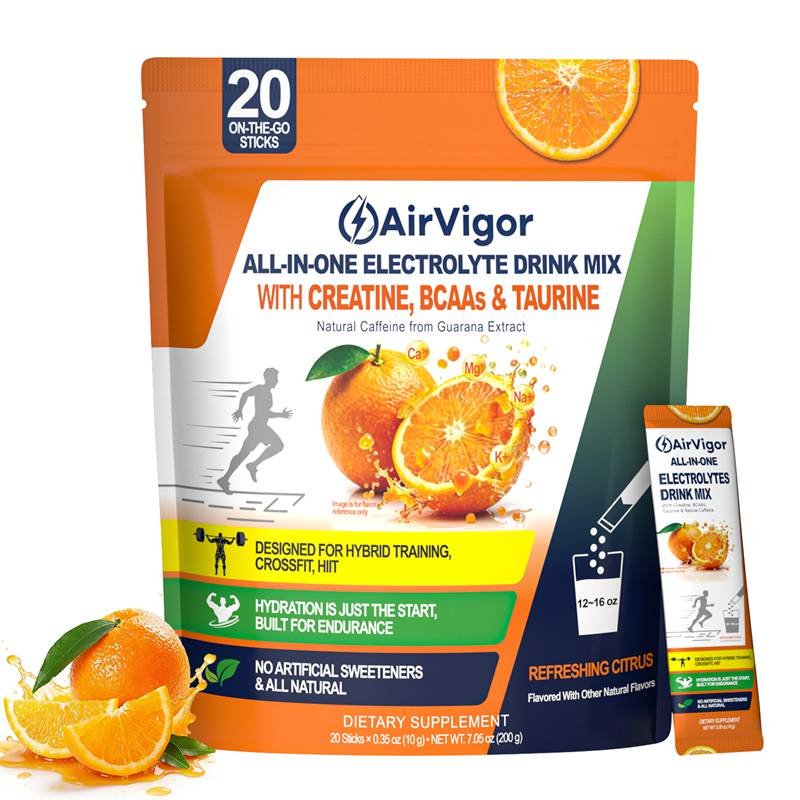
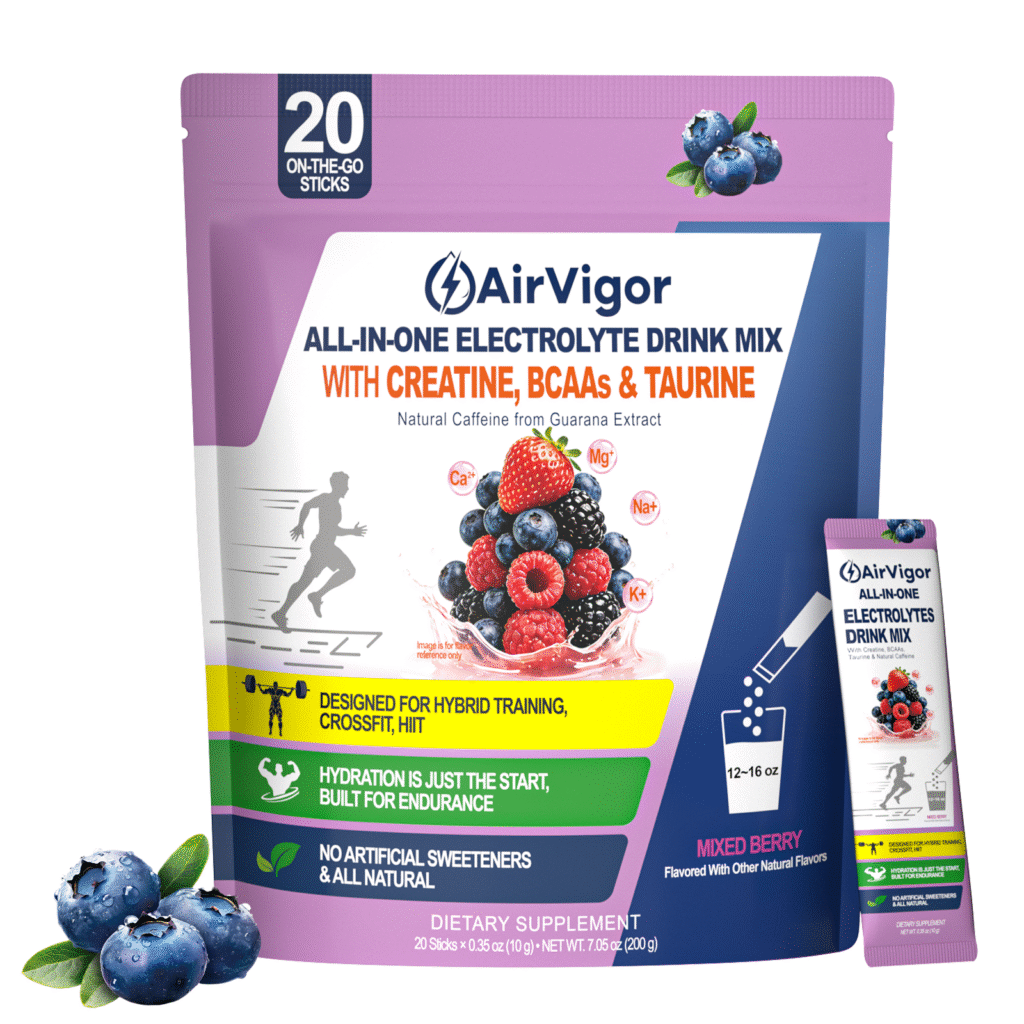
If you want a ready-to-use system designed for high-intensity athletes — or you’re a brand looking to develop a custom creatine + electrolyte formula (flavor, dosage, packaging) — AirVigor can support both direct purchase and OEM/ODM projects.
Share:
Contact Expert Team
At AirVigor, performance becomes effortless. We transform advanced nutrition science into clean, effective supplements that help you hydrate, recover, and feel stronger every day. Shop AirVigor Supplements on Amazon and experience athlete-trusted formulas—backed by real science and supported by our world-class R&D and production capabilities.
Trust AirVigor
At AirVigor, turning your performance goals into reality is no longer a struggle—it’s a science-driven journey we build together. Whether you’re a runner, lifter, cyclist, yogi, outdoor athlete, or someone simply seeking better daily energy, AirVigor transforms advanced nutrition research into clean, effective, and trustworthy supplements you can feel.
Backed by our U.S. scientific team, global certifications, and world-class production standards, every formula is engineered to deliver real hydration, real recovery, and real performance. And when you’re ready to experience the difference, you’ll find AirVigor products available on Amazon and other major platforms—fast shipping, consistent quality, and a community of athletes already seeing results.
Behind the scenes, our R&D and manufacturing ecosystem also supports specialized formulation development, ensuring AirVigor continues to lead with innovation while keeping quality and safety uncompromised. But at the core, everything we create is built for you—your health, your performance, your momentum.
Choose AirVigor. Feel the science. Elevate your every day.


Subscribe to our newsletter
Sign up to our newsletter and we’ll keep you up to date with the latest arrivals.