Skip to content
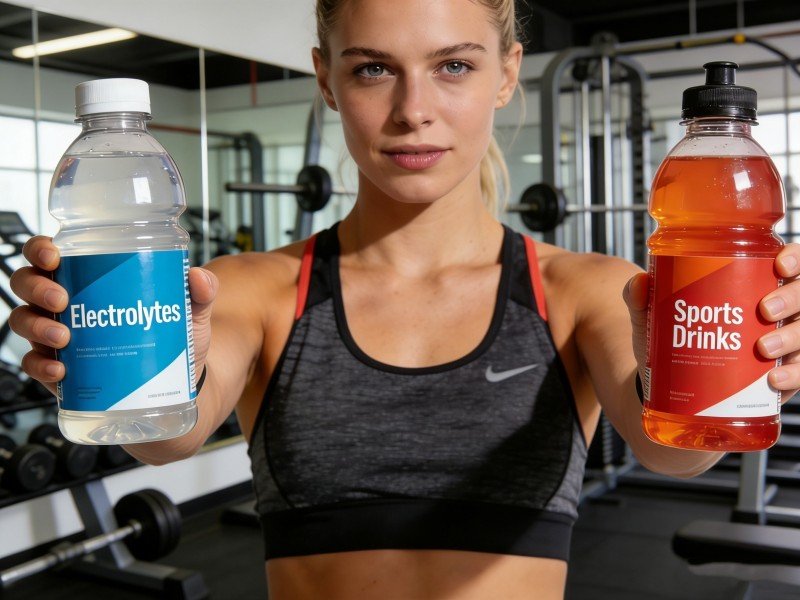
Most people do not actually need a more complicated drink. They need a better decision. That is why the comparison between electrolytes and sports drinks matters so much. A short treadmill session, a two-hour summer run, a sweaty warehouse shift, and a normal office day do not ask the body for the same thing. But many people still buy hydration products as if every situation were identical. Some drink sugary sports drinks for light workouts that only need water. Others choose low-calorie electrolyte products during long, hard sessions when their real problem is not just fluid loss, but fuel loss too. That mismatch is where money gets wasted, performance drops, and recovery feels inconsistent.
Electrolytes are minerals that help regulate fluid balance, nerve function, and muscle function. Sports drinks are usually built to do two jobs at once: replace fluid and provide fast carbohydrate energy. Public guidance is fairly consistent on this point: water is generally enough for many shorter and lighter activities, while sports drinks become more useful when exercise is longer, harder, hotter, or sweatier, especially when carbohydrate intake starts to matter too. The American Heart Association, Mayo Clinic, and pediatric hydration guidance all separate these use cases rather than treating them as the same thing.
That distinction becomes much more useful when you apply it to real life. A CrossFit athlete, a runner, a casual gym user, a traveler, and a desk worker with mild dehydration are not asking the same hydration question. Once you understand what each category is really designed to do, the label becomes easier to read and the better choice becomes much more obvious. The goal is not to find the “healthiest” bottle in the abstract. The goal is to match the drink to the actual demand in front of you.
What Are Electrolytes and Sports Drinks?
Electrolytes and sports drinks overlap, but they are not the same thing. Electrolytes are charged minerals such as sodium, potassium, calcium, magnesium, and chloride that help the body manage fluid balance, muscle contraction, and nerve signaling. Sports drinks are finished beverages that usually combine electrolytes with carbohydrates, because they were designed to support both hydration and energy during longer or harder exercise. Water still remains the baseline choice for many daily and shorter activity situations.
What Are Electrolytes?
Electrolytes are not a trendy ingredient. They are part of normal body function every day. The American Heart Association explains that electrolytes help regulate water balance, blood pressure, heart rhythm, nerve signaling, and muscle function. In practical terms, they matter because sweating does not remove only water. It also removes minerals, especially sodium and chloride. That is why hydration can feel incomplete in some situations if someone replaces only fluid and not some of the minerals lost along with it.
This is the first point that many customers misunderstand. “Electrolytes” does not automatically mean “performance drink.” It also does not automatically mean “better than water.” Electrolytes are simply the mineral side of the hydration equation. Whether you need extra electrolyte intake depends on things like sweat rate, heat exposure, exercise duration, and overall diet.
A simple reference table makes the role of each one easier to understand:
| Electrolyte | What readers care about most |
|---|---|
| Sodium | Helps replace sweat losses and support fluid balance |
| Potassium | Supports nerve and muscle function |
| Magnesium | Involved in muscle and cellular function |
| Calcium | Important for muscle contraction and signaling |
| Chloride | Helps maintain fluid balance, often alongside sodium |
What Are Sports Drinks?
Sports drinks are not just “electrolyte water with color.” Their design is broader. The American Heart Association states that sports drinks were created to provide both fluid and energy during exercise or physical labor, which is why they usually contain carbohydrates as well as electrolytes. Mayo Clinic also notes that sports drinks can help maintain electrolyte balance and give some extra energy because they contain carbohydrates. That carbohydrate piece is the main reason sports drinks should not be treated as identical to electrolyte-only products.
This matters in a very practical way. If the body needs hydration only, the added sugar may be unnecessary. If the body needs hydration and usable fuel during a longer, harder effort, then the sports-drink structure starts to make more sense. That is why sports drinks are more performance-oriented by design.
A comparison table helps make that distinction clearer:
| Drink type | Electrolytes | Carbohydrates | Main purpose |
|---|---|---|---|
| Plain water | No | No | Basic fluid replacement |
| Electrolyte drink | Yes | Sometimes very low or none | Fluid plus mineral support |
| Sports drink | Yes | Yes | Fluid plus energy support |
Are Electrolytes and Sports Drinks the Same?
No, and this is the exact point that causes most purchase mistakes.
Electrolytes are minerals. Sports drinks are one kind of finished drink formula that usually contains electrolytes plus carbohydrates. The categories overlap, but they are not interchangeable. The American Heart Association makes this distinction clearly by noting that electrolyte-infused waters can help maintain hydration but are not designed for exercise performance the same way sports drinks are, because sports drinks were designed to provide both fluid and energy.
For readers, this one distinction instantly answers a lot of common questions:
- If you say, “I need electrolytes,” that does not automatically mean you need sugar.
- If you say, “I need a sports drink,” you may actually mean you need carbohydrate support during a long effort.
- If your session is short and light, neither one may be necessary beyond plain water.
A practical situation table shows how different the use cases can be:
| Situation | Better fit |
|---|---|
| 30-minute light workout | Water |
| Hot outdoor shift with a lot of sweat | Electrolyte support may help |
| 90-minute hard run | Sports drink may fit better |
| Everyday hydration at a desk job | Usually water |
Is Water Enough for Exercise?
Very often, yes.
This is one of the most important questions because many readers have been trained to think that exercise automatically requires a specialized drink. Mayo Clinic says water is generally the best way to replace lost fluids, and that a sports drink becomes more useful when exercise lasts more than 60 minutes. The American Heart Association also notes that for workouts around an hour or less, many people do not need additional carbohydrate intake during exercise.
That means a lot of common routines are still well served by water:
- short gym sessions
- light cardio
- walking
- casual cycling
- basic mobility work
- short team practices without major heat stress
A simple decision table helps:
| Activity pattern | Is water often enough? |
|---|---|
| Under 30 minutes, light to moderate | Yes |
| 30–60 minutes, moderate | Usually yes |
| Over 60 minutes, hard or hot | Sometimes no |
| Heavy sweat even in shorter sessions | Maybe not always |

How Do They Work in the Body?
Electrolytes and sports drinks work differently because they solve different problems. Electrolytes help the body manage water distribution, nerve signaling, and muscle function. Sports drinks do that too, but they also add carbohydrates so the body has a quick energy source during longer or harder efforts. In plain language, electrolytes help the body use fluid better, while sports drinks are built to help the body manage fluid and fuel at the same time.
How Do Electrolytes Support Hydration?
Electrolytes help hydration mainly by improving how the body handles fluid, especially when sweat losses are significant. Sodium matters most in this conversation. The American Heart Association notes that sodium helps restore fluid balance after prolonged sweating and that it can help the body retain water more effectively than water alone in some higher-loss situations. This is why people who sweat heavily often feel better with some sodium support rather than plain water alone.
This is not because electrolytes “hydrate better” in every case. It is because hydration is not just about how much fluid goes in. It is also about how well the body holds and uses that fluid. If sweat loss is small, the difference may not matter much. If sweat loss is high, especially in heat, it can matter a lot more.
A useful hydration table:
| Hydration condition | Role of electrolytes |
|---|---|
| Normal day, low sweat | Often not critical |
| Light workout | Often not critical |
| Long hot session | Much more relevant |
| High-sweat athlete or outdoor worker | More relevant |
| Travel, heat exposure, repeated fluid loss | Sometimes helpful |
How Do Sports Drinks Add Energy?
Sports drinks add energy because they contain carbohydrates. That sounds simple, but it changes the whole role of the drink. Mayo Clinic explains that sports drinks can provide more energy because of their carbohydrate content. The American Heart Association notes that during longer, vigorous workouts, people may benefit from carbohydrate intake in the range of 30 to 90 grams per hour, depending on training demand and duration. That makes sports drinks more than hydration products. It makes them exercise-fueling tools.
This matters most in sessions where energy availability becomes part of the performance problem. During a long or hard effort, the question is not only “am I thirsty?” It may also be “can I keep output stable?” That is where sports drinks start to separate themselves from simpler electrolyte products.
A performance-support table helps:
| Need during exercise | Better match |
|---|---|
| Fluid only | Water or electrolytes |
| Fluid plus mineral replacement | Electrolytes |
| Fluid plus energy | Sports drink |
Why Do Sugar and Sodium Matter?
Sugar and sodium are the two label lines that often decide whether a drink is a smart fit or not.
Johns Hopkins advises that a sports drink should usually contain about 6% to 8% carbohydrate for energy replacement and around 200 milligrams of salt per 16-ounce serving as a practical guideline. That tells readers two important things. First, sports drinks are supposed to contain some carbohydrate. Second, sodium is not an afterthought. It is one of the reasons the drink can work better than plain water in the right setting.
But more is not automatically better. The American Heart Association warns that many sports drinks are high in added sugar and calories, which makes them a poor default beverage for casual sipping or short, low-demand sessions. That is why the right question is not “Is sugar bad?” or “Is sodium good?” The right question is, “Do I need this amount of sugar and sodium for what I am doing right now?”
A better label-reading table:
| Ingredient | Helpful when… | Less useful when… |
|---|---|---|
| Sugar | Long, hard, fuel-demanding exercise | Short or casual activity |
| Sodium | Heavy sweat, long heat exposure, hard efforts | Low-sweat daily hydration |
How Do They Affect Performance?
Electrolytes and sports drinks affect performance differently because they remove different limits.
Electrolytes matter more when performance is dropping because fluid balance and sweat loss are becoming problems. Sports drinks matter more when performance is dropping because both hydration and carbohydrate availability are becoming problems. Mayo Clinic and other public guidance consistently place sports-drink usefulness in the context of exercise lasting longer than about 60 minutes, where both electrolyte balance and energy support become more relevant.
This is a much more useful way to understand the difference than simply asking which drink is “better”:
| Performance problem | More helpful direction |
|---|---|
| Mild thirst in a short session | Water |
| Heavy sweat and cramping risk | Electrolyte support |
| Fading energy in long exercise | Sports drink |
| Daily low energy with no real sweat loss | Usually not a sports drink issue |

Which One Is Better for Your Routine?
There is no single winner. The better choice depends on workout length, intensity, heat, sweat rate, and whether you need only fluid replacement or both fluid and carbohydrate. Water is often enough for shorter or lighter exercise, while sports drinks become more useful when exercise is harder, lasts beyond about an hour, or causes substantial sweat loss. Electrolyte-focused drinks fit the space in between: they can make sense when fluid and mineral replacement matter more than extra sugar.
A simple decision table helps:
| Routine | Best first choice |
|---|---|
| Short, light workout | Water |
| Moderate session under 60 minutes | Usually water |
| Long or vigorous session | Sports drink or structured carb + electrolyte support |
| Heavy sweat, but not much fuel demand | Electrolyte-focused drink |
| Daily hydration | Water, with selective electrolyte use |
The key is not to ask, “Which category is healthier?” The better question is, “What am I trying to replace right now: water, sodium and other electrolytes, or water plus fuel?” That one shift makes product selection much easier and usually avoids both overbuying and underfueling.
Which Is Better for Short Workouts?
For short workouts, water is usually enough. Mayo Clinic says water is generally the best way to replace lost fluids, and sports drinks become more useful when exercise lasts more than 60 minutes. The American Heart Association also notes that during workouts of about an hour or less, many people do not need extra carbohydrate intake and can usually stay hydrated with water.
This matters because many people overestimate the hydration complexity of a normal gym session. A 20-minute bike ride, a 30-minute walk, a light lift, or a short mobility workout does not usually demand added sugar and sodium. In those settings, sports drinks can become unnecessary calories rather than useful performance tools.
A quick guide:
| Short-workout situation | Better choice |
|---|---|
| Walking, light cycling, short yoga | Water |
| Short gym session with light sweat | Water |
| Brief casual team practice | Water |
| Very hot environment with unusually heavy sweat | Water first, sometimes electrolytes if losses are clearly high |
Which Is Better for Long Workouts?
For long workouts, sports drinks usually become more useful because they can provide both hydration and carbohydrate. Mayo Clinic says sports drinks can help keep electrolyte balance and provide extra energy because they contain carbohydrates, and it places that use around exercise lasting more than 60 minutes. The American Heart Association also recommends carbohydrate intake during longer, vigorous workouts and places that need in the range of 30 to 90 grams per hour.
This is where plain water can stop being enough. Over a long session, the issue is not only thirst. The body may also need fuel to maintain output. That is the real performance logic behind sports drinks. They are not just “sweeter water.” They are designed to help cover two demands at once: fluid replacement and energy support.
A practical table:
| Long-workout situation | Better choice |
|---|---|
| Long run or ride over 60 minutes | Sports drink often makes sense |
| Long field training in heat | Sports drink often makes sense |
| Repeated hard intervals over extended time | Sports drink can help |
| Long session with access to separate carbs | Electrolytes + outside carbs can also work |
Which Is Better for Heavy Sweating?
When heavy sweat is the main issue, electrolytes become much more important, especially sodium. The American Heart Association notes that sodium helps restore fluid balance after prolonged sweating and that water is often retained less effectively without sodium. Johns Hopkins also recommends looking for sports drinks with meaningful sodium content and notes a guideline of roughly 200 milligrams of salt per 16-ounce serving, along with a 6% to 8% carbohydrate range when the drink is being used as a sports drink.
This is where “electrolytes vs sports drinks” stops being a simple label debate. If someone sweats heavily but does not need much extra carbohydrate, an electrolyte-focused drink may be the cleaner fit. If someone both sweats heavily and is exercising long enough to need energy, a sports drink may be the better fit. Heavy sweat alone does not automatically mean sugar is necessary, but it does make sodium harder to ignore.
A clearer decision table:
| Heavy-sweat pattern | Better fit |
|---|---|
| Heavy sweat during short or moderate activity | Electrolyte-focused drink may fit better |
| Heavy sweat during long, hard exercise | Sports drink may fit better |
| Heavy sweat during outdoor work | Electrolyte-focused drink often makes sense |
| Heavy sweat with low appetite but long effort | Sports drink may be more practical |
Which Is Better for Daily Hydration?
For daily hydration, water is usually the best first choice. The American Heart Association notes that many people already get adequate electrolytes from food and warns that more is not always better. It also highlights the sugar content of many sports drinks, which makes them a poor default choice for casual daily sipping.
This is an area where many consumers overcomplicate hydration. They feel a little tired, see the word “electrolytes” on social media, and assume their water needs to become a performance beverage. Sometimes that is unnecessary. If the person is not sweating heavily, not sick, not traveling in heat, and not doing long vigorous exercise, plain water remains the most practical baseline.
A daily-use guide:
| Daily situation | Better choice |
|---|---|
| Office work, normal day | Water |
| Light casual activity | Water |
| Hot day with more sweat | Water first, sometimes electrolytes |
| Frequent travel, heat exposure, or repeated sweat loss | Electrolytes may help more |
| Casual sipping of sports drinks all day | Usually not a great habit |
What Mistakes Do People Make?
The biggest mistake is using every hydration product as if it were built for every situation. Sports drinks are often overused in casual settings, while electrolytes are sometimes oversold as if everyone is depleted all the time. Public-health and sports-hydration guidance draw more nuanced lines: water works for many routines, sports drinks are more useful during longer or harder exercise, and electrolyte support becomes more relevant when sweat loss is high or fluid retention is harder.
A fast mistake map helps:
| Mistake | Better approach |
|---|---|
| Drinking sports drinks for every workout | Match the drink to duration and intensity |
| Assuming electrolytes are always needed | Check sweat loss and routine first |
| Giving kids sports drinks casually | Use them more selectively |
| Thinking more sugar or sodium is always better | Match amount to actual demand |
The safest rule is not “avoid all sports drinks” or “always choose electrolytes.” It is “use the right tool for the right session.”
Are Sports Drinks Always Necessary?
No. Sports drinks are not always necessary, and for many shorter or lighter activities, they are unnecessary. Mayo Clinic places sports-drink usefulness around efforts lasting more than 60 minutes, and the American Heart Association notes that people do not generally need extra carbohydrate intake during workouts lasting an hour or less.
This matters because sports drinks are easy to overuse. If the activity does not create a real need for carbohydrate replacement, then the drink may simply add sugar and calories without offering much benefit. That does not make sports drinks bad. It just means they should be used with purpose.
A quick reality table:
| Situation | Are sports drinks necessary? |
|---|---|
| 30-minute light workout | Usually no |
| 45-minute moderate gym session | Usually no |
| 90-minute hard summer run | More likely yes |
| Tournament day with repeated intense effort | More likely yes |
Are Electrolyte Drinks Always Better?
No. Electrolyte drinks are not automatically better just because they sound cleaner or lower in sugar. They are better only when mineral replacement or fluid retention is the real issue. The American Heart Association points out that many people already get adequate electrolytes through a normal diet and warns against overdoing electrolyte products without a clear need.
This matters because “electrolytes” has become a wellness signal as much as a real hydration concept. That can lead people to think every low-energy moment is an electrolyte problem. Sometimes it is not. Sometimes the person needs food, rest, water, or better recovery timing instead.
A practical guide:
| Situation | Are electrolytes clearly better? |
|---|---|
| Heavy sweat and heat exposure | More often yes |
| Long outdoor work | More often yes |
| Light daily hydration | Usually no |
| Low-energy afternoon with no sweat loss | Not necessarily |
Do Kids Need Sports Drinks?
Usually not for everyday use. HealthyChildren.org says water is the best drink choice for kids for healthy hydration, and it notes that electrolyte-supplemented beverages may be necessary, especially if vigorous exercise goes beyond one hour a day or if the child is sweating a lot. That is a much narrower use case than casual family consumption.
This matters because sports drinks are often positioned like normal active-kid drinks, when they are really more specialized than that. For most children and teens, routine hydration still points back to water first. Sports drinks become more reasonable around intense practices, tournaments, long hot sessions, or repeated same-day competition.
A simple youth-use table:
| Youth situation | Better choice |
|---|---|
| Normal day or casual play | Water |
| Regular school-day hydration | Water |
| Vigorous exercise beyond 1 hour | Sports drink or electrolyte support may be useful |
| Heavy sweating in competition | More likely useful |
For parents and coaches, that means the question should be about session demand, not just whether the child is active.
Is More Sugar or Sodium Always Better?
No. More is not automatically better. Johns Hopkins gives practical composition guidance for sports drinks, including about 6% to 8% carbohydrate and meaningful sodium, which shows there is an effective range rather than a “higher is always better” rule. The American Heart Association also warns that many people already consume too much added sugar and that electrolyte products can be overused.
This is the deeper lesson in the whole comparison: hydration products are tools with trade-offs. Sugar can help during long, hard exercise, but be unnecessary outside of it. Sodium can improve fluid replacement when sweat loss is high, but more sodium than needed is not automatically helpful for a lightly active person sipping drinks all day.
A better way to think about it:
| Ingredient | Helpful when… | Less useful when… |
|---|---|---|
| Sugar | Long, hard, fuel-demanding exercise | Short or casual activity |
| Sodium | Heavy sweat, long heat exposure, hard sessions | Normal daily hydration with low sweat loss |

Which AirVigor Product Fits Best?
The most useful way to choose is not to ask which product sounds more advanced. It is to ask what problem you are actually trying to solve. Public guidance keeps coming back to the same logic: water works for many shorter and lighter situations, sports-drink-style formulas become more useful when exercise is longer or harder, and electrolyte-focused options make more sense when sweat loss is the bigger issue than fuel loss. The American Heart Association explains that sports drinks were designed to provide fluid and energy, while electrolyte-focused drinks are more about hydration support than exercise fueling.
That logic helps make AirVigor’s product line much easier to understand. Based on the product details you provided, the three products are not trying to do the same job. They cover three different use cases:
| Main need | Best AirVigor direction |
|---|---|
| Hard mixed training, hydration, output, and endurance support | Peak Performance |
| Post-workout rehydration plus broader recovery nutrition | Recovery + Collagen |
| Daily-use electrolyte support, sweat replacement, and anti-fatigue support | Recovery Electrolytes |
How Does Peak Performance Fit?
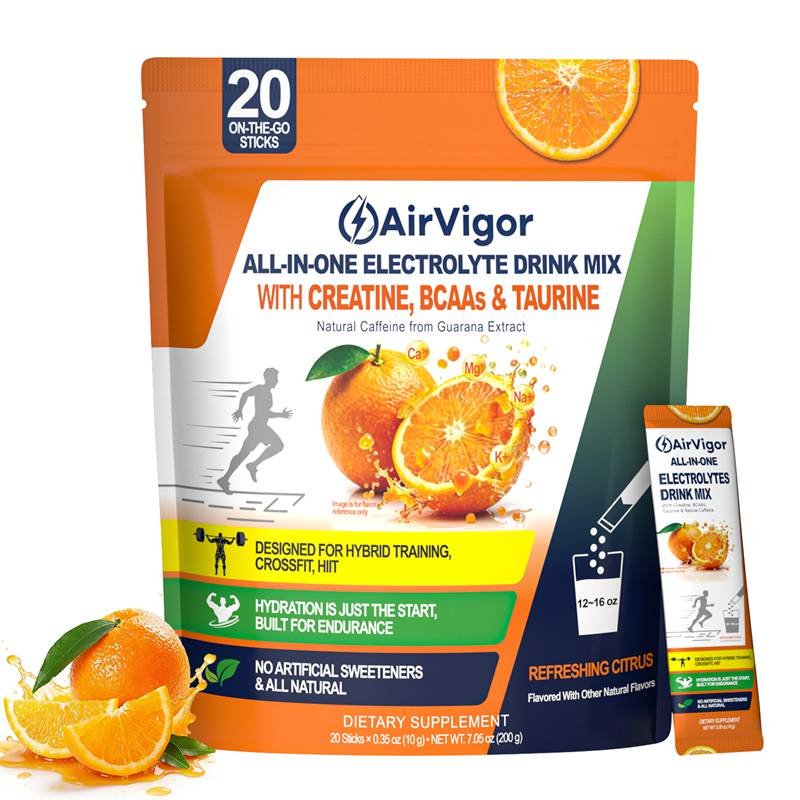
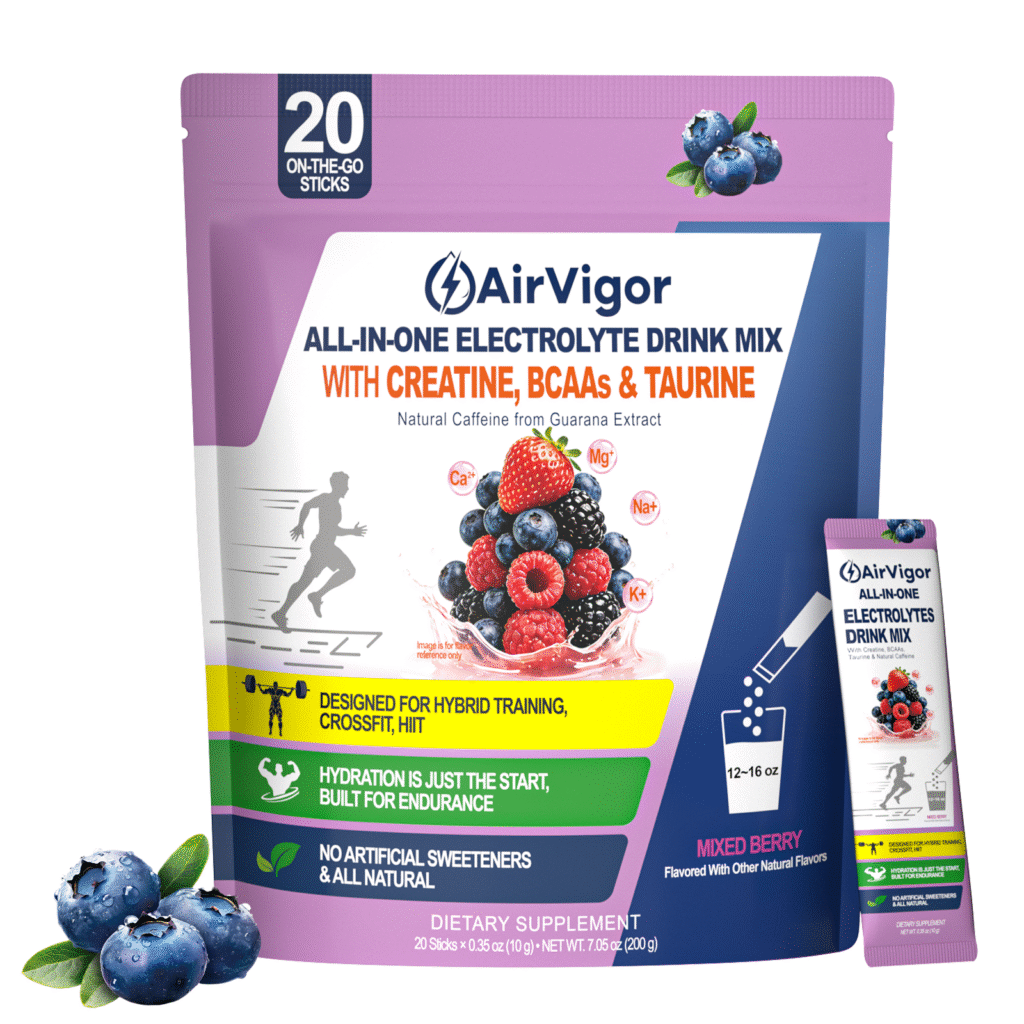
Your Peak Performance Pre-Workout Powder fits best when the customer’s problem starts during the session, not after it. This formula combines electrolytes with creatine, taurine, an amino-acid blend, BCAA, citrulline, guarana extract, and key minerals such as sodium, potassium, calcium, and magnesium. That means it is not trying to act like a simple hydration powder. It is designed more like a performance-support system that also covers hydration.
This matters because many serious training sessions are not just “sweat events.” They are output events. The athlete is trying to stay sharp, keep effort stable, avoid the mid-session drop-off, and handle both muscular and cardiovascular demand at the same time. That is especially relevant for:
- CrossFit users
- HIIT users
- hybrid endurance-strength athletes
- intense morning or after-work trainers
- team-sport athletes doing repeated hard efforts
- people who want fewer separate tubs and simpler timing
A practical fit table makes this clearer:
| If the customer says… | Why Peak Performance fits |
|---|---|
| “I fade halfway through hard sessions.” | The formula is built for more than hydration alone. |
| “I sweat a lot and still need to perform.” | Electrolytes are already integrated into the structure. |
| “I don’t want to buy three separate products.” | It reduces stacking and simplifies routine use. |
| “I need hydration plus endurance and training support.” | Better fit than a plain electrolyte drink. |
How Does Recovery + Collagen Fit?
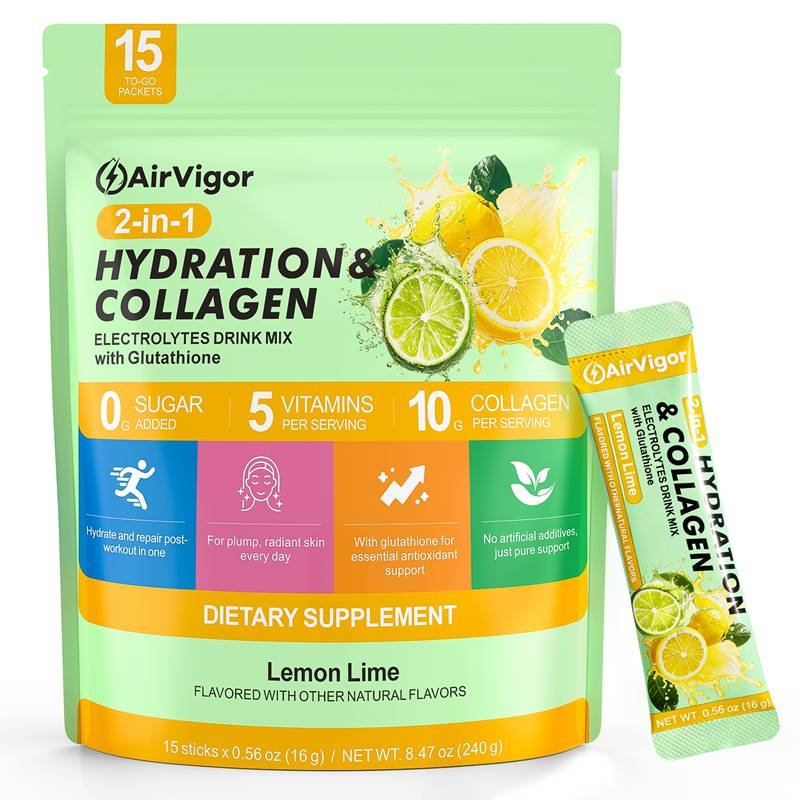
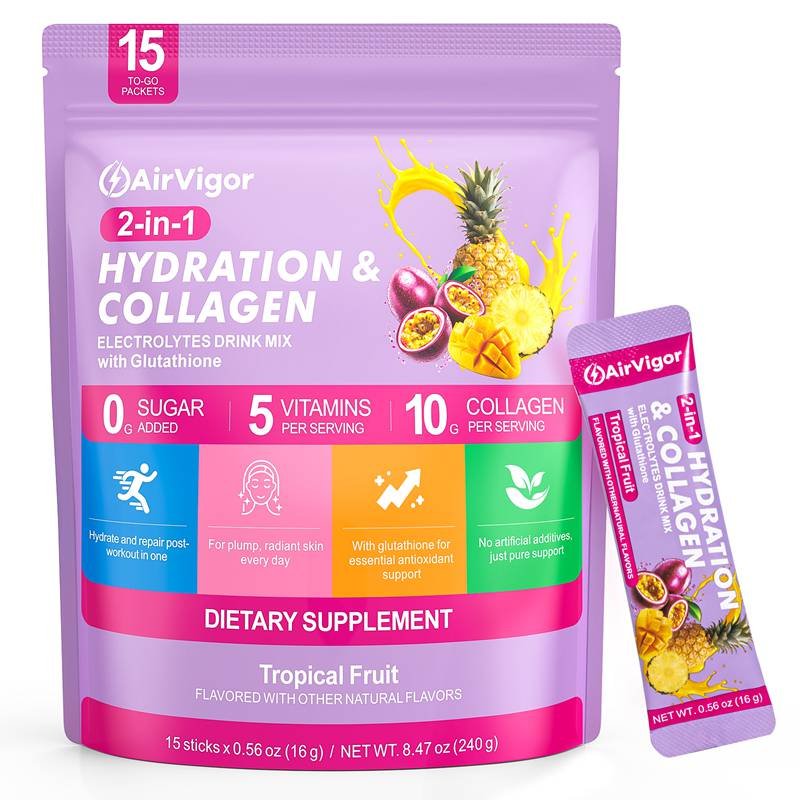
Your All-in-One Sports Recovery & Hydration Formula fits a very different problem. This product is strongest when the issue shows up after the session. Based on the formula details you provided, it combines electrolytes with a collagen blend, vitamin C, B vitamins, and glutathione. That gives it a broader recovery role than either water or a standard sports drink.
This is important because many customers finish a workout dealing with several problems at once:
- they are thirsty
- they are hungry
- they do not want a heavy meal right away
- they know they need recovery support
- they want something more complete than plain hydration
That is where a broader recovery formula becomes more useful than a standard sports drink. Sports drinks were built mainly to support hydration and quick energy during exercise or physical labor. They were not built to act as a fuller post-workout recovery format. The American Heart Association’s distinction is useful here: sports drinks are fundamentally fluid plus energy products, not broad recovery products.
A comparison table helps:
| Post-workout situation | Better fit |
|---|---|
| “I only need water.” | Water |
| “I need hydration plus carbs during the workout.” | Sports drink |
| “I need hydration plus broader recovery support after training.” | Recovery + Collagen |
How Does Recovery Electrolytes Fit?
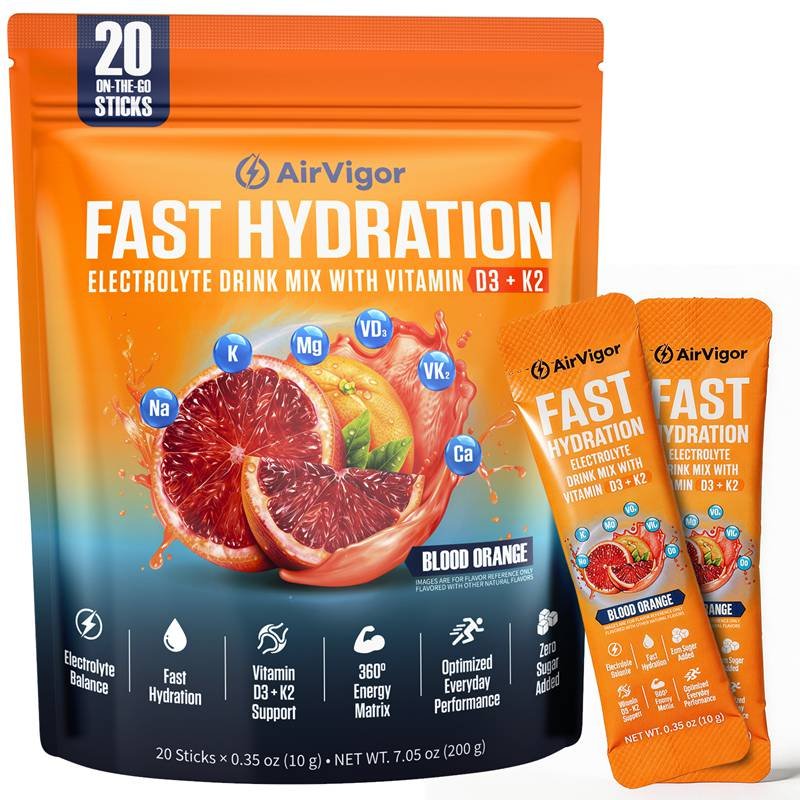
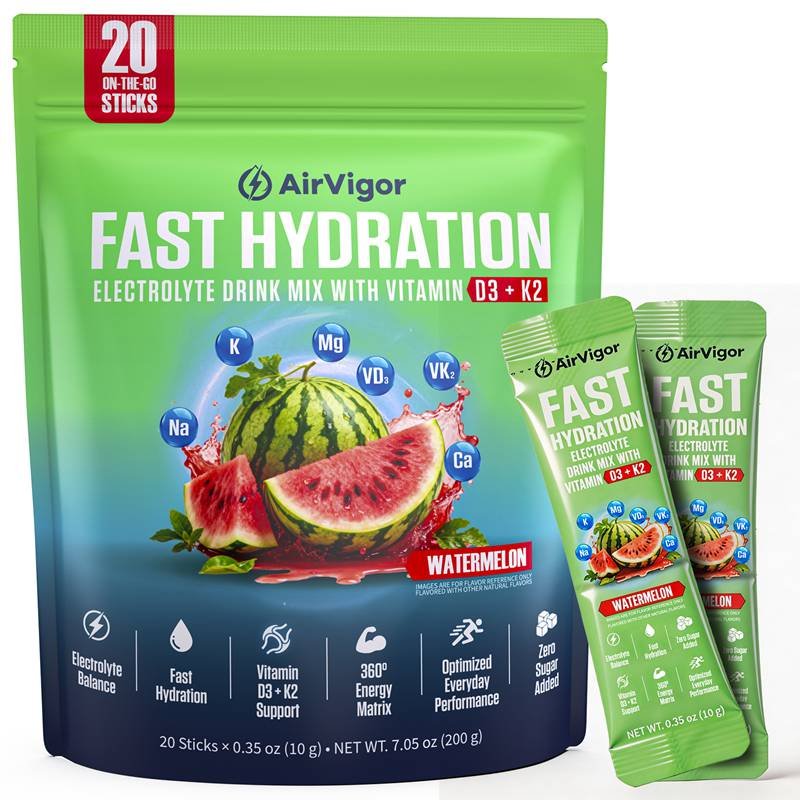
Your Recovery Electrolytes formula is the cleanest fit for customers who need a more straightforward electrolyte-first option. Based on your product details, it centers on sodium, potassium, chloride, calcium, magnesium, and vitamins D3 + K2. That makes it much closer to the electrolyte side of the comparison than to the sports-drink side.
This matters because not every user needs carbohydrates in the bottle. Public guidance repeatedly separates these needs. For many people, water is still enough. Sports drinks become more useful mainly when the activity is longer, harder, or especially sweaty. That leaves a very practical middle ground where an electrolyte-focused product makes sense: people who sweat more than average, want more support than water alone, but do not need the extra sugar of a sports drink. The American Heart Association notes that sports drinks can be useful in high-intensity or very hot conditions, but also points out that they tend to be high in added sugars and calories.
A use-case table helps:
| If the customer mainly needs… | Why Recovery Electrolytes fits |
|---|---|
| Better hydration after sweating | Electrolyte-first structure |
| A cleaner option than sugary sports drinks | Better fit for low-fuel situations |
| Travel, outdoor work, heat exposure, long days | Practical broad-use support |
| Daily-use hydration support with simpler positioning | Easier fit than a sports drink |
Which Product Matches Your Goal Best?
The easiest way to choose is to match the product to the moment where the problem shows up.
| Goal | Best fit |
|---|---|
| You want performance support during demanding training | Peak Performance |
| You want broader recovery support after training | Recovery + Collagen |
| You want simpler hydration and electrolyte support | Recovery Electrolytes |
The logic is simple:
- choose Peak Performance when the problem happens during the session
- choose Recovery + Collagen when the problem becomes obvious after the session
- choose Recovery Electrolytes when the main issue is broader hydration and anti-fatigue support
Working With AirVigor
For end users, the next step is practical. If your sessions are intense and mixed, and you want hydration support inside a more complete performance formula, Peak Performance is the strongest fit. If your main problem is recovery after the workout — thirst, low appetite, and the need for something more complete than water — Recovery + Collagen makes more sense. If you mainly want a simpler electrolyte product for sweat loss, fatigue support, travel, outdoor use, or everyday rehydration, Recovery Electrolytes is the cleaner fit.
For business customers, this same structure creates three clear product directions:
- performance hydration
- recovery hydration
- daily-use electrolyte support
That is useful because different markets want different stories. A gym-heavy audience may want a performance-hydration formula. A wellness or beauty-leaning audience may respond better to recovery plus collagen. A broader mass-market hydration customer may prefer a straightforward electrolyte-first product.
| Business goal | How AirVigor can support it |
|---|---|
| Launch a hydration-focused supplement line | Three clear product directions already exist |
| Build a private-label formula | OEM and ODM support are available |
| Develop different products for different sales channels | Performance, recovery, and daily-use categories are already separated |
| Test formula direction before scaling | Sample development and flexible customization support |
| Localize for multiple markets | Existing multi-market compliance and labeling experience |
Based on the company information you provided, AirVigor offers more than finished products. It also has the manufacturing and product-development structure behind it:
- 25+ nutrition science and food engineering researchers
- independent testing for purity, active content, stability, and solubility
- 20,000+ formulation models built and validated
- 300+ nutrition-related technology patents
- GMP, HACCP, ISO22000, FSSC, halal, organic, kosher, and related quality systems
- in-house packaging, printing, and product information coordination
- OEM, ODM, and sample-development support
- multi-country labeling and compliance adaptation
For consumers, that means better product clarity and a more consistent use experience. For distributors, retailers, and brand partners, it means a stronger path from concept to launch.
So whether you want to:
- order AirVigor-branded hydration products
- compare the three formulas for your audience
- develop a private-label electrolyte or sports-hydration product
- request samples
- ask about MOQ, flavors, packaging, OEM, ODM, or production timing
AirVigor has the structure to support that process.