Skip to content
Collagen Hydration Powder for Faster Recovery
After training, your body does not just need water
it needs hydration and recovery at the same time.
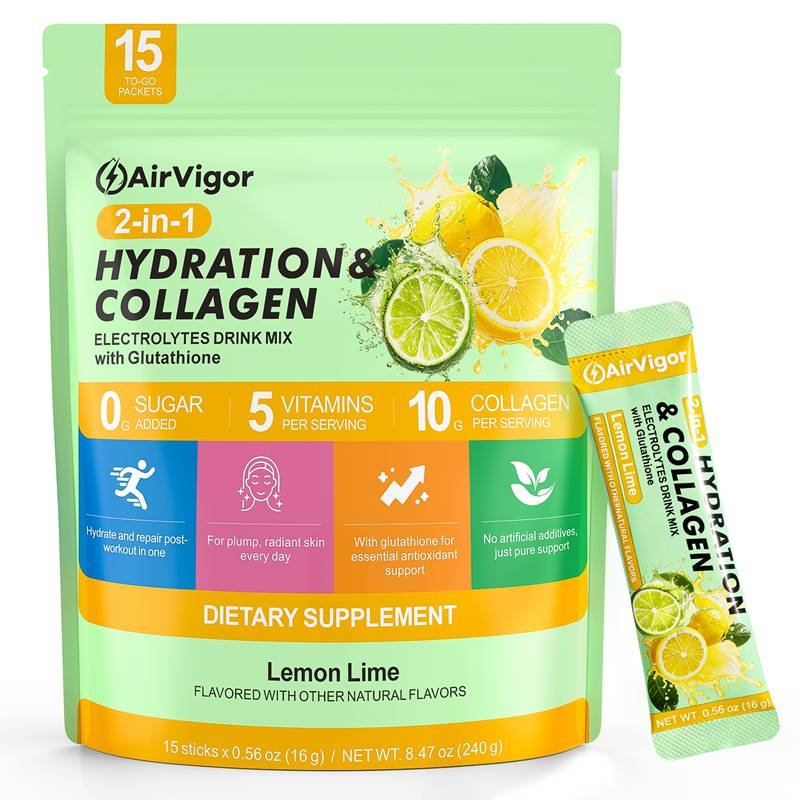
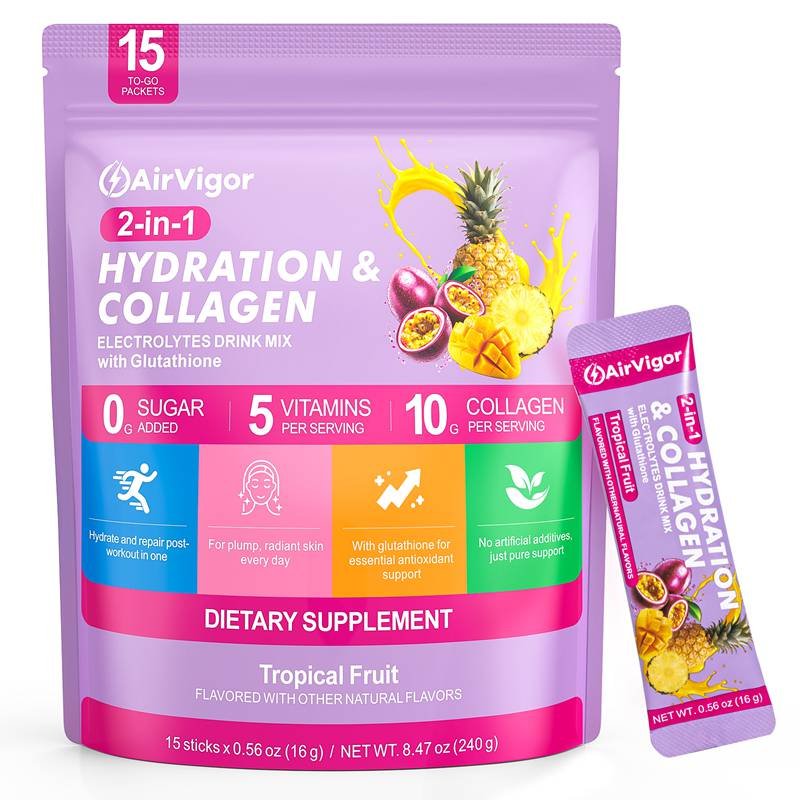
AirVigor Collagen Hydration Powder is designed to bridge that gap with a single, easy-to-drink formula that fits naturally into real post-workout routines. It helps you rehydrate, restore essential electrolytes, and start recovery immediately — without the heaviness of traditional protein shakes.
Each serving delivers:
- 10g collagen protein (bovine + marine sources)
- 200mg sodium + 370mg potassium
- Vitamin C and B-complex support
Start recovery the moment your workout ends — not later, not separately.
WHY RECOVERY OFTEN FEELS INCONSISTENT
Recovery does not fail because of effort. It breaks down when hydration and nutrient support are handled separately, especially in the first hour after activity. Most post-workout routines appear correct on the surface, but miss how the body actually responds during this period.

When Hydration and Recovery Fall Out of Sync
After training, a drop in performance or recovery quality is rarely random. It usually reflects a mismatch between what the body needs and what it actually receives in the first hour after activity.
In most cases, two signals appear at the same time — and they are often misinterpreted.
- Thirst that persists even after drinking water
- Hunger that does not match a full meal or heavy shake
- A noticeable drop in energy within 15–30 minutes post-training
This pattern is common across both strength and endurance training, yet it is often treated as simple fatigue rather than a recovery gap.

What These Signals Actually Indicate
These symptoms reflect two parallel physiological conditions:
- Fluid and electrolyte loss through sweat During moderate to intense training, fluid loss can reach 0.5–1.5 liters per hour, depending on temperature and intensity. Sodium and potassium are lost along with it.
- Nutrient depletion from physical output Muscle activity increases the demand for amino acids, especially in the period immediately following exercise.
These processes occur simultaneously — not separately.
Where Most Recovery Routines Become Inefficient
In practice, recovery is often handled in isolated steps.
| Common Habit | What It Solves | What It Leaves Unaddressed |
|---|---|---|
| Drinking water | Replaces fluid volume partially | Does not restore electrolyte balance or support recovery |
| Protein shake | Provides amino acids for repair | Does not address hydration; often delayed due to low appetite |
| Electrolyte drink | Restores fluid and mineral balance | Does not provide protein for recovery processes |
Each approach addresses one need, but not the full condition.
What Happens When Recovery Is Split
When hydration and recovery are handled separately — or delayed — several patterns tend to appear:
- Recovery intake is postponed due to low appetite
- Hydration is prioritized, but nutrient intake is incomplete
- Protein intake is delayed by 30–60 minutes or more
- Recovery becomes inconsistent across sessions
This is not a lack of discipline.
It is a mismatch between recovery methods and real post-activity conditions.
Fix the gap in your recovery routine →
What Recovery Actually Requires After Training
Recovery is often treated as separate actions — drink water first, eat later, take protein when convenient. In reality, the body does not recover in stages but responds as an integrated system where hydration, nutrient delivery, and tissue repair are interconnected from the start.

1、Recovery Requires Fluid and Electrolyte Restoration
After physical activity, the body loses not only water but also essential electrolytes through sweat. Restoring fluid balance is the first step in stabilizing internal conditions.
- Fluid loss can reach 0.5–1.5 liters per hour depending on intensity
- Sodium and potassium are critical for maintaining balance
- Without electrolyte support, hydration remains incomplete
When fluid and electrolyte levels are not restored together, the body cannot efficiently return to a stable state.

2、Recovery Requires Efficient Nutrient Delivery
Recovery depends not only on what is consumed, but on how effectively it is transported and utilized.
Hydration status directly affects:
- Circulation efficiency
- Nutrient transport speed
- Cellular uptake
When hydration is insufficient, the delivery of nutrients slows down, reducing the effectiveness of any recovery intake.

3、Recovery Requires Immediate Protein Availability
After training, the demand for amino acids increases as the body begins repair processes.
However, timing and conditions influence how effectively protein is used.
- Delayed intake reduces responsiveness
- Low hydration may affect absorption efficiency
- Inconsistent intake leads to uneven recovery
Providing protein during the early recovery period allows these processes to begin without delay.
Support recovery from the first minute→
What Is Collagen Hydration Powder
Once recovery is understood as a system, requiring fluid balance, efficient nutrient delivery, and immediate protein availability — Collagen hydration powder is designed to meet these combined requirements in a single step.
A Functional Format Built Around Recovery Needs
Collagen hydration powder is a blended formula that combines:
- Electrolytes for fluid and mineral balance
- Collagen protein for amino acid support
- Supporting nutrients that enhance utilization
Instead of separating hydration and recovery into different products, this format allows both to begin together — immediately after activity.
How It Differs from Traditional Recovery Options
Most recovery approaches are built around single functions.
| Category | Primary Focus | Limitation in Practice |
|---|---|---|
| Water | Fluid replacement | No electrolyte balance, no recovery support |
| Electrolyte drinks | Hydration | No protein for tissue repair |
| Protein shakes | Muscle recovery | Often heavy, delayed intake, no hydration support |
Collagen hydration powder is positioned between traditional hydration products and protein-based recovery options, as it is not intended to replace full meals or high-protein shakes but to support the early recovery window when both fluid balance and nutrient availability need to be addressed simultaneously, particularly in situations where heavy intake or multi-step routines are less practical.

Understand recovery differently→
How Hydration and Recovery Work Together
Recovery efficiency is not determined only by what is consumed, but by how quickly and effectively the body can absorb, transport, and utilize those inputs.
From Intake to Recovery: A Connected Process
When hydration and protein are provided together, the body responds through a coordinated sequence:
Electrolytes support fluid absorption in the intestine
Sodium facilitates the uptake of water, allowing fluid levels to be restored more efficiently than water alone.
Improved hydration supports circulation
As fluid balance is restored, blood volume stabilizes, enabling more effective transport of nutrients.
Collagen-derived amino acids are delivered to tissues
With circulation functioning efficiently, amino acids can be distributed where recovery processes are active.
Repair processes begin without delay
The presence of both hydration and amino acids allows recovery mechanisms to initiate earlier and operate more consistently.
Functional Roles Within the Formula
| Component | Amount (Per Serving) | Role in the Process | Practical Effect |
|---|---|---|---|
| Sodium | 200mg | Supports fluid absorption | Faster rehydration after sweat loss |
| Potassium | 370mg | Maintains fluid balance | Reduces imbalance and fatigue |
| Collagen Protein | 10g | Provides amino acids | Supports connective tissue recovery |
| Vitamin C | 62mg | Supports collagen synthesis | Improves utilization efficiency |
| B Vitamins | Included | Supports metabolic processes | Helps maintain energy post-activity |

Make recovery more efficient from the start→
Single-Solution Recovery Often Leaves Gaps
Most recovery routines rely on a single solution — hydration, protein, or electrolytes. While each serves a purpose, none fully addresses the combined conditions that occur after physical activity.
How Common Recovery Choices Perform
| Approach | What It Addresses | Where It Becomes Limited |
|---|---|---|
| Water | Replaces fluid volume | Does not restore electrolyte balance or support recovery processes |
| Electrolyte drinks | Improve hydration and mineral balance | Do not provide amino acids required for tissue repair |
| Protein shakes | Support muscle recovery | Often delayed due to low appetite; do not address hydration |
| Combined hydration and protein | Addresses both conditions | More aligned with actual recovery needs |

Where These Approaches Break Down
In practical scenarios:
- Water is consumed immediately, but recovery nutrients are delayed
- Protein intake is postponed due to low appetite or preparation time
- Electrolyte intake restores fluids but leaves recovery incomplete
This creates a fragmented process where hydration and recovery do not occur under the same conditions.

Why This Fragmentation Reduces Effectiveness
When recovery steps are separated:
- Hydration may not support nutrient delivery at the right time
- Protein may be consumed under suboptimal conditions
- Recovery initiation becomes inconsistent
Over time, this leads to variability in recovery quality rather than predictable outcomes.
Replace fragmented recovery with one simple step
Who This Type of Recovery Is Designed For
Collagen hydration powder is not defined by a single type of activity. It is designed for situations where hydration and recovery need to happen together, but are often delayed, simplified, or skipped due to real-world constraints.

Strength Training and High-Intensity Workouts
After 45–75 minutes of strength training or high-intensity sessions, fluid loss becomes noticeable while muscle demand for recovery increases. However, appetite is often reduced, making traditional protein shakes less appealing immediately after training. This is where a lighter, drinkable format allows both hydration and recovery to begin without delay, improving consistency across sessions.

Endurance and Long-Duration Activities
During running, cycling, or extended sessions, the body experiences continuous fluid and electrolyte loss. Post-activity fatigue is often a combination of dehydration and nutrient depletion rather than a single factor. A combined hydration and recovery approach allows both conditions to be addressed at the same time, supporting a smoother transition after prolonged effort.

Yoga, Pilates, and Low-Intensity Training
Not all training requires a high-calorie recovery solution. After yoga or Pilates, fatigue is usually moderate, but hydration and light recovery support are still beneficial. A heavy protein shake may feel unnecessary, while water alone may not fully address post-session needs. A lighter formulation provides a more appropriate balance without adding excess intake.

Physically Demanding Work Environments
In high-temperature or labor-intensive conditions, fluid loss can accumulate throughout the day. At the same time, muscle fatigue develops gradually due to repeated physical effort. Recovery in these situations is not limited to post-activity but needs to occur continuously. A hydration and recovery drink can function as both fluid support and nutritional reinforcement during work hours.

Time-Constrained or Busy Schedules
For individuals with limited time, recovery is often inconsistent rather than absent. Work, commuting, and daily responsibilities reduce the likelihood of preparing multiple recovery products. In these cases, a single-step solution that requires minimal preparation increases the probability of consistent use, which is more impactful than occasional, ideal routines.

Inconsistent Recovery Habits
Many individuals follow structured training plans but lack a consistent recovery process. Hydration, nutrition, and timing are often handled irregularly, leading to variable results despite similar effort levels. A simplified approach that combines hydration and recovery into one step reduces the likelihood of missed intake and supports more stable long-term outcomes.
See if this fits your routine→
When to Use Collagen Hydration Powder
Recovery is influenced not only by what you take, but by when you take it. The body responds differently across phases of activity, and timing determines how effectively hydration and recovery processes begin.
After Activity — The Most Critical Window
The most relevant moment for collagen hydration powder is within 30–60 minutes after activity.
During this period:
- Fluid loss is most noticeable
- Electrolyte balance needs to be restored
- Muscles are more responsive to nutrient availability
- Appetite is often reduced
This combination makes heavy meals or protein shakes less practical. A light, drinkable format allows recovery to begin immediately, without waiting for appetite or preparation.
AirVigor is designed specifically for this transition point, enabling hydration and recovery to start together rather than separately.
During Activity — Maintaining Balance Over Time
For longer sessions or continuous physical effort, hydration becomes an ongoing requirement rather than a single event.
Sipping a balanced hydration drink during activity helps:
- Maintain fluid balance
- Reduce cumulative fatigue
- Support performance consistency across phases
While not always necessary for shorter sessions, this approach becomes more relevant as duration and intensity increase.
Before Activity — Preparing Initial Conditions
In certain situations, taking electrolytes before activity can help establish a more stable starting point.
This is especially useful for:
- Morning training sessions
- Fasted workouts
- High-intensity sessions in warm conditions
Starting in a well-hydrated state reduces early fatigue and helps maintain output in the initial phase of activity.
A Simple Timing Framework
| Timing | How to Use | Purpose |
|---|---|---|
| Before activity | Optional, 20–30 minutes prior | Prepare hydration status |
| During activity | Sip as needed | Maintain fluid balance |
| After activity | 30–60 minutes window | Start hydration and recovery |

Use the right timing to improve recovery→
Why AirVigor Is Designed Differently for Real Recovery Use
Most recovery products are built around individual ingredients or isolated functions. AirVigor is structured around this principle — not as a collection of ingredients, but as a format designed for how recovery actually happens.
A Balanced Composition Without Excess Load
Each serving is calibrated to provide targeted support without unnecessary heaviness.
With 10g of collagen protein, the formula delivers amino acids needed for recovery without the density of traditional protein shakes. At the same time, 200mg of sodium and 370mg of potassium support fluid absorption and electrolyte balance, aligning hydration and recovery within the same intake.
This balance allows the product to function effectively in the early recovery window, where appetite is often limited but recovery demand is high.

Dual-Source Collagen for Broader Functional Support
AirVigor combines bovine and marine collagen sources, providing a broader amino acid profile to support connective tissue, joints, and overall recovery.
Rather than focusing on high protein volume, this approach prioritizes functional relevance and usability, making it more suitable for repeated daily use.
Designed for Immediate Use, Not Delayed Intake
One of the main limitations of traditional recovery products is timing. Heavy shakes or multi-step routines often delay intake by 30–60 minutes or more, reducing consistency.
AirVigor addresses this by using a 16g stick pack format that mixes quickly and can be consumed within minutes after activity. This removes preparation barriers and supports immediate use at the moment recovery should begin.

A Flavor Profile That Supports Consistency
Taste is not a secondary factor in recovery — it directly affects long-term adherence.
AirVigor is formulated with a light, balanced flavor profile, combining mild sweetness with a subtle electrolyte finish. This makes it easier to consume after training, when tolerance for heavy or overly sweet drinks is often reduced.
Positioned Between Hydration and Full Nutrition
AirVigor is not designed to replace meals or high-calorie recovery shakes. Instead, it fills the gap between hydration and full nutrition.
This positioning allows it to function as a transition step — enabling hydration and recovery to begin immediately, while leaving space for regular meals later.
Choose a recovery solution that fits real use→
What Changes When Recovery Becomes Consistent
The impact of recovery is rarely defined by a single session. It becomes noticeable when the process starts at the right time and is repeated consistently, especially in the period immediately following activity.

A More Immediate Transition After Activity
When recovery begins within minutes instead of being delayed by 20–60 minutes, the body transitions more smoothly from exertion to restoration.
Rather than a prolonged period of fatigue followed by gradual recovery, the shift becomes more continuous and controlled.
More Stable Energy Across Sessions
When fluid balance and nutrient availability are addressed together, energy levels after training tend to stabilize.
This does not necessarily increase peak performance, but it reduces the variability that often occurs between sessions, particularly in repeated weekly training.

Less Interruption in Recovery Patterns
One of the most common issues in recovery is inconsistency — not absence.
By removing delays and reducing friction, recovery becomes a repeatable step rather than an occasional action. This leads to fewer gaps between what is intended and what is actually done.
A More Predictable Recovery Response Over Time
As hydration and recovery begin under the same conditions each time, the body’s response becomes more predictable.
Instead of fluctuating outcomes, the pattern shifts toward consistency, which is often more relevant for long-term performance than isolated improvements.
Build a recovery routine you can actually maintain→
How It Fits Into Your Daily Routine
A recovery approach only works if it can be repeated consistently. A routine that requires preparation, multiple products, or precise timing is more likely to be delayed or skipped, even when the intention to recover is clear.

A Single Step at the Point Where Routines Usually Break
The moment immediately after activity is where most recovery routines become inconsistent. Hydration is often addressed first, while protein intake is delayed due to low appetite or inconvenience.
A combined, drinkable format allows both to begin in the same step. By reducing the process to something that can be mixed and consumed within minutes, it becomes easier to act before attention shifts to other tasks.

A Practical Bridge Before Normal Nutrition Resumes
This approach is not intended to replace meals, but to support the transition period before regular nutrition becomes practical.
After activity, appetite typically returns gradually over 30–90 minutes. A lighter intake during this period allows hydration and recovery to begin without interfering with later food intake, maintaining continuity rather than creating gaps.

Adaptable Across Different Environments
Recovery does not always take place in controlled or ideal conditions. It often occurs in environments where preparation is limited — at the gym, outdoors, or during physically demanding work.
A portable, single-serving format allows the same recovery step to be applied consistently across these situations, without requiring adjustments or additional planning.
A Simple Structure That Can Be Repeated Daily
| Moment | Action | Role in the Routine |
|---|---|---|
| Immediately after activity | Drink one serving | Initiates hydration and recovery together |
| 30–90 minutes later | Resume normal meals | Completes overall nutritional intake |
| Throughout the day | Maintain regular hydration | Supports ongoing balance |
Make recovery part of your routine — not an extra step→
Real Use Cases from Consistent Recovery Routines
When recovery is simplified into a single, repeatable step, the changes are not immediate or extreme, but they become noticeable through consistency. The following examples reflect how combined hydration and recovery support fits into different routines, age groups, and real-life conditions.

Daniel R. — 34, Strength Training (5–6 Sessions per Week)
Daniel follows a structured strength training routine with sessions lasting 60–75 minutes. Previously, he often delayed protein intake due to low appetite, typically waiting 30–60 minutes after training.
After introducing a combined hydration and recovery step immediately post-workout, his intake became consistent and immediate.
Within 2–3 weeks, he reported more stable energy across sessions and fewer missed recovery days.

Emily S. — 29, Yoga & Pilates (3–4 Sessions per Week)
Emily’s routine focuses on low-intensity training. Before, she relied only on water and did not follow a structured recovery process.
By adding a light hydration and recovery drink after each session, she introduced a consistent recovery step without increasing calorie intake.
After 2 weeks, she noticed reduced post-session fatigue and improved routine consistency.

Jason L. — 27, Endurance Training (Running & Cycling)
Jason trains for endurance events, with sessions often exceeding one hour. Hydration was part of his routine, but recovery intake was inconsistent and usually delayed until meals.
After shifting to a single-step recovery approach immediately after training, he was able to start recovery without waiting for appetite.
Over several weeks, he experienced a smoother post-training transition and less variability in fatigue.

Michael T. — 41, Outdoor Physical Work (High-Heat Conditions)
Michael works in a physically demanding environment with continuous heat exposure. His previous approach focused mainly on hydration, with little attention to recovery.
By incorporating a combined hydration and protein intake during and after work, he addressed both fluid loss and ongoing physical strain.
Within 2–3 weeks, he reported more stable energy levels and reduced accumulated fatigue across workdays.

Sarah K. — 38, Busy Professional with Irregular Workouts
Sarah maintains a moderate workout routine but struggles with consistency due to a busy schedule. Recovery was often skipped because of time constraints or lack of preparation.
After switching to a simple, single-step recovery approach, she was able to integrate recovery into her routine without additional effort.
Within a few weeks, she reported fewer skipped recovery days and a more consistent post-workout pattern.

David M. — 52, Active Lifestyle & General Fitness
David focuses on maintaining an active lifestyle rather than structured training. His recovery approach was previously unstructured, relying mostly on water and occasional protein intake.
By adding a light hydration and recovery step after activity, he established a more consistent routine without increasing intake complexity.
Over time, he reported improved post-activity recovery comfort and more stable energy levels throughout the day.
FREQUENTLY ASKED QUESTIONS
1. Is collagen hydration powder a replacement for protein shakes?
No. It is not designed to replace full protein intake or meals. AirVigor provides 10g of collagen protein per serving, which supports recovery in the early post-activity window, but it works best as a first step before regular nutrition rather than a complete substitute.
2. Can this replace drinking water after exercise?
No. Regular water intake is still important throughout the day. However, after activity, hydration alone may not fully address electrolyte loss or recovery needs. A combined approach helps restore fluid balance while also supporting recovery at the same time.
3. Why combine electrolytes and collagen instead of taking them separately?
Because timing matters. After activity, hydration and recovery processes begin simultaneously. When they are handled separately, one is often delayed. Combining them allows both to start immediately, improving consistency rather than requiring multiple steps.
4. Will this feel heavy like a traditional protein drink?
No. The formulation is designed to be light and easy to drink, especially in situations where appetite is low. This makes it more practical to use immediately after activity, when heavier options are often postponed.
5. When is the best time to use it?
The most relevant time is within 30–60 minutes after activity, when fluid loss is highest and the body is more responsive to nutrient intake. It can also be used before or during longer sessions if needed, but its primary role is the transition step after activity.
6. Who benefits most from this type of product?
It is most useful for individuals who experience inconsistent recovery due to time constraints, low appetite after training, or the need to manage hydration and recovery separately. It is particularly relevant for regular training routines, physically demanding work, or active daily schedules.
7. Is it suitable for daily use?
Yes. The formulation is designed for repeated use, especially in routines where hydration and recovery need to be maintained consistently. Its light format makes it easier to integrate into daily habits without adding complexity.
8. What makes this different from standard electrolyte drinks?
Standard electrolyte drinks focus on hydration only. AirVigor combines electrolytes with collagen protein and supporting nutrients, allowing hydration and recovery to begin together rather than in separate steps.

Start a more consistent recovery routine today→