Skip to content
Electrolytes with Collagen for Post-Workout Recovery
Electrolytes with collagen are increasingly used as a practical post-workout solution for people who need both hydration and muscle recovery. Instead of using separate products, combining electrolytes and collagen in one drink makes recovery easier to follow and more consistent over time.
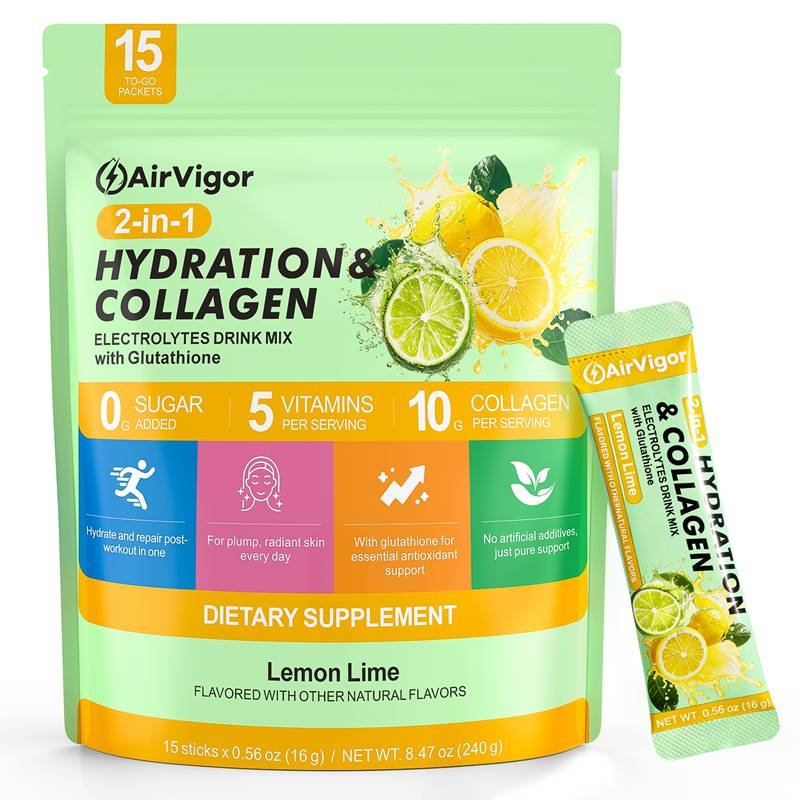
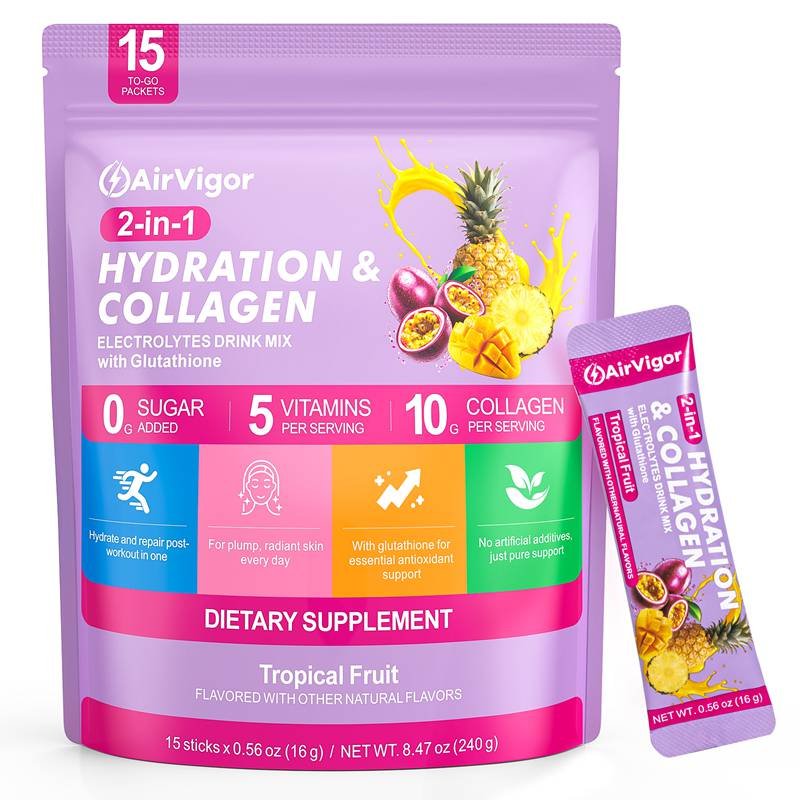
AirVigor Electrolytes with Collagen combines hydration support and protein intake in one simple step.
Each serving includes:
- 10g collagen protein (bovine + marine)
- 200mg sodium and 370mg potassium
- Vitamin C and B-complex support
- A light, easy-to-drink formula
Designed for use within the 30–60 minute post-workout window, it helps you start recovery without adding extra steps to your routine.
Why Post-Workout Recovery Often Feels Incomplete
Recovery often feels simple, but many people still feel tired, dehydrated, or low on energy after training. This usually happens because only part of the recovery process is being addressed.


Hydration Is Replaced, But Not Fully Restored
After moderate to intense training sessions, especially those lasting 45 to 90 minutes, fluid loss is not limited to water alone. Sweat also carries out sodium and other electrolytes that help regulate fluid balance. When only plain water is consumed, hydration may feel temporarily improved, but it does not last as effectively because key electrolytes are missing. Over time, this can make recovery feel incomplete, even when fluid intake seems sufficient.
Protein Is Taken, But Hydration Is Overlooked
Many people focus on protein after training, but this often happens separately from hydration. While protein supports muscle repair, it does not address fluid loss or electrolyte depletion. As a result, even after taking protein, the body may still feel dehydrated or low in energy. This creates a gap where recovery is only partially supported, especially after higher-intensity workouts.
Recovery Steps Are Split and Hard to Maintain
In real routines, recovery is often divided into multiple steps, such as drinking water, preparing a protein shake, and managing timing. After training, when appetite is low and fatigue is present, this process can feel inconvenient. It is common for one step to be delayed or skipped entirely. Over time, this leads to inconsistent recovery, where some sessions are supported and others are not.
The Body Needs Multiple Things at the Same Time
Feeling both thirsty and hungry after exercise is not random. It reflects the body’s need to restore fluid balance, replenish electrolytes, and provide amino acids for repair at the same time. When these needs are addressed separately or at different times, recovery becomes slower and less efficient. The issue is not a lack of effort, but a lack of alignment in how recovery is approached.
Recovery Feels Inconsistent Across Sessions
Even with similar training routines, recovery can feel different from day to day. Some sessions feel smooth, while others leave lingering fatigue or soreness. This inconsistency often comes from uneven recovery habits rather than differences in training itself. When hydration and nutrient intake are not handled in a consistent way, results become less predictable over time.
Recovery Routines Are Not Built for Real Life
Many recovery strategies look effective in theory, but are harder to follow in real situations. Busy schedules, low appetite after training, and the need to prepare multiple products can all reduce consistency. When a routine requires too many steps or too much effort, it becomes less likely to be repeated, even if the approach itself is correct.
BEFORE VS AFTER
What Changes When Recovery Becomes Consistent
Recovery is not always obvious after a single workout. The difference becomes more noticeable over several sessions, especially when hydration and protein intake are handled more consistently.

Without a Consistent Recovery Routine
After moderate to intense training (45–90 minutes), incomplete recovery often shows up in small but noticeable ways:
- Hydration takes longer to feel restored, especially after heavy sweating
- Muscle soreness can last into the next day or affect the following session
- Energy levels may drop earlier during workouts
- Performance can vary from one session to another
Over time, this leads to uneven training quality and less predictable progress.

With a More Complete Recovery Approach
When hydration and protein intake are addressed together shortly after training:
- Fluid balance is restored more efficiently within the first few hours
- Muscles tend to feel less tight or stiff the next day
- Energy levels remain more stable across sessions
- Workouts feel more consistent from one day to the next
This does not change results overnight, but it improves how the body responds over time.
Comparison
| Experience | Incomplete Recovery | More Complete Recovery |
|---|---|---|
| Hydration | Slower rehydration after sweat loss | Fluid balance restored more efficiently |
| Muscle Feel | Soreness may carry into next session | Reduced stiffness the next day |
| Energy | Drops earlier during workouts | More stable throughout sessions |
| Routine | Inconsistent, easy to skip steps | Easier to follow consistently |

Make recovery more consistent, not more complicated.
Why Most Recovery Options Still Leave a Gap
After training, recovery is usually handled in separate steps. One product focuses on hydration, while another focuses on protein. In practice, this split approach often makes recovery less complete and harder to follow consistently.
What Happens With Common Choices
In real use, especially after 45–90 minute sessions or high sweat workouts, different options solve different parts of the problem:
| Option | What It Does Well | What It Misses |
|---|---|---|
| Water | Replaces fluid volume | Does not restore sodium or support nutrient retention |
| Electrolyte drinks | Help maintain fluid balance | Do not provide amino acids for muscle repair |
| Protein shakes | Provide protein for recovery | Do not address hydration and often feel heavy post-workout |
| Separate products | Can cover both needs | Requires multiple steps, often delayed or skipped |
Even when people understand they need both hydration and protein, the extra steps are often not followed consistently, especially right after training.

Where AirVigor Fits In
Instead of separating hydration and recovery, AirVigor combines both into a single step that fits more naturally into post-workout routines.
Each serving provides:
- 200mg sodium + 370mg potassium to support fluid balance after sweat loss
- 10g collagen protein for early-stage recovery
- A light, easy-to-drink format designed for immediate use
This makes it easier to start recovery within the first 30–60 minutes after training, without needing to prepare multiple products.

Side-by-Side Comparison
| Feature | Water | Electrolyte Drink | Protein Shake | AirVigor |
|---|---|---|---|---|
| Hydration Support | Replaces fluid only | Supports fluid + electrolytes | Not designed for hydration | Supports hydration + retention |
| Protein Support | None | None | High protein, often delayed intake | Moderate protein, immediate use |
| Post-Workout Comfort | Easy to drink | Easy to drink | Can feel heavy or thick | Light and easy to finish |
| Routine Complexity | Simple | Simple | Requires preparation | Single-step routine |
| Consistency Over Time | Low impact | Partial recovery | Often skipped after training | Easier to repeat daily |

Recovery works best when it’s simple enough to do every time.
What Actually Makes a Recovery Routine Work
Recovery does not depend on one single factor. In real use, especially after moderate to intense sessions (45–90 minutes), the body needs several things at the same time. When one part is missing, recovery tends to feel slower or less complete.
Three elements make the biggest difference.

Fluid Balance Is More Than Just Water
After sweating, the body loses both fluid and electrolytes, especially sodium.
Replacing water alone is often not enough. Without sodium, the body may not retain fluid effectively, and hydration can feel incomplete even after drinking.
Sodium plays a role in:
- Supporting fluid retention after sweat loss
- Maintaining blood volume during recovery
- Supporting nerve and muscle function
AirVigor provides 200mg sodium per serving, which helps the body hold onto the fluid you drink instead of losing it quickly.
Potassium, at 370mg per serving, supports intracellular fluid balance and normal muscle contraction, especially after longer sessions or high sweat output.

Protein Needs to Be Practical, Not Just Effective
After training, the body is ready to begin repair, but appetite and digestion are often not at their best.
Many protein shakes provide 20–30g protein, but in real use:
- They can feel too thick immediately after exercise
- Some people delay intake because they are not ready to drink something heavy
- This delays the start of recovery
AirVigor uses 10g collagen protein, which is designed for early-stage recovery:
- Easier to drink within the first 30–60 minutes
- Less likely to cause a heavy or full feeling
- Suitable as a first step before a regular meal
Collagen also provides amino acids such as glycine and proline, which support connective tissue and overall recovery.

Absorption Efficiency Is Often Overlooked
Even when hydration and protein are consumed, how well they are absorbed matters.
After training, the body is in a state where:
- Fluid loss needs to be restored quickly
- Nutrients need to be delivered efficiently
Electrolytes, especially sodium, help improve:
- Fluid absorption in the intestines
- Movement of nutrients into circulation
When electrolytes and protein are consumed together:
- Fluid is absorbed more efficiently
- Amino acids are delivered sooner
- Recovery processes can begin earlier
How These Factors Work Together
| Factor | Role in Recovery | AirVigor Approach |
|---|---|---|
| Hydration | Restore fluid balance after sweat loss | 200mg sodium + 370mg potassium |
| Protein | Support early muscle repair | 10g collagen, easy to consume |
| Absorption | Improve how nutrients are used | Electrolyte-supported uptake |
When these three elements are addressed together, recovery becomes easier to apply consistently and more predictable over time.
HOW ELECTROLYTES WITH COLLAGEN WORK
What Happens in the First Hour After Training
Right after a workout, the body enters a short window where hydration and nutrient intake have a more immediate impact. Fluid loss is still ongoing, and the repair process has just begun, which makes this moment especially important. What you drink during this time does not just replace what was lost, it influences how quickly your body starts to recover.

1. Hydration Begins as You Drink
As you start drinking, the body begins restoring fluid balance. With 200mg sodium and 370mg potassium, the effect is not just about adding water back, but helping your body hold onto it and distribute it more effectively. After heavier sweat sessions, hydration tends to feel more complete, rather than fading quickly or requiring repeated intake. This becomes more noticeable after longer workouts, especially those lasting around 45 to 90 minutes or in warmer conditions.
2. Recovery Starts Without Delay
Recovery does not begin when you plan it, but when nutrients are actually taken in. With 10g collagen, amino acids are available early, at a time when the body is more ready to use them. Because the drink is light, it is easier to consume immediately after training, even when appetite is low. Compared to thicker protein shakes, there is less resistance to drinking it, which reduces the chance of delaying intake. As a result, recovery tends to start sooner instead of being pushed back.
3. Absorption Happens While the Body Is Still Responsive
During the first hour after exercise, the body is more responsive to both fluids and nutrients. When electrolytes and protein are consumed together, hydration and nutrient delivery happen more smoothly, without needing separate steps. Fluids are absorbed more efficiently, and nutrients begin circulating sooner, which helps reduce the gap between finishing a workout and starting recovery. This makes the overall process feel more immediate and connected, rather than delayed.
Start your recovery while your body is still ready for it.
OUR PROFESSIONAL SOLUTION
A Simple Recovery Routine You Can Actually Follow
Recovery should not feel like an extra step — it should fit naturally into what you already do after training, without adding complexity or preparation.
Step 1 — Finish Your Workout
Once your session ends, fluid loss has already occurred, especially after 45–90 minutes of training or higher sweat output.
This is when your body is most ready to begin recovery.
Step 2 — Mix One Stick With Water
Add one 16g stick to:
- 400–500ml of water
- Shake for a few seconds
The powder dissolves quickly and stays clear, making it easy to drink without waiting or adjusting.
Step 3 — Drink While Your Body Is Still Ready
Drink within the 30–60 minute window after training, when:
- Hydration demand is still elevated
- Nutrient uptake is more efficient
- Recovery processes are beginning
Because the formula is light, it is easier to finish even if appetite is low.
Step 4 — Continue With Your Normal Routine
After this initial step, you can continue with your regular meals or schedule.
This works as a first stage of recovery, not a replacement for your full daily nutrition.
When This Type of Recovery Makes the Most Sense
Not every recovery product fits every situation. In real use, what matters is whether it matches how you train, how you feel after activity, and how easy it is to keep using over time.

After Strength Training or HIIT
After a typical 45 to 75 minute session that combines strength and conditioning, it is common to feel both depleted and not quite ready to eat. Sweat loss is noticeable, energy drops, and appetite is often lower than expected. In these moments, heavier recovery options tend to be delayed, not because they are ineffective, but because they are not easy to take right away. A lighter option fits more naturally here, allowing hydration and recovery to begin immediately without waiting or forcing intake.

After Yoga or Low-Intensity Training
Not every session calls for a heavy recovery approach. After yoga, Pilates, or lower-intensity movement, the body often feels slightly fatigued but not drained. Muscles may feel tight, but appetite is usually not strong enough for a full shake or meal. In these cases, a lighter recovery option feels more appropriate, providing hydration and moderate support without adding unnecessary heaviness.

During High-Sweat Work or Outdoor Activity
For people who spend long hours in hot environments, recovery is not limited to a single moment after training. Sweat loss continues throughout the day, and fatigue builds gradually rather than all at once. Relying on water alone may not fully restore balance, especially when electrolyte loss is ongoing. In these situations, adding a light source of both hydration and protein can help maintain a more stable physical state without interrupting work.

During Travel or Long Active Days
Travel and long active days often disrupt normal routines. Hydration becomes inconsistent, meals are delayed, and energy levels fluctuate throughout the day. In these situations, recovery is less about timing and more about flexibility. A portable option that can be mixed quickly makes it easier to stay consistent without relying on a fixed schedule or full meal.

After Running or Endurance Training
After longer sessions such as running or cycling, fatigue tends to build gradually. Fluid loss accumulates, and electrolyte depletion becomes more noticeable over time. Unlike short workouts, the drop in energy often happens later, sometimes hours after finishing. In this case, starting recovery early with a lighter drink can help stabilize how the body feels afterward, without requiring a full meal immediately.

Early Morning or Fasted Training
For early morning training, the body often starts in a slightly depleted state. Hydration may already be low, and there is usually little or no food intake before exercise. After finishing, appetite does not always return right away, which can delay recovery. A lighter drink makes it easier to begin hydration and nutrient intake without needing to force solid food, helping bridge the gap until the first meal of the day.

Back-to-Back Training or Double Sessions
When training more than once a day, recovery becomes more time-sensitive. There is less time between sessions, and delays in hydration or nutrition can carry into the next workout. In this situation, simplicity matters. A quick, easy-to-consume option allows recovery to begin without adding extra steps, making it easier to stay consistent across multiple sessions.

Busy Schedules with Limited Recovery Time
For people balancing training with work or daily responsibilities, recovery is often rushed or skipped. There may be little time after workouts, and access to proper meals is not always consistent. In these cases, the challenge is not knowing what to do, but finding something easy enough to actually follow. A simple, portable option removes friction and makes recovery more likely to happen, even on busy days.
HOW TO CHOOSE AN ELECTROLYTE RECOVERY DRINK
There are many electrolyte powders and protein products available, but not all are designed for post-workout recovery. The difference is not just in ingredients, but in how well a product fits into real recovery situations.
What Happens in the First Hour After Training
Right after a workout, the body enters a short window where hydration and nutrient intake have a more immediate impact. Fluid loss is still ongoing, and the repair process has just begun, which makes this moment especially important. What you drink during this time does not just replace what was lost, it influences how quickly your body starts to recover.

It Should Address Hydration and Recovery at the Same Time
After training, the body does not need just one thing.
A suitable recovery drink should:
- Replace electrolytes lost through sweat
- Provide protein for early-stage muscle repair
If one of these is missing, recovery becomes incomplete, and an additional product is usually required.
In practice, combining both reduces the chance of skipping part of the routine.
Electrolyte Levels Should Be Meaningful, Not Just Present
Many products list electrolytes, but the actual amount determines whether they have a noticeable effect.
For example:
- Sodium under ~100mg → may not significantly support fluid retention after sweating
- Balanced sodium and potassium → better support for hydration and muscle function
AirVigor provides:
- 200mg sodium
- 370mg potassium
This level is designed for real post-workout use, especially after moderate to high sweat sessions.
The Format Should Be Easy to Use Immediately After Training
This is where many products fall short.
Right after exercise:
- Appetite is often low
- Heavy drinks feel difficult to consume
- Delays in intake are common
A suitable product should be:
- Light enough to drink immediately
- Easy to mix without preparation
- Not overly sweet or thick
AirVigor uses a light, slightly salty-sweet profile, which makes it easier to consume even when the body is still cooling down.
The Formula Should Be Transparent and Clearly Defined
Some products rely on proprietary blends, which make it difficult to evaluate their effectiveness.
A clear formula should show:
- Exact protein amount
- Exact electrolyte levels
- Supporting nutrients with defined quantities
AirVigor includes:
- 10g collagen protein
- 62mg Vitamin C
- 19.3mg niacin
- 1.93mg Vitamin B6
- 9.6mg pantothenic acid
This allows users to understand exactly what they are consuming.
Practical Comparison
| Criteria | Basic Electrolyte Powder | Protein Powder | AirVigor |
|---|---|---|---|
| Hydration Support | Replaces fluid and some minerals | Not designed for hydration | Supports fluid + electrolyte balance |
| Protein Support | None | High protein, often delayed intake | Moderate protein, immediate use |
| Post-Workout Comfort | Easy to drink | Often heavy or thick | Light and easy to finish |
| Routine Fit | Partial solution | Often requires separate timing | Single-step routine |
| Consistency Over Time | Moderate | Often inconsistent | Easier to repeat daily |
Built for Consistent Use, Not Just One-Time Results
Many recovery products work well on the first try, but are harder to use consistently over time. In practice, consistency is what determines whether a recovery routine actually delivers results. AirVigor is designed around repeat use — not just initial performance.

Clear and Defined Formulation
Each serving provides fixed, transparent amounts:
- 10g collagen protein
- 200mg sodium
- 370mg potassium
- 62mg Vitamin C
- 19.3mg niacin, 1.93mg Vitamin B6, 9.6mg pantothenic acid
This makes it easier to understand what you are consuming and how it fits into your routine, instead of relying on unclear formulations.

Balanced for Real Post-Workout Conditions
After training, the body is not always ready for heavy intake.
The formula is designed to reflect that:
- Sodium level supports hydration without making the drink overly salty
- Protein amount supports early recovery without feeling heavy
- Overall texture remains light enough for immediate use
In real use, this balance makes the difference between something you try once and something you use regularly.

Designed for Easy Mixing and Immediate Use
One of the most common reasons people skip recovery drinks is inconvenience.
AirVigor is designed to reduce that friction:
- Dissolves quickly in standard water bottles
- No visible clumping or residue
- Clear, clean appearance after mixing
This allows you to prepare and drink it within seconds, without interrupting your routine.

Fits Into Real Schedules, Not Ideal Conditions
Each box contains 15 single-serve sticks (16g each), making it easier to use in everyday situations:
- Before leaving the gym
- During travel
- Between activities on busy days
When a product fits into your schedule without extra planning, it is more likely to be used consistently.
REAL USER EXPERIENCES
How This Fits Into Real Routines
Recovery products are often judged by labels, but in practice, what matters is whether people actually use them consistently. Below are examples of how different routines change when recovery becomes easier to follow.

Case 1 — Marcus, 29 — Strength + Conditioning (California)
“I usually train 4–5 times a week, combining lifting and conditioning. Before, I would drink water during training and then try to take a protein shake later, but I didn’t always follow through.
Some days I would take it, other days I wouldn’t.
With AirVigor, I just mix it right after I finish. It’s light enough that I don’t delay it.
After a few weeks, the biggest change is consistency. I don’t have those ‘off’ days after training as often.”
- Training frequency: 4–5 sessions per week
- Session length: 60–75 minutes
- Before: inconsistent recovery timing
- After: more stable recovery across sessions

Case 2 — Daniel, 34 — Gym + Full-Time Work Schedule (Texas)
“After work, I usually go straight to the gym. By the time I finish, I just want to go home, not prepare multiple things.
Before, I would often skip protein because I didn’t feel like drinking a heavy shake.
Now I mix this and drink it before leaving. It takes less than a minute.
The difference is I actually do it every time, instead of thinking about it and skipping.”
- Limited time after workouts
- Before: skipped recovery due to inconvenience
- After: consistent routine with no extra steps

Case 3 — Ethan, 38 — Outdoor Work (Arizona)
“I work outside most of the day, especially in the heat. By midday, I usually feel drained even if I drink water.
Before, I was only focusing on hydration.
Adding this made a noticeable difference. I feel more stable through the day, not just less thirsty.
It’s light, so I can use it during breaks without it feeling like a meal.”
- High sweat exposure
- Before: hydration only, still fatigued
- After: more balanced energy during the day

Case 4 — Chris, 31 — Running & Cardio Focus (New York)
“I usually run 3–4 times a week, around 5–8 miles each session. Before, I would just drink water after running, but I still felt tired later in the day.
I didn’t really think about protein after cardio.
After using AirVigor, I started drinking it right after my runs. It’s light, so I don’t feel like I’m forcing it.
The biggest difference is that I feel more stable afterward, instead of gradually crashing a few hours later.”
- Training type: running / endurance
- Before: hydration only, energy drops later
- After: more stable energy post-run

Emily, 27 — Early Morning Training (Florida)
“I train early in the morning before work. Most days I don’t eat before training, and after I finish, I don’t feel like eating right away either.
Before, I would just leave and deal with it later.
Now I mix this right after my session. It’s easy to drink even when I’m not hungry.
It helps me get something in without overthinking it, and I feel more ready to start the day.”
- Training time: early morning (fasted)
- Before: delayed nutrition intake
- After: immediate, low-effort recovery

Jessica, 35 — Busy Schedule & Travel (Chicago)
“I travel quite a bit for work, and my routine is not always consistent. Sometimes I train at hotel gyms, sometimes not at all.
Before, recovery was all over the place. If I didn’t have the right setup, I would just skip it.
With these packets, I just keep a few in my bag. It’s simple and doesn’t depend on where I am.
That’s probably the biggest change — I actually stay consistent even when my schedule isn’t.”
- Lifestyle: frequent travel
- Before: inconsistent recovery habits
- After: portable, consistent routine anywhere
Common Questions About Electrolytes with Collagen
Most questions about recovery come down to timing, convenience, and whether the routine is practical to follow. Here are the answers based on real use.
1. Can you take electrolytes and protein at the same time?
Yes, and in many cases it is more practical after training. Electrolytes support hydration while protein supports recovery, and taking them together allows both processes to begin at the same time instead of delaying one. This approach is especially useful within the first 30–60 minutes after exercise, when the body is more responsive.
2. Is collagen enough as a post-workout protein?
Collagen works well as a first step in recovery, particularly when taken immediately after training. AirVigor provides 10g collagen, which helps initiate recovery early, while a regular meal later can support total daily protein needs. In practice, timing often matters more than simply increasing protein quantity in one serving.
3. When is the best time to use AirVigor?
The most effective time is within 30–60 minutes after a workout, when hydration demand is still elevated and the body is more efficient at using nutrients. Taking it during this period helps reduce delays between finishing training and starting recovery. It can also be used during long or physically demanding days when hydration and energy need support.
4. Can this replace both electrolyte drinks and protein shakes?
For post-workout use, it can replace the need for separate products. Instead of preparing both an electrolyte drink and a protein shake, one serving provides hydration support and protein in a single step. This makes the routine easier to follow consistently, especially immediately after training.
5. Will it feel heavy like a protein shake?
No, the formula is designed to stay light and easy to drink. Most users find it easier to finish right after exercise, without the heaviness or fullness that can come with thicker protein shakes. This is particularly important when appetite is low and recovery intake might otherwise be delayed.
6. Does it help with muscle soreness?
It supports recovery, which can help reduce soreness over time. Muscle soreness depends on factors such as hydration, nutrient timing, and training intensity, and addressing these together helps the body recover more consistently. The effect is gradual rather than immediate, especially across repeated sessions.
7. Is it suitable for daily use?
Yes, it is suitable for daily use, especially for people who train regularly, sweat frequently, or have physically demanding routines. Because the formula is light and easy to consume, it can fit naturally into everyday habits. In most cases, consistency matters more than occasional use.
8. Does it contain sugar or artificial fillers?
No, the formula is designed to stay clean and simple, without added sugar or artificial colorants. It is lightly flavored with fruit powder and stevia to maintain drinkability without making it overly sweet. This makes it more suitable for regular use as part of a daily routine.
9. What does it taste like?
The taste is lightly salty with a mild sweetness, which helps balance hydration support and drinkability. The slight saltiness reflects the electrolyte content, while the mild sweetness makes it easier to consume after exercise. It is designed to feel light rather than strong or overwhelming.
10. How is it different from standard electrolyte powders?
Most electrolyte powders focus only on hydration, while AirVigor combines hydration support with collagen-based recovery and added vitamins. This makes it more suitable for post-workout use rather than just fluid replacement. In practice, it simplifies recovery by covering multiple needs in one step.

Make Recovery Simpler, Not More Complicated
After training, your body needs hydration and recovery at the same time. Most routines separate these steps, which often leads to delays, skipped intake, or inconsistent results.
AirVigor is designed to remove that friction — combining electrolytes and collagen into one simple step you can use immediately after training.
What This Means for You
- No need to choose between hydration and protein
- No need to prepare multiple products
- No delay between finishing training and starting recovery
Just mix, drink, and move on with your routine.
Start With One Simple Change
Instead of adding more steps, simplify what you already do.
- One bottle
- One step
- More consistent recovery