Skip to content
Most supplements promise energy. Creatine is one of the few that explains energy in a way your body actually recognizes—because it works with the same “instant battery” system your muscles already use when you sprint, lift, jump, or grind through a tough set. The funny part? People often start creatine for “bigger lifts,” then stay on it because training feels more consistent: fewer flat days, better repeat performance, and less of that “I’m gassed way too early” frustration.
But creatine also comes with the internet’s favorite myths: “Is it just water weight?” “Is it bad for kidneys?” “Will it dehydrate me?” “Can I take it every day?” If you’ve ever stood in the supplement aisle (or scrolled Amazon) thinking, I just want the simple truth, you’re in the right place.
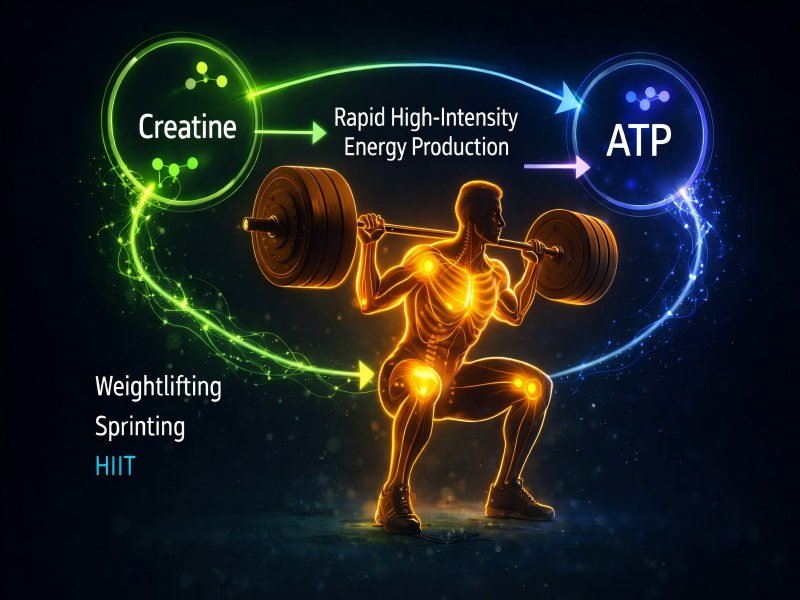
Creatine helps your body produce rapid energy (ATP) during short, intense efforts like lifting, sprinting, and HIIT. It increases muscle creatine and phosphocreatine stores, letting you perform more total work, recover between bursts faster, and train with higher quality. Over time, that often supports strength gains and lean mass when paired with resistance training. Most healthy adults can take creatine daily, with the most studied form being creatine monohydrate.
And to make it real: imagine two athletes doing the same workout. Same program. Same motivation. One just has a slightly bigger “burst-energy buffer” available on every set. Nothing magical—just more repeatable output. Over weeks, that small edge adds up… and that’s where creatine gets interesting.
What Does Creatine Do in the Human Body?
Creatine helps the human body produce rapid energy by replenishing ATP, the primary energy currency of cells. It is stored mainly in skeletal muscle as phosphocreatine, where it supports short, high-intensity efforts such as lifting, sprinting, and jumping. By increasing muscle creatine stores, supplementation improves repeated power output, delays fatigue during intense activity, and supports higher training quality over time.
How Creatine Functions at the Cellular Level
To understand what creatine does in the body, you first need to understand ATP (adenosine triphosphate). ATP is the immediate energy source used for muscle contraction, nerve signaling, and many metabolic processes. The problem is that muscles only store a very small amount of ATP—enough to fuel maximal effort for just a few seconds.
Creatine solves this limitation by acting as an energy buffer system.
Inside muscle cells, creatine is converted into phosphocreatine. When ATP is rapidly depleted during intense activity, phosphocreatine donates a phosphate group to ADP, regenerating ATP almost instantly. This allows muscles to maintain force output for a longer period and recover faster between repeated efforts.
In practical terms, creatine does not “add energy” like caffeine. Instead, it recycles energy more efficiently, which is why its effects are most noticeable during short, explosive, or repeated high-intensity actions.
Where Creatine Is Stored and Why That Matters
Approximately 95% of the body’s creatine is stored in skeletal muscle, with the remaining amount distributed across the brain, heart, and other tissues. This storage pattern explains why creatine’s most obvious benefits appear in physical performance rather than general endurance.
People who consume little dietary creatine—such as those eating minimal meat or fish—often start with lower baseline muscle creatine levels. In these individuals, supplementation may lead to a more noticeable improvement in performance and training consistency.
Why Creatine Improves High-Intensity Performance
Creatine is especially effective during activities that rely on the ATP–phosphocreatine energy system, typically lasting 5–30 seconds. These include:
- Heavy resistance training
- Sprinting and repeated accelerations
- HIIT and CrossFit-style workouts
- Jumping, throwing, and explosive sport movements
By increasing phosphocreatine availability, creatine helps reduce performance drop-off between sets or intervals. Over weeks of training, this often results in greater total training volume, which is a key driver of strength and muscle adaptation.
How Creatine Influences Body Weight and Muscle Size
One of the most searched questions related to creatine is “Why does creatine make you gain weight?”
The answer requires separating short-term effects from long-term adaptations.
Short term (days to 2 weeks):
Creatine increases intracellular water content inside muscle cells. This can cause a small increase in scale weight and a “fuller” muscle appearance. This is not fat gain.
Long term (weeks to months):
If creatine enables higher-quality training—more reps, better load retention, improved recovery—this can support real lean muscle growth over time when combined with resistance training and sufficient protein intake.
Creatine Weight Gain Explained Clearly
| Change People Notice | Cause | Fat Gain? |
|---|---|---|
| Early scale increase | Water stored inside muscle cells | No |
| Muscles look fuller | Increased muscle hydration | No |
| Strength improves | Faster ATP regeneration | No |
| Lean mass increases (over time) | Higher training volume & adaptation | No |
Beyond Muscle: Does Creatine Do Anything Else in the Body?
Although muscle is the primary storage site, creatine also plays a role in brain and nervous system energy metabolism. Brain cells use ATP heavily, especially during mentally demanding or stressful conditions. This is why creatine has been studied for cognitive fatigue, sleep deprivation, and high mental workload scenarios.
While these effects are subtler than physical performance changes, they help explain why creatine is no longer viewed as “just a gym supplement.”
Why This Matters for Real-World Users
From a user perspective, creatine’s role in the body can be summarized simply:
- It does not change hormones
- It does not act as a stimulant
- It does not force unnatural growth
Instead, creatine helps the body do what it already does—more efficiently under stress. That efficiency is why creatine remains one of the most researched and consistently used supplements in sports nutrition, and why brands like AirVigor focus on it as a foundational performance ingredient rather than a trend-driven add-on.
How Does Creatine Improve Strength and Power Performance?
Creatine improves strength and power by increasing muscle phosphocreatine stores, which accelerates ATP regeneration during high-intensity efforts. This allows muscles to sustain higher force output, recover faster between sets or sprints, and reduce performance drop-off across repeated efforts. Over time, the primary benefit is improved training quality—more total reps, better load retention, and greater weekly volume—which drives measurable gains in strength and explosive performance.
The Core Principle: Strength Is About Repeatable Output
Most people think strength gains come from one maximal effort.
In reality, they come from how well you can repeat near-maximal efforts over time.
Here’s the bottleneck creatine addresses:
- Your nervous system can fire hard
- Your muscles can contract forcefully
- But ATP availability limits how long that output can be sustained
Creatine does not increase motivation, hormones, or aggression.
It improves the energy recycling speed inside muscle cells—specifically during efforts that last seconds, not minutes.
This is why creatine consistently shows benefits in:
- heavy lifting
- power training
- HIIT
- repeated sprint sports
And much weaker effects in long, steady endurance work.
Mechanism → Performance Outcome Map
| Biological Mechanism | What Changes in the Body | What You Feel in Training |
|---|---|---|
| ↑ Muscle phosphocreatine | Faster ATP regeneration | Less drop-off between sets |
| Faster ATP recycling | Shorter recovery time between bursts | Better bar speed late |
| Higher immediate energy availability | More high-quality reps possible | One extra rep becomes common |
| Reduced early fatigue | Output stays stable longer | Sessions feel “more consistent” |
| Higher weekly training volume | Better stimulus over time | Strength & power increase |
How Creatine Increases Strength and Explosive Output
Creatine is most effective during high-force, short-duration efforts—typically 5 to 30 seconds—where ATP demand spikes faster than the body can replenish it naturally.
In practical terms, creatine helps you:
- maintain force production longer in a set
- preserve bar speed as fatigue accumulates
- recover enough to repeat quality efforts
This explains why users often say:
“The weight doesn’t feel lighter—but I don’t crash as early.”
That feeling matters. Because when the last third of your workout improves, total training stimulus improves—and that’s what strength responds to.
Which Training Styles Benefit Most from Creatine?
Creatine’s benefits are training-context dependent, not universal.
| Training Context | Creatine Effectiveness | Why |
|---|---|---|
| Heavy compound lifting | Very high | Repeated ATP-demanding sets |
| Hypertrophy blocks | High | Better volume & set quality |
| Power / speed training | High | Explosive repeat efforts |
| HIIT / CrossFit | High | Short bursts + short rest |
| Team sports | Moderate–high | Repeated accelerations |
| Steady endurance only | Low–moderate | Limited ATP–PCr demand |
Why Creatine Improves Progress Over Weeks
Creatine is often misunderstood as a short-term performance boost.
Its real value is longitudinal.
Here’s the chain reaction:
- Creatine improves repeat effort quality
- Repeat effort quality increases total work per session
- Total work per session increases weekly training load
- Weekly load drives adaptation (strength, power, size)
This is why creatine fits long-term programs better than “pump” or stimulant-based supplements. It supports boring consistency, and boring consistency is what builds strength.
Pros and Cons of Creatine for Strength Athletes
Performance Pros
- Improves repeatable strength output
- Supports higher training volume
- Works without stimulating the nervous system
- Well-supported by decades of research
Performance Trade-Offs
- Early weight increase (mostly water in muscle cells)
- May feel unnecessary in very low-volume programs
- Some users are low responders
Important nuance:
Weight gain does not equal reduced performance—but in weight-class sports, timing matters.
Common Misinterpretations That Limit Results
These misunderstandings cause people to quit creatine too early:
- “I didn’t feel stronger in 3 days.” → Creatine works through saturation + training accumulation.
- “The scale went up, so it must be fat.” → Early increases are intracellular water, not adipose tissue.
- “I should only use creatine during bulks.” → Creatine supports performance, not just mass gain.
Why Brands Like AirVigor Treat Creatine as a Foundation
At AirVigor, creatine isn’t positioned as a shortcut—it’s treated as a baseline performance tool:
- predictable
- non-stimulating
- stackable with electrolytes, protein, and recovery nutrition
- suitable for long-term use
This aligns with modern sports nutrition thinking:
optimize systems, not spikes.
What Does Creatine Do for Muscle Growth and Recovery?
Creatine supports muscle growth and recovery indirectly by improving training quality. By increasing phosphocreatine stores, creatine allows you to perform more total work—more reps, better load retention, and less performance drop-off across sets. Over time, this higher training volume stimulates greater muscle adaptation. Creatine may also support recovery between intense efforts by improving short-term energy availability and muscle cell hydration.
The Big Idea: Creatine Builds Muscle by Improving Training, Not by “Forcing Growth”
Creatine does not directly cause muscle growth.It enables better training, which causes muscle growth.
This distinction matters because many users expect supplements to replace effort. Creatine does the opposite—it rewards consistent effort by making high-quality training easier to repeat.
Muscle growth (hypertrophy) depends on:
- sufficient mechanical tension
- enough total training volume
- repeated exposure over time
- adequate recovery and protein intake
Creatine influences the volume and quality side of that equation.
How Creatine Supports Higher Training Volume
Training volume—total reps × load × sets—is one of the strongest predictors of hypertrophy. The problem is that fatigue often limits volume before muscles are fully stimulated.
Creatine helps by:
- regenerating ATP faster between reps and sets
- delaying the point where force output drops sharply
- allowing later sets to stay closer in quality to early sets
In real life, this looks like:
- finishing the last set with fewer “grinder” reps
- maintaining the same weight across all working sets
- accumulating more effective reps per session
Over weeks and months, these small improvements compound into a larger hypertrophic signal.
Does Creatine Help Muscles Recover Faster?
Recovery is often misunderstood as “less soreness.” Creatine’s role is more nuanced.
Creatine primarily supports:
- short-term recovery between intense efforts (set-to-set, interval-to-interval)
- readiness for the next training session, especially in high-frequency programs
It does this by improving the availability of rapid energy (ATP), not by acting as an anti-inflammatory or pain reliever.
For athletes training 4–6 days per week, this matters. If you can:
- recover enough to train again without excessive performance drop-off
- maintain output across sessions
then your effective recovery has improved, even if soreness still exists.
This is why creatine fits well into structured programs focused on consistency rather than “quick fixes.”
How Creatine Influences Muscle Cell Hydration and Size
One of the most visible early effects of creatine is muscle fullness, which often causes confusion.
Here’s what’s happening physiologically:
- Creatine draws water into muscle cells (intracellular water)
- This increases cell volume, not fat mass
- The muscle may appear fuller or denser within 1–2 weeks
This effect explains:
- early scale weight increases
- visual changes before real muscle tissue growth is possible
Importantly, intracellular hydration is not bloating and is not the same as subcutaneous water retention.
Some research suggests that well-hydrated muscle cells may create a favorable environment for anabolic signaling, but the most reliable growth effect still comes from training volume, not water alone.
Creatine Weight Gain: Muscle, Water, or Fat?
| Timeframe | What Changes | Why It Happens | Is It Fat? |
|---|---|---|---|
| Days–2 weeks | Scale weight ↑ | Water stored inside muscle cells | No |
| 1–4 weeks | Muscles look fuller | Increased intracellular hydration | No |
| 4–16+ weeks | Lean mass may ↑ | Higher training volume + adaptation | No |
Creatine does not increase fat mass by itself. Any fat gain comes from caloric surplus, not creatine.
Creatine and Recovery in High-Frequency Training Programs
Creatine is especially valuable when:
- training frequency is high
- rest days are limited
- workouts include repeated near-failure sets
In these cases, creatine helps reduce the accumulation of fatigue across the week—not by eliminating fatigue, but by keeping performance from collapsing too early.
This is why creatine is commonly used during:
- hypertrophy blocks
- strength accumulation phases
- CrossFit or hybrid training cycles
It supports sustainable workload, which is the real driver of long-term progress.
What Creatine Does Not Do for Muscle Growth
To maintain authority and avoid overclaims, it’s important to state what creatine doesn’t do:
- It does not replace adequate protein intake
- It does not override poor sleep or recovery habits
- It does not cause muscle growth without resistance training
- It does not act like anabolic hormones
Creatine is a multiplier, not a shortcut.
Why This Matters for Real Users
From a consumer perspective, creatine’s role in muscle growth and recovery can be summarized simply:
Creatine helps you train better, more often, with less drop-off.Training better is what builds muscle.
This is why performance-driven brands like AirVigor position creatine as a foundational supplement, often paired with:
- protein for muscle repair
- electrolytes for hydration and contraction efficiency
- structured dosing for long-term use
Not hype. Just systems that work together.

Does Creatine Affect Endurance, Hydration, or Electrolyte Balance?
Creatine does not directly improve long, steady endurance, but it can support repeated high-intensity efforts within endurance or mixed training. Research does not show that creatine causes dehydration or electrolyte imbalance in healthy adults. Instead, creatine increases intracellular water within muscle cells, which is different from dehydration and does not impair fluid balance when normal hydration is maintained.
The Core Confusion: Why Endurance Athletes Are Unsure About Creatine
- “Creatine is only for lifters.”
- “Creatine causes dehydration.”
- “Creatine will make you heavier and slower.”
The reality is more nuanced. Creatine’s effects depend on how endurance performance is limited—by aerobic capacity alone, or by repeated bursts of power layered on top of endurance.
Understanding this distinction is key for runners, cyclists, team-sport athletes, and hybrid trainers.
Is Creatine Only Useful for Strength and Power Athletes?
Creatine is most effective in activities that rely on the ATP–phosphocreatine system, which fuels efforts lasting roughly 5–30 seconds. Pure endurance events (long, steady output at moderate intensity) rely primarily on aerobic metabolism, not phosphocreatine.
However, many endurance and field sports are not purely aerobic.
Creatine can be useful when endurance performance includes:
- sprint finishes
- hills or surges
- repeated accelerations
- strength or power maintenance alongside endurance training
Examples:
- Runners using creatine during strength phases to preserve muscle and power
- Cyclists benefiting during repeated attacks or sprint segments
- Soccer, hockey, and basketball players performing continuous movement plus repeated sprints
Creatine does not replace aerobic conditioning, but it can support the non-aerobic components of endurance-based sports.
How Creatine Interacts With Hydration in the Body
One of the most persistent myths is that creatine “pulls water out of the body,” leading to dehydration. This idea is outdated and inaccurate.
Here’s what actually happens:
- Creatine increases intracellular water (water stored inside muscle cells)
- This does not mean water is lost from blood plasma or other tissues
- Intracellular hydration is distinct from systemic dehydration
Multiple studies have shown that creatine supplementation does not increase the risk of dehydration or impair thermoregulation in healthy individuals when fluid intake is normal.
In practical terms:
- Creatine does not require special hydration protocols
- Normal fluid intake is sufficient for most users
- Creatine does not increase sweat loss or fluid requirements by itself
Does Creatine Cause Cramping, Bloating, or Electrolyte Imbalance?
What the evidence shows:
- Creatine does not deplete sodium, potassium, or magnesium
- It does not increase cramp incidence in healthy users
- It does not interfere with electrolyte absorption or retention
When side effects occur, they are usually related to:
- taking very large single doses (e.g., 10–20 g at once)
- insufficient fluid intake during intense training
- individual gastrointestinal sensitivity
These effects are dose-management issues, not electrolyte imbalance.
Best practice:
Use moderate daily dosing (3–5 g) and pair creatine with normal hydration—especially during high-sweat sessions.
Creatine, Body Weight, and Endurance Performance
For endurance athletes, the concern is often not hydration—but body mass.
Creatine may increase body weight slightly due to:
- increased water stored inside muscle cells
- not fat gain
For some endurance athletes, even a 1–2 kg increase can feel noticeable, particularly in:
- uphill running
- climbing-heavy cycling
- weight-sensitive competition formats
This doesn’t mean creatine is “bad” for endurance athletes—it means timing and context matter.
Common strategies include:
- using creatine in off-season or strength phases
- discontinuing before key races if body weight sensitivity is critical
- maintaining creatine year-round if power output is more limiting than body mass
How Creatine Can Be Combined With Electrolytes
Creatine and electrolytes serve different but complementary roles:
| Component | Primary Function |
|---|---|
| Creatine | Rapid ATP regeneration for short-burst effort |
| Electrolytes | Fluid balance, nerve signaling, muscle contraction |
During intense or long training sessions—especially in heat—using creatine alongside a balanced electrolyte formula can make practical sense.
This is where system-based formulations, such as those developed by AirVigor, come into play: instead of treating creatine as a standalone “gym supplement,” it becomes part of a hydration + performance ecosystem.
The key is clarity:
- Creatine does not replace electrolytes
- Electrolytes do not replace creatine
- Used together correctly, they support different layers of performance
What Does Creatine Do for the Brain and Daily Energy Levels?
Creatine supports brain function and daily energy levels by helping brain cells maintain ATP, the primary energy source for neural activity. Like muscle cells, neurons rely on creatine–phosphocreatine systems to buffer energy demand during mentally demanding tasks, stress, or sleep deprivation. Creatine does not act as a stimulant but may help reduce mental fatigue, support cognitive resilience, and improve energy stability during high cognitive load.
The Big Shift: Creatine Is Not Just a “Muscle Supplement”
For years, creatine was framed as a gym-only supplement. That framing is outdated.
The brain is one of the most energy-demanding organs in the human body. Although it represents only ~2% of body weight, it consumes roughly 20% of daily energy expenditure. Every thought, decision, memory recall, and emotional regulation process depends on a steady supply of ATP.
This is where creatine becomes relevant beyond physical performance.
Just as creatine supports rapid energy recycling in muscle cells, it plays a similar energy-buffering role in neurons, especially when demand outpaces supply.
How Creatine Supports Brain Energy Metabolism
Neurons rely on ATP to:
- transmit electrical signals
- recycle neurotransmitters
- maintain ion gradients essential for focus and reaction time
The brain stores creatine and phosphocreatine in much smaller amounts than muscle, but the function is the same:
to regenerate ATP quickly when energy demand spikes.
Situations that increase brain energy demand include:
- prolonged concentration
- multitasking
- psychological stress
- sleep deprivation
- cognitively demanding work or study
Creatine does not increase baseline intelligence or cognition. Instead, it helps the brain maintain performance when conditions are suboptimal, which is exactly when most people feel mentally drained.
Can Creatine Help With Mental Fatigue and Focus?
Mental fatigue is one of the most common modern complaints—and one of the hardest to manage.
Unlike caffeine, which stimulates the nervous system, creatine works quietly in the background. Users who benefit often describe effects such as:
- less “brain fog” late in the day
- more stable focus during long work sessions
- reduced mental drop-off when tired or stressed
Research on creatine and cognition suggests benefits are most noticeable when the brain is under energetic stress, such as:
- sleep restriction
- extended mental workload
- high emotional or psychological demand
This explains why creatine may feel “useless” on a well-rested vacation day—but valuable during intense work weeks.
Creatine vs Caffeine: Energy Stability vs Stimulation
One reason creatine is often misunderstood is because people expect it to feel like caffeine.
| Aspect | Creatine | Caffeine |
|---|---|---|
| Primary action | Energy buffering (ATP support) | Nervous system stimulation |
| Onset | Gradual, cumulative | Rapid |
| “Buzz” feeling | No | Yes |
| Crash risk | No | Possible |
| Daily dependence | Low | High for many users |
| Works when tired | Yes | Sometimes (with diminishing returns) |
Creatine supports energy stability, not alertness spikes. For people sensitive to stimulants—or those already consuming enough caffeine—this distinction matters.
Who May Benefit From Creatine for Brain and Daily Energy?
Creatine’s cognitive relevance is not universal, but certain groups may benefit more:
- High-pressure professionals (long hours, sustained focus)
- Students during exam or study periods
- Shift workers with disrupted sleep cycles
- Gamers and esports participants (reaction time + endurance)
- People under chronic stress or cognitive overload
In these contexts, creatine supports resilience, not excitement.
Does Creatine Improve Mood or Mental Health?
Creatine:
- is not an antidepressant
- is not a treatment for anxiety or mood disorders
- should not replace medical care
However, by supporting cellular energy metabolism, creatine may indirectly influence how the brain handles stress and fatigue. Feeling mentally steadier often improves perceived well-being—but this is supportive, not therapeutic.
How Daily Creatine Use Fits Into Energy Management
Unlike stimulants, creatine works best when:
- taken daily
- at consistent doses
- viewed as a background support system
Many users report that creatine’s mental benefits become noticeable only after several weeks, once brain creatine stores stabilize.
This aligns with how AirVigor positions creatine: not as a quick fix, but as a foundational performance nutrient—for body and mind.
What Creatine Does Not Do for the Brain
Creatine does not:
- increase IQ
- act as a stimulant
- replace sleep, nutrition, or stress management
- create instant focus or motivation
Creatine supports energy systems—it does not override biology.

Is Creatine Safe to Use Long Term and Who Should Take It?
Creatine is considered safe for long-term use in healthy adults when taken at recommended doses (typically 3–5 g daily). Decades of research show no evidence of kidney damage, dehydration, or serious adverse effects in healthy individuals. Most side effects are mild and dose-related. Creatine is suitable for many physically active people, but those with pre-existing kidney conditions or specific medical concerns should consult a healthcare professional.
Few supplements have been studied as extensively as creatine—yet few are surrounded by as much confusion.
- “Is creatine bad for your kidneys?”
- “Can you take creatine every day?”
- “Is creatine safe long term?”
- “Who should not take creatine?”
The reason is simple: creatine affects cellular energy metabolism, which sounds serious—and it is important—but importance does not equal danger.
From a scientific and regulatory perspective, creatine is one of the most well-characterized dietary supplements available.
Is Creatine Safe for Healthy Adults According to Research?
For healthy adults, the consensus across sports nutrition and medical literature is clear:
Creatine monohydrate is safe when used at recommended doses.
- Long-term studies (months to years) show no adverse effects on kidney or liver function in healthy individuals
- Blood markers such as creatinine may increase slightly, but this reflects normal creatine metabolism, not kidney damage
- No credible evidence links creatine to dehydration, muscle cramps, or electrolyte imbalance in healthy users
Creatine’s safety profile is one reason it is approved for use by:
- professional athletes
- military populations
- research institutions studying long-term performance nutrition
Is Creatine Okay to Take Daily for Months or Years?
Yes. Daily use is not only safe—it is how creatine is intended to work.
Creatine functions by saturating muscle and tissue stores. Once those stores are full, daily intake maintains them. Stopping and restarting repeatedly offers no proven safety benefit for healthy users.
Important clarifications:
- There is no requirement to “cycle off” creatine for safety
- There is no evidence of tolerance buildup
- Long-term daily intake at moderate doses does not “shut down” natural creatine production
For most people, creatine works best when treated as a background nutrient, not a short-term stimulant.
What Are All the Known Side Effects of Creatine?
This is where clarity builds trust.
Common, mild, and usually avoidable:
- Gastrointestinal discomfort (bloating, cramping, loose stools) → most often caused by large single doses or poor mixing
- Temporary water weight increase → due to increased intracellular muscle water, not fat gain
Uncommon and usually dose-related:
- Nausea when taken on an empty stomach (for sensitive users)
Not supported by evidence in healthy adults:
- Kidney damage
- Liver damage
- Dehydration
- Muscle cramps
| Issue | Most Likely Cause | How to Reduce It |
|---|---|---|
| Stomach discomfort | Large single dose | Split dose, reduce to 3–5 g |
| Bloating | Poor mixing / loading | Mix thoroughly, skip loading |
| Weight increase | Muscle cell hydration | Normal and non-harmful |
Creatine and Kidney Health: Clearing the Biggest Myth
Creatine is broken down into creatinine, which is measured in blood tests as a marker of kidney function. Supplementing creatine can slightly raise creatinine levels—but this does not mean kidney damage.
Think of it like this:
- Eating more protein increases urea
- Taking creatine increases creatinine
- Neither automatically indicates pathology
For healthy kidneys, research consistently shows no increased risk.
However, who should be cautious:
- individuals with diagnosed kidney disease
- those with reduced kidney function
- people taking medications that affect kidney filtration
For these groups, creatine use should be discussed with a healthcare professional—not because creatine is inherently dangerous, but because baseline risk is different.
Who Should Consider Taking Creatine?
Creatine is not just for bodybuilders.
People who may benefit include:
- strength and power athletes
- HIIT and CrossFit participants
- team-sport athletes with repeated sprint demands
- endurance athletes with strength or sprint components
- busy professionals seeking physical and mental performance stability
Because creatine supports energy availability, its relevance extends beyond aesthetics or maximal strength.
This broader applicability is why performance-focused brands like AirVigor treat creatine as a foundational supplement, not a niche product.
Who Should Avoid Creatine or Consult a Professional First?
Creatine is safe for most—but not for everyone without consideration.
Consult a healthcare professional if you:
- have known kidney disease or impaired kidney function
- are pregnant or breastfeeding
- are under 18 (use only with professional guidance)
- take medications affecting kidney or fluid balance
Importantly, consultation is about context, not fear. This distinction improves trust and aligns with responsible health communication standards.
Is Creatine Safe for Women and Older Adults?
Another high-intent search topic.
- Women: Creatine is safe and effective; it does not cause masculinization or hormonal disruption
- Older adults: Research increasingly explores creatine for maintaining muscle mass, strength, and functional capacity with aging
Creatine’s safety profile does not change by gender. Differences in response are usually related to body size, diet, and training status—not risk.

How Should You Take Creatine for Best Results?
For best results, take creatine consistently at 3–5 g per day. Daily use saturates muscle creatine stores and supports strength, power, and training quality over time. A loading phase is optional and speeds saturation but is not required. Timing (pre vs post workout) is less important than consistency. Mixing creatine well and avoiding large single doses helps minimize gastrointestinal discomfort.
The First Rule: Consistency Beats Timing
One of the biggest mistakes users make is treating creatine like a pre-workout stimulant. Creatine doesn’t work that way.
Creatine works by gradually increasing and maintaining creatine stores in muscle and other tissues. Once stores are saturated, performance benefits depend on keeping them there—not on hitting a perfect clock window.
If you take creatine every day, you’re already doing 90% of it right.
How Much Creatine Should You Take Per Day?
For most healthy adults, the optimal daily dose is:
- 3–5 grams per day (standard recommendation)
This dose:
- is sufficient to saturate muscle creatine stores
- minimizes side effects
- is supported by decades of research
Some users prefer a body-weight-based approach:
- ~0.03 g per kg of body weight per day
For example:
- 70 kg (154 lb) → ~2–3 g/day
- 90 kg (198 lb) → ~3–5 g/day
Important:
Taking more than needed does not lead to faster or greater benefits. Excess creatine is simply excreted.
Is a Creatine Loading Phase Necessary or Optional?
A loading phase is optional, not required.
Two valid approaches exist:
| Approach | Dose | Time to Full Saturation | Best For |
|---|---|---|---|
| Loading + maintenance | 20 g/day (split) for 5–7 days, then 3–5 g/day | ~1 week | Athletes needing rapid effect |
| Daily low dose | 3–5 g/day | ~3–4 weeks | Most users, fewer side effects |
Pros of loading:
- Faster saturation
- Earlier performance benefits
Cons of loading:
- Higher risk of GI discomfort
- Not necessary for long-term results
For most lifestyle users and recreational athletes, skip loading and start with daily dosing.
When Is the Best Time to Take Creatine?
“The best time to take creatine is the time you won’t forget.”
What research and practice agree on:
- Timing has a minor effect compared to daily consistency
- Pre-workout vs post-workout differences are small and inconsistent
Practical recommendations:
- Take creatine when you’ll remember it
- With a meal if you have a sensitive stomach
- Around training if that fits your routine (optional, not required)
Should You Take Creatine on Rest Days?
Yes. Always.
Creatine does not work acutely—it works by maintaining elevated tissue stores.
Skipping rest days:
- slows saturation
- reduces consistency
- provides no known benefit
Creatine should be treated like a daily nutrient, not a workout-only supplement.
What Form of Creatine Works Best?
Creatine monohydrate is:
- the most researched form
- consistently effective
- cost-efficient
- well tolerated
Other forms (HCl, buffered, nitrate, etc.) are often marketed as “better,” but they lack strong evidence of superior performance or safety.
For best results:
- choose creatine monohydrate
- ensure purity and quality sourcing
- avoid unnecessary additives
This simplicity aligns with how brands like AirVigor approach formulation: evidence first, hype last.
How to Reduce Side Effects and Improve Tolerance
Most creatine side effects are preventable.
Common issues and fixes:
| Issue | Likely Cause | Simple Fix |
|---|---|---|
| Bloating | Large single dose | Split dose or reduce amount |
| Stomach upset | Poor mixing | Mix thoroughly in warm liquid |
| Nausea | Empty stomach | Take with food |
| Cramping (rare) | Training + dehydration | Maintain normal hydration |
Best practices:
- Start with 3 g/day if sensitive
- Avoid dry-scooping
- Dissolve fully in water or a beverage
When used correctly, creatine is one of the best-tolerated supplements available.
Should Creatine Be Taken With Protein, Carbs, or Electrolytes?
Creatine does not require co-ingestion—but stacking can be practical.
- With protein: supports muscle repair routines
- With carbs: may slightly enhance uptake (minor effect)
- With electrolytes: useful during intense or sweaty training
Creatine works on its own—but it fits naturally into a broader performance nutrition system.
How Long Does It Take to See Results From Creatine?
Timeline expectations matter for user satisfaction:
- 1–2 weeks: possible strength endurance improvements (especially with loading)
- 3–4 weeks: muscle creatine stores saturated (daily dosing)
- 4–12+ weeks: noticeable training consistency and performance improvements
Creatine rewards patience and consistency, not impulsive expectations.
What Creatine Intake Does Not Need
Creatine does not require:
- cycling on/off
- megadoses
- complicated timing strategies
- “detox” periods
Simplicity improves adherence—and adherence determines results.
Practical “Best Results” Checklist
- Take 3–5 g daily
- Use creatine monohydrate
- Take it every day (training or rest)
- Mix well and hydrate normally
- Don’t chase timing perfection
- Don’t overload unless necessary
Why This Matters for AirVigor’s Users
At AirVigor, creatine guidance is designed around:
- real-world adherence
- long-term usability
- integration with training, hydration, and recovery
Creatine is positioned not as a shortcut, but as a reliable daily performance foundation—one that works quietly, consistently, and predictably when used correctly.
Where AirVigor Fits Into Your Creatine Strategy
Creatine works best when it’s part of a system, not a shortcut.
At AirVigor, we design performance nutrition the same way serious athletes train:
- clear mechanisms,
- transparent dosing,
- stable, repeatable results.
Whether you’re looking to:
- buy high-quality creatine or recovery formulas directly on Amazon, or
- customize your own creatine-based product (OEM/ODM, flavor systems, electrolyte integration, compliant labeling),
Buying on Amazon (In-Stock): If you’re ready to start with a simple, daily creatine routine (or pair it with hydration support for training in heat), you can purchase AirVigor’s in-stock products on Amazon and build a repeatable plan you’ll actually follow.
Custom Wholesale Quote: If you need custom creatine blends, reach out to AirVigor for a fast quotation and sampling timeline.
Creatine doesn’t change who you are.
It just makes your effort show up more consistently.